



For all the talk about President Trump’s sagging poll numbers, one pattern has held: he tends to outlast — often after battering — Republicans who cross him.
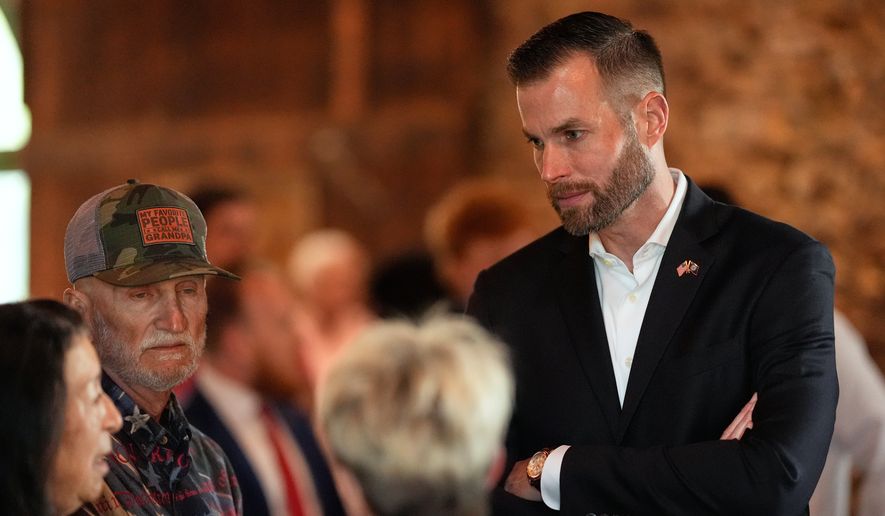
That played out again Tuesday, when voters in Georgia’s 14th Congressional District backed his preferred pick, Clay Fuller, to replace former Rep. Marjorie Taylor Greene, effectively swapping in a new loyalist for one who had fallen out of favor.
With 78% of the vote in, Mr. Fuller held 56% to 44% lead over Democrat Shawn Harris, a farmer and retired Army brigadier general who ran on a moderate message.
Mr. Trump’s endorsement suffocated the other Republican hopefuls in the jungle primary and underscored his continued grip on the party.
Mr. Fuller leaned hard into that support ahead of the special election, assuring voters that his chief mission was to fight alongside the president in Washington. That was enough to overcome Mr. Harris’ attempt to stitch together a coalition of Democrats, independents and anti‑Trump Republicans.
In his victory speech, he said the result reflected how much regard voters have for Mr. Trump, and vowed to have the president’s back on Capitol Hill “each and every day.”
“President Trump is the most critical factor in our election,” he said. “He made sure he was the ultimate trump card.”
Mr. Harris declared victory in defeat, saying the result showed Democrats are making gains and Mr. Trump’s support is waning across the country.
“We are going to take the whole thing in November,” he said. “I am telling you right now, the 14th has changed.”
Mr. Fuller will serve out the final months of Ms. Greene’s term and, barring a loss in the May primary, is expected to face Mr. Harris again in November.
Despite the win, there are lingering concerns in Republican ranks that the same Trump brand that lifts candidates in deep‑red districts could drag down others running this fall in more competitive statewide and congressional races.
Republicans were watching the final tally closely in Georgia. They said alarm bells should go off if the Democrat carried north of 40% in the conservative stronghold.
“The deciders right now aren’t crazy about Trump, and that is a precarious situation for us to be in, and in 2024, the deciders were not crazy about Biden, and that was a precarious situation for Democrats to be in,” said a Georgia‑based Republican strategist.
Georgia has arguably been the ultimate laboratory for testing Mr. Trump’s stranglehold on the party. Gov. Brian Kemp and Secretary of State Brad Raffensperger survived reelection in 2022 after landing on Mr. Trump’s enemies list for rejecting his claims of a stolen election after his 2020 loss to Joseph R. Biden. Mr. Kemp sidestepped another direct clash this cycle by opting against a run for the U.S. Senate.
Mr. Raffensperger, meanwhile, is testing his luck in a gubernatorial bid, where his past confrontations with Mr. Trump are making for an uphill climb. Former Lt. Gov. Geoff Duncan has abandoned the Republican Party altogether and is running as a Democrat after breaking with Mr. Trump.
Mr. Trump also has weighed in on the race to replace Mr. Kemp, endorsing Lt. Gov. Burt Jones in a Republican primary that includes Attorney General Chris Carr and billionaire Rick Jackson. Mr. Jackson is trying to elbow past a Trump‑endorsed rival by flattering the president at every turn and flooding the airwaves with ads, hoping money and praise can overcome the endorsement gap.
The Trump record suggests that surviving an intraparty feud with him is the exception, not the rule. Rep. Liz Cheney became the starkest example when she lost her 2022 Wyoming primary by more than 36 percentage points to Trump‑backed Harriet Hageman after serving as vice chair of the House Jan. 6 committee.
Of the 10 House Republicans who voted to impeach Mr. Trump after the Capitol riot in 2021, four opted against running for reelection and four more lost their primaries to Trump‑backed challengers. That included former Rep. Jaime Herrera Beutler of Washington, who fell to Joe Kent, only for Mr. Kent to lose the general election to Democrat Marie Gluesenkamp Perez, flipping what had been considered a safe Republican seat.
Ms. Greene said she wouldn’t allow herself to be treated like a “battered wife” after falling out of favor with Mr. Trump. She crossed Mr. Trump by demanding — against his wishes — the release of the government’s Jeffrey Epstein files and by questioning why Mr. Trump wasn’t doing more to address rising costs at home even as he was greenlighting expensive military missions abroad that, in her view, strayed from the MAGA agenda.
On Tuesday, she escalated her criticism by calling for Mr. Trump to be removed from office amid his threat to bomb Iran into oblivion. “25TH AMENDMENT!!! Not a single bomb has dropped on America. We cannot kill an entire civilization,” Ms. Greene wrote on X.
Now, the question of Mr. Trump’s influence is playing out again, in real time, on several of the most closely watched fronts of the 2026 cycle.
In Louisiana, Sen. Bill Cassidy — one of seven Senate Republicans who voted to convict Mr. Trump in his second impeachment trial — is fighting for his political life. Mr. Trump endorsed Rep. Julia Letlow in January, urging her to challenge Mr. Cassidy with a characteristically blunt “RUN, JULIA, RUN!!!” Mr. Cassidy is the only Republican senator whom Mr. Trump’s team is actively targeting for defeat this primary season. He has vowed to fight on and has pushed back by highlighting Ms. Letlow’s past support for DEI programs in college. The line of attack is aimed at blunting her appeal among conservative voters.
In Maine, Sen. Susan M. Collins occupies a different and, perhaps, more precarious perch. Mr. Trump has called her a “disaster” and has not endorsed her, yet he remains the dominant force in national Republican politics. She voted to convict him in his second impeachment trial, wrote in Nikki Haley in the 2024 presidential election, and publicly announced she would not support him in 2016. She also voted against several of his nominees in the current term, including Defense Secretary Pete Hegseth and FBI Director Kash Patel.
Mr. Trump has taken shots at her throughout the year and declared that she and a handful of Republicans who backed bipartisan legislation to rein in his war authorities “should never be elected to office again.” Yet Ms. Collins is betting that the same independence that draws Mr. Trump’s ire is exactly what Maine voters reward. Mr. Trump lost Maine by 7 points in 2024; that same year, she won reelection by nearly 9.
In Kentucky, Rep. Thomas Massie has emerged as perhaps Mr. Trump’s top House target and one of the few Republicans who seems to relish the fight. The MAGA world has poured millions of dollars into the race to support Mr. Trump’s preferred candidate, former Navy SEAL Ed Gallrein. Mr. Massie and his allies are framing the contest as an attempt to silence the president’s remaining critics in Congress.
Mr. Trump traveled to Mr. Massie’s district in March and called him “disloyal to America” while boosting Mr. Gallrein from the stage — a rare move for a sitting president targeting a member of his own party. Mr. Massie has played up his independence, arguing that he has adhered more closely to the MAGA movement’s desire for less military adventurism and for more taxpayer money to be spent at home.
Ms. Greene has been among his most vocal supporters, calling him “one of my best friends.”
“There are districts all over the country that would give anything to have a representative like Thomas Massie,” she said in a recent fundraising call. “Thank you to Thomas for holding everyone accountable to what we campaigned on in 2024 … even when necessary, the White House.”
• Seth McLaughlin can be reached at smclaughlin@washingtontimes.com.

Please read our comment policy before commenting.