


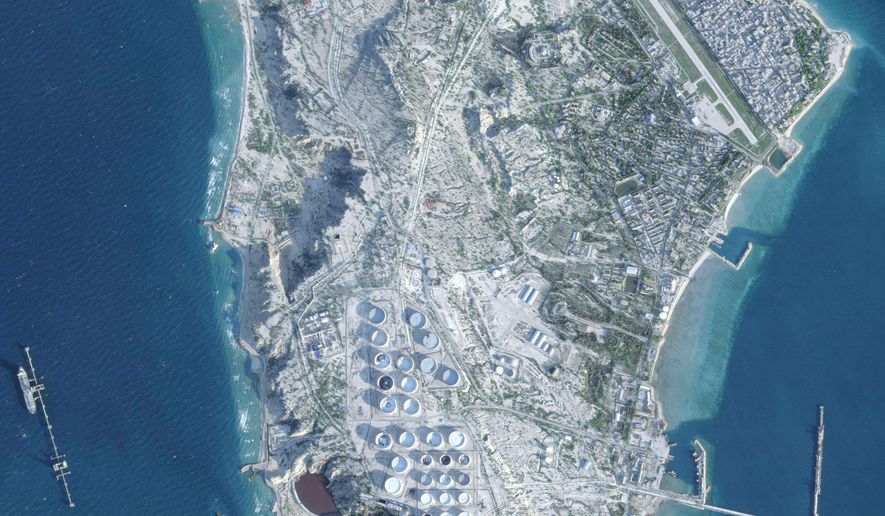

Kharg Island, the critical offshore hub of Iran’s oil-export industry, was hit again by American airstrikes on Tuesday, the latest escalation in the war as President Trump’s 8 p.m. deadline for reopening the Strait of Hormuz approaches.
U.S. forces struck more than 90 targets on Kharg Island early Tuesday, hitting mostly military facilities that were already damaged during a previous round of strikes last month. The most recent attacks reportedly avoided the island’s valuable energy infrastructure.
U.S. Vice President J.D. Vance confirmed that the U.S. was behind the strikes during a press conference in Hungary on Tuesday, but added that the attacks do not change the situation on the ground.
Iran’s semi-official Mehr news agency originally reported that explosions rocked the small island early Tuesday, though the targets of the airstrikes and the extent of the damage inflicted were undetermined.
Still, West Texas Intermediate, the U.S. oil benchmark, jumped 2% in response to the Kharg Island strikes, and Brent crude rose nearly 0.5%, reaching $110.22 a barrel.
The island at the north end of the Persian Gulf is a transit point for as much as 94% of Iran’s oil output.
The American strikes come just hours before Mr. Trump’s deadline for Iran to reopen the Strait of Hormuz, which Tehran has kept effectively closed since early March. He has threatened to destroy all of Iran’s power plants, bridges and Kharg Island itself if his demand is not met Tuesday evening.0
“A whole civilization will die tonight, never to be brought back again,” Mr. Trump posted on Truth Social Tuesday. “I don’t want that to happen, but it probably will.”
Iran has responded defiantly, reportedly breaking off diplomatic contact with the U.S. that was being mediated by Pakistan.
Iranian government officials have also called on regime supporters to form human chains around power plants and bridges to dissuade U.S. strikes.
International law experts and humanitarian organizations have loudly condemned Mr. Trump’s threats on civilian infrastructure, arguing that such attacks would constitute war crimes.
“Any war fought without limits is incompatible with the law. It is indefensible, inhumane and devastating for entire populations,” International Committee of the Red Cross President Mirjana Spoljaric wrote in a statement. “I urgently call on parties to spare civilians and civilian objects in all military operations. It is their obligation under international humanitarian law.”
At least 3,000 people have been killed in Iran since the war began on Feb. 28, according to the U.S.-based Human Rights Activists News Agency
The U.S. last hit Kharg Island on March 13, with U.S. Central Command confirming that precision airstrikes destroyed naval mine storage facilities and missile storage bunkers. However, the March attacks avoided the island’s oil infrastructure, used in Iran’s exporting operations.
The island is Iran’s energy revenue linchpin, managing at least 90% of the country’s oil exports. While sufficient damage to its oil infrastructure from airstrikes would devastate Tehran financially, the risk is that Iran’s retaliation would increase pressure on international markets.
Mr. Trump has implied for weeks that U.S. forces could seize Kharg Island or that airstrikes could “completely obliterate” the island’s oil infrastructure if Iran does not reopen the Strait of Hormuz.
Iran has reportedly laid traps on the island and deployed air defenses ahead of a potential U.S. invasion or assault.
At least 20% of the world’s oil travels through the Strait of Hormuz each year, and its closure has put extreme pressure on global markets and brought the effects of the U.S. and Israel’s war to nations around the world.
The United Nations Security Council on Tuesday failed to pass a Bahrain-sponsored resolution that called for the international community to coordinate a plan to open the Strait of Hormuz. Russia and China, permanent members of the council, vetoed the resolution.
Meanwhile, Iran said its U.N. ambassador, Amir-Saeed Iravani, was heading back to Tehran to discuss diplomatic options for reopening the strait with mediators.
The strikes on Kharg Island come as the U.S. and Israel launch a wave of attacks on Iranian infrastructure this week. The Israeli military has struck at least eight road and railway bridges across Iran that it said are used by the Iranian military. Additionally, Israeli jets struck a petrochemical facility in the city of Shiraz.
Iran also continued its assault on Gulf nations and Israel on Tuesday. Israeli authorities reported that at least 25 people have been injured by rocket and missile attacks from Iran or Hezbollah on Tuesday.
Saudi Arabia’s defense ministry said debris from an intercepted Iranian ballistic missile had fallen near an energy facility, but did not disclose if it had sustained any damage. The United Arab Emirates also reported that an Iranian missile targeted administrative buildings for a telecommunications company; the damage is unknown.
• Vaughn Cockayne can be reached at vcockayne@washingtontimes.com.

Please read our comment policy before commenting.