



NEWS AND ANALYSIS:
China’s People’s Liberation Army expanded the number of intermediate-range missiles in its arsenal last year as part of its expansion to 3,450 missiles of all range types, according to the director of the Defense Intelligence Agency.
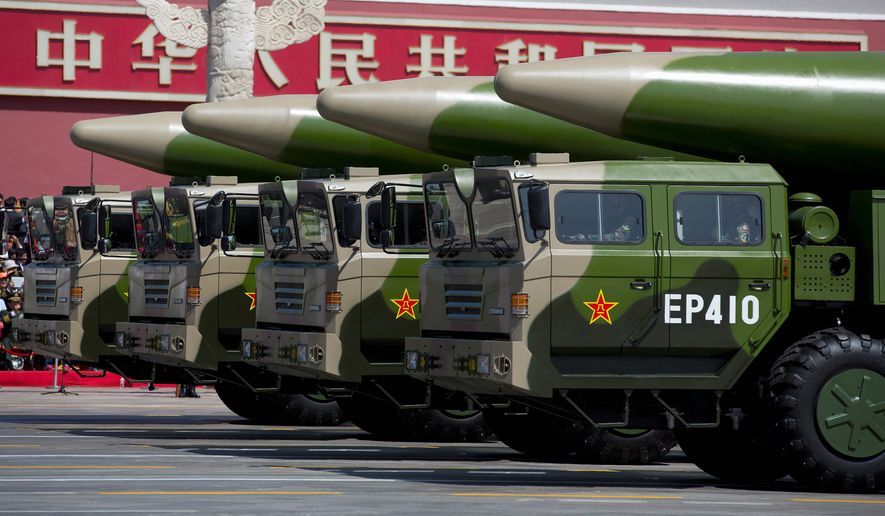
Fifty new DF-26 intermediate-range ballistic missiles were added in 2025 for a total of 550 of these long-range missiles, Marine Corps Lt. Gen. James Adams, the DIA chief, told Congress on Thursday in written testimony.
Gen. Adams said the Chinese military, a major U.S. adversary, is “expanding their missile inventories and aggressively pursuing new systems, such as hypersonic glide vehicles, to support their nuclear strategies of coercion and deterrence and to complicate U.S. defenses.”
“China is rapidly advancing its military modernization efforts and developing capabilities across all warfare domains that could enable its military to seize Taiwan by force, project power across the First Island Chain, and disrupt U.S. attempts to intervene in a regional conflict,” he told the House Armed Services subcommittee on intelligence and special operations.
China’s rapid military buildup is continuing despite the purge of senior military leaders as part of what the three-star general called a “political rectification campaign” pressed by Chinese President Xi Jinping.
The purge has targeted senior officers across the PlA, including national-level leaders and operational commanders.
The Pentagon has said the long-range DF-26 can be used to attack land targets and U.S. aircraft carriers at sea. It will be armed with either conventional warheads or low-yield nuclear warheads.
U.S. intelligence estimates intermediate-range missiles have ranges of between 1,864 miles and 3,418 miles and China has deployed the DF-26 for what the Pentagon’s annual report on the Chinese military calls “highly precise theater weapons” for low-yield nuclear attacks.
Other Chinese ballistic and cruise missile forces remained constant or declined last year, Gen. Adams stated.
The force of 900 short-range missiles, most of which are deployed within range of Taiwan, did not change and the 1,300 medium-range missiles deployed also remained constant, he said.
A total of 400 intercontinental ballistic missiles did not increase last year and 300 ground-launched cruise missiles decreased from 400 that were deployed in 2024.
DIA recently estimated that the PLA plans to have as many as 700 ICBMs by 2035, including 70 orbiting nuclear strike weapons called fractional orbital bombardment systems weapons.
The agency stated in a report published last year that the PLA now has 600 hypersonic missiles and will deploy 4,000 aeroballistic and glide vehicle hypersonic weapons by 2035.
The DF-26 has been called the “Guam killer” by Chinese state media for its ability to hit the strategic U.S. island in the western Pacific.
China’s nuclear warheads exceed 600 currently and another 400 will be added in the next five years, Gen. Adams said, noting nuclear missiles are being deployed at higher states of readiness than in the past, and will be used to threaten the United States if Beijing moves against Taiwan militarily in the coming years.
Beijing showed off new military capabilities in September with a parade marking the 80th anniversary of the end of World War II, according to the DIA director’s statement.
The new arms featured both deployed and developmental weapons focused on nuclear and unmanned weapons as a foundational element of a modernized PLA.
“In particular, the PLA displayed systems from all three legs of its nuclear triad for the first time, as well as multidomain [counter unmanned systems] including carrier-capable unmanned aerial vehicles and unmanned underwater vessels,” Gen. Adams said.
PLA priorities include accelerating development of advanced combat capabilities, strengthening CCP control over the military and enhancing strategic assets, he said.
Key weapons technology work includes artificial intelligence, biotechnology, quantum technology, advanced semiconductors and advanced energy generation and storage.
On Taiwan, PLA military pressure increased in 2025 with large-scale drills that included practice for an island blockade and targeting Taiwan’s energy infrastructure, Gen. Adams said.
The PLA forces that would be utilized in an assault on Taiwan are improving, but Chinese leaders remain unsure of the military’s readiness to take over Taiwan and counter a potential U.S. and allied intervention, he said.
“As of today, China’s risks and costs of forcing unification probably continue to outweigh the benefits, and its stated redlines have not been crossed,” Gen. Adams said, noting that the PLA is improving capabilities for projecting power globally.
The PLA also continued unsafe air and maritime actions. The dangerous encounters included a PLA ship lasing a German military aircraft in the Gulf of Aden and the release of flares near an Australian P-8 maritime patrol aircraft, he said.
On the space threat posed by China, Gen. Adams said Beijing is developing “cislunar” capabilities to back political, economic and military goals on and near the Moon. A Chinese lunar research station is planned for 2028 near the Moon’s south pole.
Cyber threats linked to China involved large-scale operations to gather intelligence and conduct operations for potential electronic attacks on U.S. critical infrastructure networks in a crisis or conflict.
“China very likely will continue to develop access to networks it assesses will provide it with intelligence or military value,” Gen. Adams said.
Chinese state Volt Typhoon hackers entered critical U.S. infrastructure networks that could “enable disruption or destruction of critical services in the event of increased geopolitical tensions or military conflict with the United States and its allies,” he said.
Navy to deploy containerized weapons
The Navy is developing weapons and other military systems to be deployed inside shipping containers and used on both drone ships and traditional warships, according to Navy officials.
The program was launched by Chief of Naval Operations Adm. Daryl Caudle last month and is a strategic effort to use modular, containerized weapons and payloads to enhance combat operations.
The containerized systems will include drone swarms that can be released from shipping containers and used by the Navy’s Pacific Fleet.
Other containers will house logistics and support equipment, anti-submarine warfare sensors, and radars that will support both electronic and kinetic warfare.
Several types of missile systems will also be fitted inside containers — matching similar systems already deployed by China and Russia.
Rear Adm. Derek A. Trinque, surface warfare director in the office of the CNO, told a Senate Armed Services subcommittee hearing on Tuesday that modular payloads in containers will be used with the Navy’s drone ship — the Medium Unmanned Surface Vessel.
The MUSV will hold two 40-foot shipping containers on its deck.
The Navy plans to deploy over 30 MUSVs in the Indo-Pacific along with thousands of small, unmanned surface vessels and large numbers of unmanned aerial systems operating from either manned ships or drone ships, Navy Capt. Garrett Miller, commander of Surface Development Group One, said Monday during a talk at the Navy League’s Sea-Air-Space Symposium.
Adm. Trinque said that after a specific request from the Pacific Fleet for shipping container payloads that are now being acquired, “we recognized that there were going to be a similar collection of requirements from all of the fleets.”
Some will be logistics containers, others will hold sensors for hunting enemy submarines or radars for targeting and weapon guidance. Still others will contain “effectors” — military jargon for missiles and other weapons such as electronic warfare or directed energy arms, he said.
The Navy is working with defense contractors to rapidly develop the systems, he said.
In joint prepared testimony with civilian defense official Rebecca Gassler, Adm. Trinque said the key to the medium-sized drone ship is “its ability to employ containerized naval combat capabilities that can be rapidly embarked.”
“By designing systems to fit within standard International Organization for Standardization containers, we will rapidly add new capabilities — such as sensors, communication relays, logistics packages or weapon systems — to the fleet,” they said.
“This flexibility further enables tailored force packages, augmenting our general-purpose forces to address specific mission needs.”
Containerized weapons and systems give the Navy “speed, scale and flexibility needed to maintain an advantage in all operational environments,” the statement said.
The container program is part of a larger CNO effort to produce more flexible naval power with ships and drones. “I want to containerize everything,” Adm. Caudle said during a defense conference last month.
Paparo on PLA use of AI
The commander of the Indo-Pacific Command told Congress that the Chinese People’s Liberation Army is already using artificial intelligence to enhance the combat power of its forces.
“I think they see AI’s power from a targeting standpoint, mass data analytics, to quickly discern where the target is given the covariance among all the factors that come into various sensors,” Adm. Sam Paparo told the Senate Armed Services Committee during a hearing Tuesday.
“I think they see the power of AI for strategic decision making, to know the game that you’re playing, to be able to suss out what an adversary’s intentions are, I think they’re right to see that,” he said.
The four-star admiral, who sees his major mission as deterring war with China, said whoever masters AI technology, and more importantly, the adoption of it, “is the one that’s going to have the offset advantage in the 21st century.”
In terms of whether the U.S. military or the PLA has greater AI capabilities, Adm. Paparo said the U.S. has “product superiority” in AI agentic tools and large learning models.
The U.S. side also has product superiority in computing power, while the Chinese have key advantages in robotics.
“We’ve got to move faster, and those robotics can be employed for cheap, at scale, kill capabilities, and we have to increase our game on that,” he said.
“And I think that our lead is a tenuous lead of six months to 12 months at the most, and we’ve got to maintain and advance that lead with an emphasis on data, on compute, on application, including AI application, and most importantly, on human adoption.”
Asked if the PLA has access to more advanced AI technology, whether it would likely improve warfighting capabilities at the expense of American service members,” Adm. Paparo said: “Not likely, undoubtedly.”
“Increasing with AI, the ability to compute better and faster, is the ability to think better and faster. And every other form of warfare, whether it is drone warfare, missile warfare, all of those forms of warfare are commoditized, and so the overarching factor around all of it is compute and decision superiority,” he said.
• Bill Gertz can be reached at bgertz@washingtontimes.com.

Please read our comment policy before commenting.