


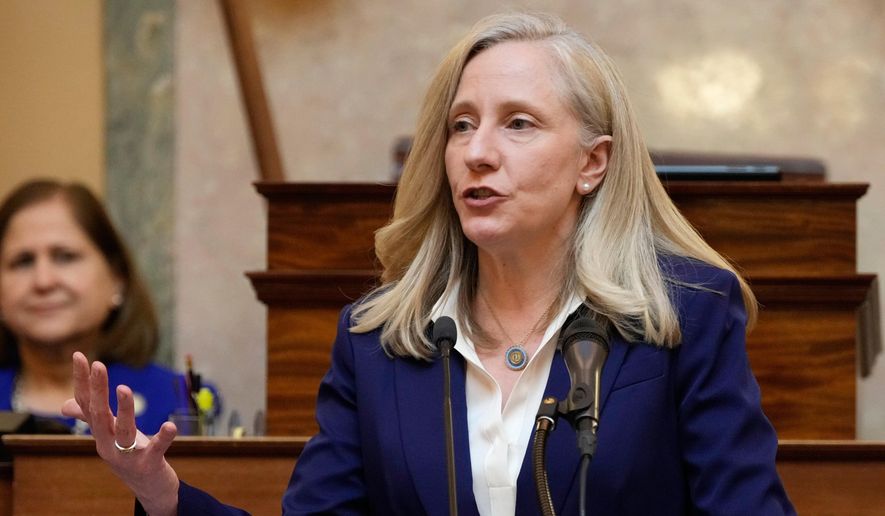

Virginia Gov. Abigail Spanberger, a Democrat, has vetoed a bill that would have paved the way for a casino in Fairfax County.
Ms. Spanberger’s office explained that most Fairfax County politicians opposed the casino. Under state law, once a locality becomes eligible as a casino location, local authorities are required to petition a court to hold a referendum on whether the casino should be built.
County authorities, she said Thursday, “explicitly opposed this legislation, and an overwhelming majority of the General Assembly members who represent Fairfax voted against it.”
That also included the county Board of Supervisors, whose chairman cheered the decision.
“On behalf of the Fairfax County Board of Supervisors and our over 1 million residents, I would like to thank Governor Spanberger for her veto of SB756, also known as the casino bill,” said Jeff McKay, a Democrat, in a statement. “This veto demonstrates the governor’s respect for local authority and being responsive to those we represent. Our residents have been clear in their overwhelming opposition to a casino.”
The legislation was sponsored by Virginia Senate Majority Leader Scott Surovell, a Democrat for the 34th district, which includes the city of Fairfax and parts of the county.
The bill stipulated that any future casino be built within a quarter-mile of a Metrorail Silver line station, outside the Capital Beltway, in a mixed-use development at least 1.5 million square feet in size and within 2 miles of a “regional enclosed mall containing not less than 1.5 million square feet of gross building area.”
Those stipulations place the proposed casino in Tysons.
Ms. Spanberger said that “in no other circumstance has the General Assembly prescribed specifications for a casino’s location. This effectively precludes local input and eliminates local decisions. … it would set a precedent to bring casino referendums to other localities where the local governing board may similarly oppose such an effort.”
Virginia has five casinos, all south of Richmond: Hard Rock Bristol, Caesars Virginia in Danville, The Interim Gaming Hall Norfolk, Rivers Casino Portsmouth and Live! Petersburg.
Mr. Surovell said after the veto that the referendum would have still offered local voters a chance to decide whether to build a casino and that revenue from Virginian gamblers should be going into state coffers instead of those of its neighbors.
“This bill would also have ended, once and for all, the absurd economic reality that Virginia taxpayers drive across the Potomac to spend hundreds of millions of dollars every year at MGM National Harbor and at casinos in West Virginia — dollars that generate tax revenue for Maryland schools and Maryland infrastructure while Virginia gets nothing. That is a subsidy of our neighbors, paid for by our own residents, and this veto ensures it continues,” Mr. Surovell said.
Mr. Surovell also brought up the miniature “Sphere” planned for National Harbor, a smaller version of the entertainment venue in Las Vegas. He cited a study that estimates the new Sphere would bring in $1.5 billion in annual revenue.
“While we stood still, Maryland ran. The Sphere, one of the most iconic and transformative entertainment venues in the world — is going to MGM National Harbor, not Tysons. … That is $1.5 billion every single year flowing to our neighbors across the Potomac — jobs, tax revenue and tourism that belong in Virginia, serving Virginia families,” Mr. Surovell said.
Maryland’s six casinos raked in almost $2 billion in revenue in fiscal 2025, which ended June 30. In March, the state’s six casinos brought in more than $168 million in revenue, with almost $72.4 million going to the state, the Maryland Gaming Commission said.
MGM National Harbor brought in over $72.1 million, a 2.4% increase from March 2025, the commission said.
An estimated 30-40% of the Oxon Hill casino’s revenue comes from Virginia gamblers, according to WAMU-FM analyst Tom Sherwood.
Of the $1.95 billion the casinos brought in last year, more than $606 million went to the Maryland Education Trust Fund; over $105 million was used to aid the local jurisdictions near the six casinos; more than $20.3 million went to the state’s Small, Minority and Women-Owned Business/Commerce Fund; and more than $4.44 million went to the state’s Problem Gambling Fund, the Maryland Gaming Commission said.
The grassroots No Fairfax Casino Coalition said Ms. Spanberger “made the right decision” and that “claims that a casino would solve vacancy or economic problems in Tysons were not supported by independent analysis.”
A casino would “hurt local businesses, increase gridlock and public safety problems, lower property values, and encourage risky behaviors, while forever changing the character of our community,” the coalition said.
Mr. Surovell said Tysons relies too much on office buildings that have been hurt by telework, telling Axios that “the county’s economic development plan is stuck in 1990s thinking.”
• Brad Matthews can be reached at bmatthews@washingtontimes.com.

Please read our comment policy before commenting.