



OPINION:
President Trump has made unleashing American energy dominance a cornerstone of his agenda. From reversing harmful restrictions to reforming permitting under the National Environmental Policy Act, his administration has sent a clear message that the U.S. will not be held back by bureaucrats or foreign climate dictates.
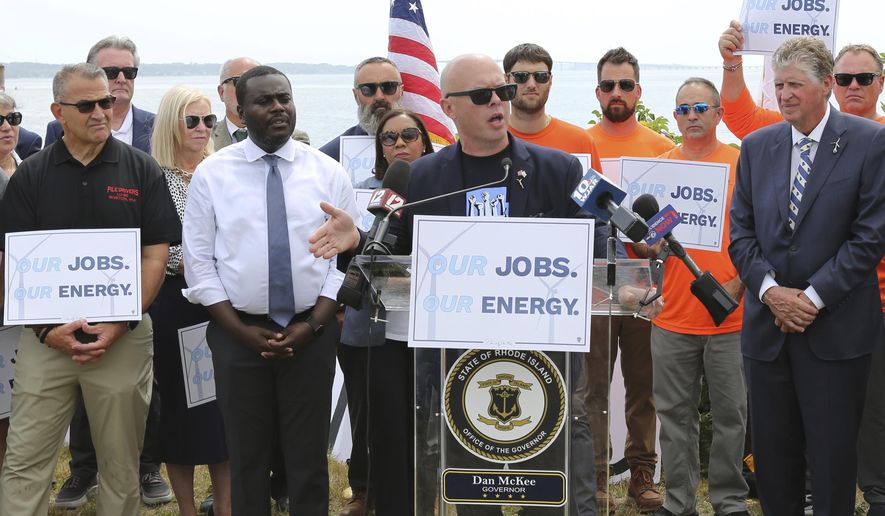
That’s why the Interior Department’s recent decision to halt construction on the Revolution Wind project in Rhode Island is so disappointing. The move contradicts the very principles that have made Mr. Trump’s energy dominance agenda successful.
Revolution Wind is not some green boondoggle. It had already cleared the gauntlet of federal and state permits, secured financing and created thousands of jobs. The project was about 80% finished and on track to power 350,000 homes in New England as soon as next year.
Stopping a project that far along doesn’t just hurt consumers and workers; it also signals to investors around the world that they and their project might be next if it falls afoul of the ever-evolving American political landscape. Even when you follow the rules in the U.S., politics can still pull the rug out from underneath you.
That’s dangerous because energy projects of all kinds — oil, gas, nuclear, pipelines, transmission lines and, yes, wind farms — require billions of dollars in up-front capital and years of planning. If developers start to believe the U.S. government will change its mind at the last minute, they will take their money elsewhere and put America’s global energy dominance at risk.
We are already seeing the effects. According to BloombergNEF, U.S. investment in renewables fell by 36%, more than $20 billion, in the first half of 2025. At the same time, the European Union increased its renewable spending by 63%, or nearly $30 billion, with most of that surge in wind. Globally, clean energy investment is up 10% over the same period, including a 24% jump in wind investment. America is the one falling behind.
This is not about choosing wind over oil or solar over gas. Mr. Trump has been right all along that America needs to produce more energy of every kind to meet rising demand and lower costs. Peak U.S. electricity demand is projected to grow 14% by 2030 and more than 50% by 2050. No single source can meet that challenge alone. An “all of the above” approach in which oil, gas, coal, nuclear and renewables each play to their strengths is the only path forward.
That’s why this stop-work order feels like such a misstep. Electricity prices for families across New England are already spiking, driven higher by rising energy demand from data centers and other power-hungry sectors. Why take any power off the grid when supply is struggling to keep pace with demand?
The Trump administration’s last-minute move to block Revolution Wind is the same kind of weaponization of government against politically unfavorable energy sources in which the Biden administration infamously engaged. The Biden administration forced coal-fired power plants to shut down, halted approval of exports of liquefied natural gas and revoked permits for the Keystone XL pipeline. Both parties turning energy into a political football will surely have a chilling effect on investment in U.S. energy infrastructure, ultimately to the detriment of families struggling to keep up with rising prices.
Rejecting projects late in the game creates uncertainty that drives up costs for everyone. Worse, it gives Europe and Asia an advantage at the very moment when Mr. Trump’s “America First” energy strategy should be cementing U.S. leadership.
Mr. Trump is right to be skeptical of overpromised green schemes and heavy-handed regulation, but Revolution Wind is different. It was a project that checked the boxes, cleared the hurdles and promised real benefits for American families and workers. If we want true energy dominance, we need consistency as well as boldness.
Mr. Trump’s record on energy is strong, and his instincts about unleashing America’s potential are exactly what the country needs, but letting the Revolution Wind project fall victim to regulatory whiplash risks undermining that legacy. Investors are watching, and so are America’s workers. Let’s not allow one bad decision to cast doubt on the best energy strategy we’ve had in decades.
• Charlie Sauer is president of the Market Institute.

Please read our comment policy before commenting.