


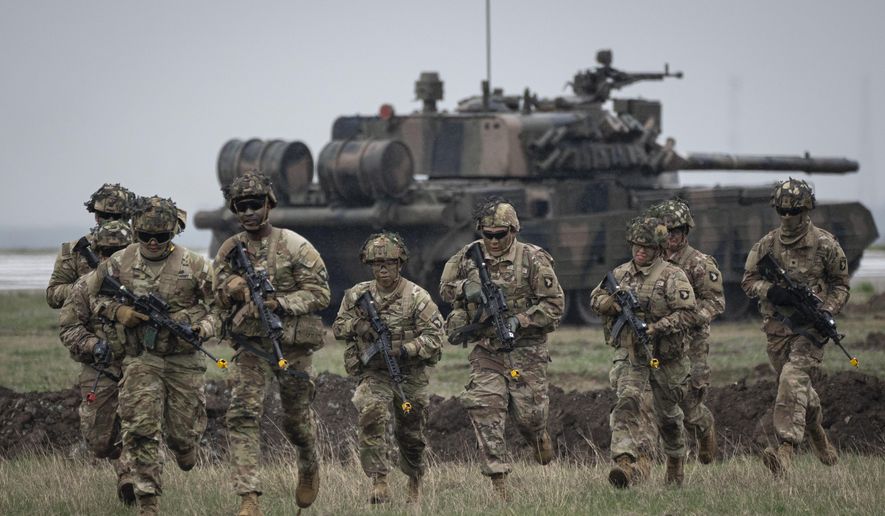

The Trump administration’s decision to withdraw about 800 U.S. troops from NATO’s eastern flank in Romania has drawn sharp criticism from two reliable allies on Capitol Hill — the Republican chairmen of the House and Senate armed services committees.
On Wednesday, Sen. Roger Wicker of Mississippi and Rep. Mike Rogers of Alabama said the Pentagon’s decision to cancel future rotations of a U.S. military brigade to Romania appeared “uncoordinated and directly at odds with the president’s strategy.” They said the move could trigger further drawdowns of U.S. forces from Eastern Europe.
“The decision also sends the wrong signal to Russia at the very moment President Trump is applying pressure to force [President] Vladimir Putin to come to the table to achieve a lasting peace in Ukraine,” the lawmakers said in a statement. “The president has it exactly right: Now is the time for America to demonstrate our resolve against Russian aggression.”
Reducing America’s military presence in Eastern Europe only weeks after Russian drones violated Romanian airspace undermines deterrence and risks inviting further aggression from Moscow, Mr. Wicker and Rep. Rogers said.
They expressed concern that Congress was kept out of the loop about the decision, particularly given the clear, bipartisan and bicameral support for a robust U.S. posture in Europe.
Mr. Wicker and Mr. Rogers said they were seeking clarification from the Pentagon about plans to “mitigate the impact” of the decision on NATO’s defense and whether U.S. officials coordinated the action with allies ahead of time.
“We will also seek assurances that, as the president has previously stated, the two armored brigades in Poland remain in place, and that the United States continues to sustain a persistent rotational presence in Poland, the Baltic states, and Romania,” they said.
The decision to redeploy the 2nd Infantry Brigade Combat Team of the 101st Airborne Division to its home base at Fort Campbell, Kentucky, is part of Defense Secretary Pete Hegseth’s “deliberate process to ensure a balanced U.S. military force posture,” officials with U.S. Army Europe and Africa said Wednesday.
“This is not an American withdrawal from Europe or a signal of lessened commitment to NATO. Rather, this is a positive sign of increased European capability and responsibility,” they said in a statement. “Our NATO allies are meeting President Trump’s call to take primary responsibility for the conventional defense of Europe. This force posture adjustment will not change the security environment in Europe.”
Romanian defense officials said the return of about 800 U.S. Army personnel to their home base was part of the Trump administration’s reassessment of America’s global force posture. The troops were mostly assigned to the Mikhail Kogalniceanu Air Base, a key hub for NATO operations in the region.
“The decision was expected, as Romania is in permanent contact with its American strategic partners,” defense officials in Bucharest said in a statement. “The decision also took into account the fact that NATO had strengthened its presence and activity on the Eastern Flank, which allows the United States to adjust its military posture in the region.”
The increase of U.S. troops to Eastern Europe followed Russia’s 2022 full-scale invasion of Ukraine. Romanian officials said it was intended to deter Moscow from any further aggression and to reassure NATO allies of its commitment to regional security.
The forces were intended to deter Moscow from further aggression and reassure nervous NATO allies of U.S. commitment to regional security. But the Trump administration has made no secret of its desire to reduce America’s military footprint in Europe in favor of other regions, including the Indo-Pacific and the Western Hemisphere.
Mr. Wicker and Mr. Rogers said they won’t accept significant changes to the nation’s warfighting structure that are made without a “rigorous interagency process,” which includes coordinating any staffing decisions with combatant commanders, the Joint Staff, and Congress.
“The president is right that U.S. force posture in Europe needs to be updated as NATO shoulders additional burdens and the character of warfare changes,” the lawmakers said. “But that update must be coordinated widely both within the U.S. government and with NATO.”
• Mike Glenn can be reached at mglenn@washingtontimes.com.

Please read our comment policy before commenting.