



SEOUL, South Korea — Details are still scarce, but President Trump and South Korean President Lee Jae-myung have touted a tentative deal to boost South Korean investment in the U.S., lower American tariffs on Korean cars and cooperate more on shipbuilding projects.
Early Thursday, Mr. Trump announced on social media that the U.S. had agreed to share sensitive tedchnology that would let South Korea build a nuclear-powered submarine.
Mr. Trump said the trade agreement reached at their face-to-face summit Wednesday was “pretty much finalized.” It has yet to be signed.
His Thursday Truth Social post also bragged about the pact as having been reached, saying “South Korea has agreed to pay the USA 350 Billion Dollars for a lowering of the Tariff’s charged against them by the United States” via several means.
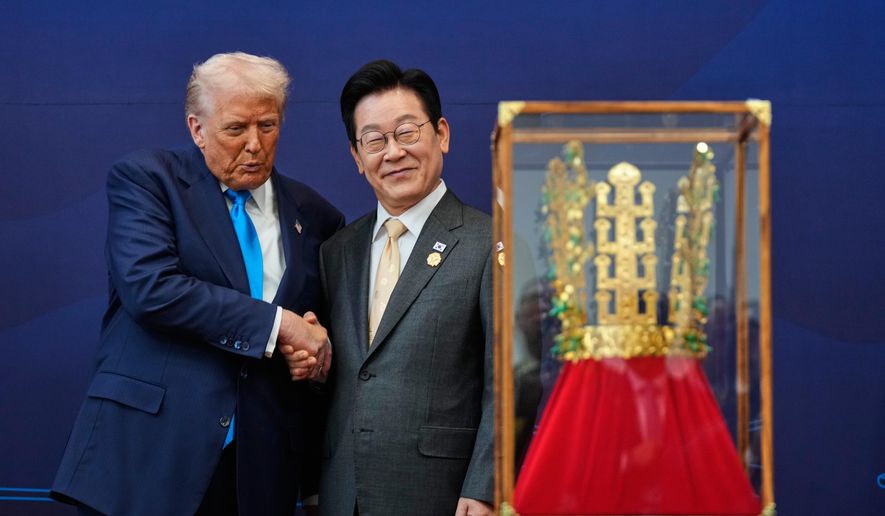
Mr. Lee had welcomed the American president to South Korea the previous day with a lavish ceremony and the presentation of a gold medal and a symbolic gold crown.
South Korea’s historic southeastern city of Gyeongju is the latest stop on Mr. Trump’s five-day Asia tour. He met Tuesday with Japanese Prime Minister Sanae Takaichi in Tokyo. On Thursday, Mr. Trump is set to meet with Chinese President Xi Jinping.
Gyeongju, capital of the ancient Silla Dynasty, hosts the 2025 Asia-Pacific Economic Cooperation summit this week.
South Korea ensured the vibes were upbeat for the U.S. president. Upon arrival, Mr. Trump was greeted by a band playing his rally theme, “YMCA.”
In talks, Mr. Trump and Mr. Lee added details about a complex trade deal, and Mr. Lee asked Mr. Trump about South Korea acquiring nuclear-powered submarines.
In his Truth Social post, Mr. Trump framed the deal in economic terms, saying that Seoul had agreed to build the submarine at a shipyard that was bought last year by South Korea’s Hanwha Group.
“South Korea will be building its Nuclear Powered Submarine in the Philadelphia Shipyards, right here in the good ol’ U.S.A. Shipbuilding in our Country will soon be making a big comeback,” Mr. Trump wrote, accompanying the post with a cash-filled envelope.
One visitor who likely would have received a warm welcome from both men was a no-show.
In the run-up to his five-day Asia trip, Mr. Trump repeatedly spoke of his hopes of renewing his first-term acquaintance with North Korean leader Kim Jong-un.
Mr. Lee, who took office in June, has frequently voiced hopes of engaging with Mr. Kim, reversing the stance of his conservative predecessor, impeached former President Yoon Suk Yeol.
Regarding the non-meet, the subject of intense speculation, Mr. Trump said, “We really weren’t able to work out timing.”
North Korea sent its own message. Pyongyang state media, monitored in Seoul, announced that its forces had carried out a cruise missile test in the Yellow Sea on Tuesday.
South Korea’s Yonhap News Agency wrote that the test had not been publicized in domestic vernacular media, indicating that the target audience for the launches was overseas.
The launch followed a test of hypersonic ballistic missiles on Oct. 22.
Experts say Pyongyang feels less compelled to engage Washington than in 2018-2019, when Mr. Trump and Mr. Kim met three times.
In 2024, North Korea entered a far-reaching security partnership with Russia. Moscow offers Pyongyang economic and technical aid, as well as diplomatic and political support in global forums. North Korean troops have been fighting for Russia in its war against Ukraine.
Hopes were widespread in South Korea that Wednesday’s summit could result in a final agreement on a $330 billion investment by Korea and the country’s top businesses in the U.S.
On Tuesday, the White House released a detailed outline of a similar $550 billion investment pledge by Japan.
Both deals are tied to Mr. Trump’s tariffs.
South Korea has pledged a mixed package of phased investments, loans and loan guarantees.
Mr. Trump requested “up-front” payments. Seoul said that would drain its foreign exchange reserves, which Trading Economic valued this month at $422 billion.
On Thursday, such details as timings and investment vehicles were not clear, but South Korea’s presidential office laid out broad contours: a $200 billion cash investment and another $150 billion in U.S. shipbuilding. To avoid risk, the cash investment will be capped at $20 billion annually.
In return, U.S. auto tariffs would drop to 15%.
That should provide relief to Korean automakers, which have been subject to 25% tariffs compared with their Japanese competitors’ 15%.
A deal also should provide relief to Mr. Lee, a former leftist who has pivoted to the center. Despite constantly touting the importance of the South Korea-U.S. alliance, he is under sustained political assault from conservatives in the U.S. and Korea who consider him pro-North Korea and pro-China.
Certainly, his government has unleashed widespread legal assault against the previous administration.
In the wake of Mr. Yoon’s December martial law declaration and subsequent impeachment, multiple people are detained under prosecution investigation. These include Mr. Yoon, his wife, and religious figures who took strong political stances or were embroiled in alleged corruption.
Putting additional strain on cross-Pacific ties was U.S. Immigration and Customs Enforcement’s arrest and deportation in September of hundreds of South Korean specialist workers at an under-construction Hyundai factory in Georgia for working without appropriate visas.
That shook Korea. Modest anti-U.S. and anti-Trump demonstrations were ignited, and some fret that the affair may strengthen the left wing of Mr. Lee’s party. However, a person familiar with Korean politics noted that “Lee is more popular than his party,” granting him room to maneuver.
The future of the Korea-U.S. alliance will be discussed. Defense Secretary Pete Hegseth will attend the annual bilateral talks in Seoul on Tuesday.
Mr. Lee’s nuclear-submarine request stumped experts.
“I hope you will make a decision to allow us to have supply for nuclear-powered submarines,” he told Mr. Trump, requesting an acceleration of consultations on spent nuclear-fuel reprocessing.
Mr. Lee made clear that the proposed boats would be nuclear-powered, not nuclear-armed.
“If fuel supply is permitted, we can build several submarines equipped with conventional weapons using our own technology to defend the waters around the Korean Peninsula, ultimately reducing the burden on U.S. forces,” Mr. Lee said.
Nuclear submarines have longer range and underwater endurance than conventional versions, making them ideal for high-endurance, far-ranging patrols. South Korea’s navy, postured against North Korea, has no such mission set.
Mr. Lee also made clear that he wants to improve relations with China. Seoul has customarily distanced itself from any defense of Taiwan.
“We are dealing with North Korea: We don’t need a nuclear-powered submarine,” said Yang Uk, a security expert at Seoul’s Asan Institute. “If we were fighting the Chinese navy out on the big ocean, then nuclear submarines are a must — but if not, why would we need that, and why would we spend that much money?”
A precedent for Mr. Lee’s request exists.
The Australia-U.K.-U.S., or AUKUS, pact will supply Canberra with a flotilla of attack boats for forward defense. Australia’s littoral is almost 5,000 miles from China’s coast. An Australian naval officer, who spoke off the record, noted that even the distances between Australian ports are vast.
That is not the case for geographically smaller South Korea, which shares a peninsula with North Korea and is separated from its strategic competitor by a 4-mile-wide Demilitarized Zone.
Mr. Yang called Mr. Lee’s request “a political fiasco.”
He suggested that politicians want to impress the public by acquiring iconic weapons to “show they are doing their best for defense” against nuclear-armed North Korea, even though there is “no reason” for them, operationally.
• Andrew Salmon can be reached at asalmon@washingtontimes.com.

Please read our comment policy before commenting.