



ILSAN, South Korea — A dramatic, viral clip of a “near-death” moment has become one of the most chilling pieces of footage to emerge from the Russia-Ukraine war.
American video journalist Patrick Lancaster, embedded with Russian forces in Kursk oblast in March, filmed himself and two Chechen soldiers in the open back of a pickup barreling down a track strewn with wrecked vehicles.
In the sky close above and behind, a Ukrainian kamikaze drone appears and starts its attack run.
The Chechens — one armed with an assault rifle, one with a shotgun — shoulder their weapons and open fire as the tiny machine swoops in for the kill.
At the last moment, within 50 yards, the drone is hit and downed.
Mr. Lancaster exults as the Chechens chant, “Allahu Akbar,” while swiftly reloading.
The clip, posted on YouTube, has garnered 1.2 million views.
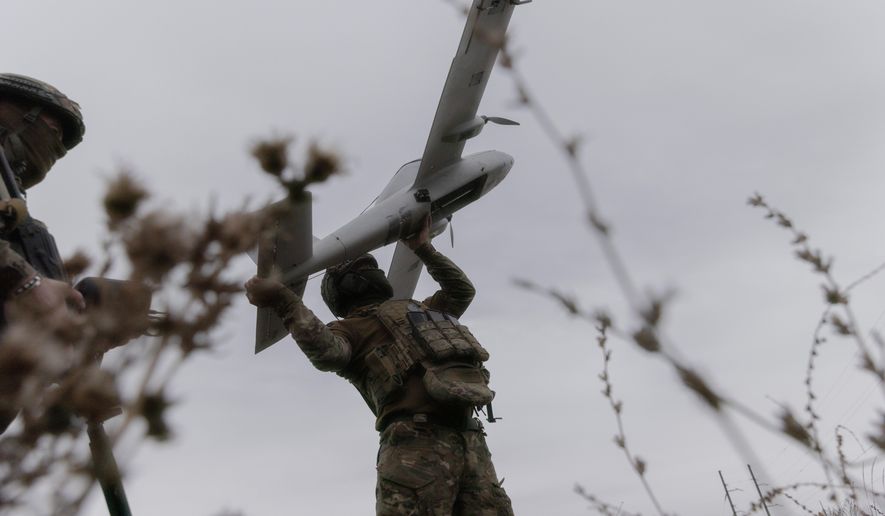
Cheap, disposable attack and reconnaissance drones, some costing less than $100 on commercial websites, have proved easy to weaponize in Ukraine. These high-volume, low-altitude threats make economical, close-range counter systems critical.
Such systems were displayed — along with missile mock-ups, armored vehicles and other high-cost, high-tech weapons — at the Seoul Aerospace and Defense Exposition, or ADEX, this week at the Korea International Exhibition Center, or KINTEX, in Ilsan, northwest of the South Korean capital.
For drone defense, old-school marksmanship does not cut it.
The gruesome videos posted on open-source intelligence websites, showing the ends of soldiers trying desperately but unsuccessfully to down incoming kamikaze drones with rifle fire in Ukraine, make clear the difficulty of the task.
An emerging solution is the humble shotgun.
Though a sporting weapon, it has been adopted for war by troops fighting at close quarters in jungle and urban environments. Drone kill is its latest combat task.
The shotgun makes sense given its efficacy against low-flying game birds, which are about the size of quadcopter drones.
Unlike rifles, which are bullet-firing point weapons, shotguns fire a spread of pellets, offering a better chance of hitting hard-to-track targets.
Specialized munitions upgrade effectiveness.
“Many drones are made of carbon fiber, so they can resist lead shot,” said Park Soong-hyun, a representative of Korean firm UTG Co. Ltd.
The “Drone Guardian” system Mr. Park exhibited at ADEX marries Italian gunmaker Beretta’s Benelli M4 combat shotgun to shells filled with tungsten shot from Swedish munitions maker Norma.
“If tungsten hits the drone, the drone is down,” Mr. Park said.
The system, which Mr. Park said has been proved in combat, offers ranges of 50 yards (optimal shots) to more than 100 yards (less optimal).
As such, Drone Guardian is marketed as a “last resort” system. American Randy Vance, another ADEX exhibitor, agreed that shotguns are ideal for “inside-the-perimeter” defense. Moreover, their light weight makes them easy for infantrymen to carry.
The use of firearms against drones looks like a step back in time.
For peacetime defense of installations against snooping or nuisance drones, and in the early days of the Russia-Ukraine war, the trend was for “soft kill”: using electronic countermeasures, signal jamming and spoofing to drop unmanned aerial vehicles.
Several exhibitors at ADEX said soft kill is falling out of fashion in favor of “hard kill” kinetic solutions.
“With soft kill, you don’t know if the drone is down or where it is,” Mr. Park said. “And if it goes down with a bomb attached … well. Hard kill is necessary.”
Getting maximal fire into the air is crucial against single or swarm drones. Assault rifles are not ideal: They overheat during sustained fire.
Ukrainian air defense units have innovated one solution.
Water-cooled heavy machine guns from the World War I era have been dual-mounted on swivel frames on the backs of vehicles. When sensors warn of incoming threats, the antique machine guns elevate and fire a curtain barrage into the UAV’s path.
A more up-to-date volume fire solution is the minigun.
Mr. Vance was exhibiting a 7.62 mm model produced by High Ground Defense of Scottsdale, Arizona, which has customers in 48 countries.
Miniguns are multiple-barreled rotary machine guns with external power sources that fire 100 rounds in a single-second burst.
Their motors and the depletion of prodigious ammunition supplies mean they cannot be hand-fired (despite occasional Hollywood follies).
Instead, they are mounted on emplacements. In Seoul, some are positioned on high-rise rooftops or vehicles: SUVs, armor, helicopters, warplanes and warships.
The minigun, which fires NATO ball ammunition, fills the range gap between shotguns and bigger systems such as missiles. Its formidable burst capacity makes it effective against individual UAVs and swarms, Mr. Vance said.
Manned miniguns can be fitted with red-dot magnifier optics to extend their visual range from around 875 to 1,640 yards.
Mr. Vance said an artificial-intelligence-enhanced remote weapons station is being developed for more immediate counter-drone action. The aim: “scan, detect, engage.”
The station merges the weapon with visual sensors and a software library that contains thumbnails of aerial objects such as leaves, birds, drones and aircraft.
Once a flying object is picked up, the AI scans the thumbnails and decides what it is “in a nano-second,” Mr. Vance said. “It can ID what to shoot and what not to shoot,” he said.
However, he acknowledged that drone warfare is becoming so ubiquitous and sophisticated that no single solution offers “the secret sauce.”
Looking ahead, he wondered half-jokingly whether the ancient sling could make a battlefield comeback by unleashing an airburst grenade.
• Andrew Salmon can be reached at asalmon@washingtontimes.com.

Please read our comment policy before commenting.