


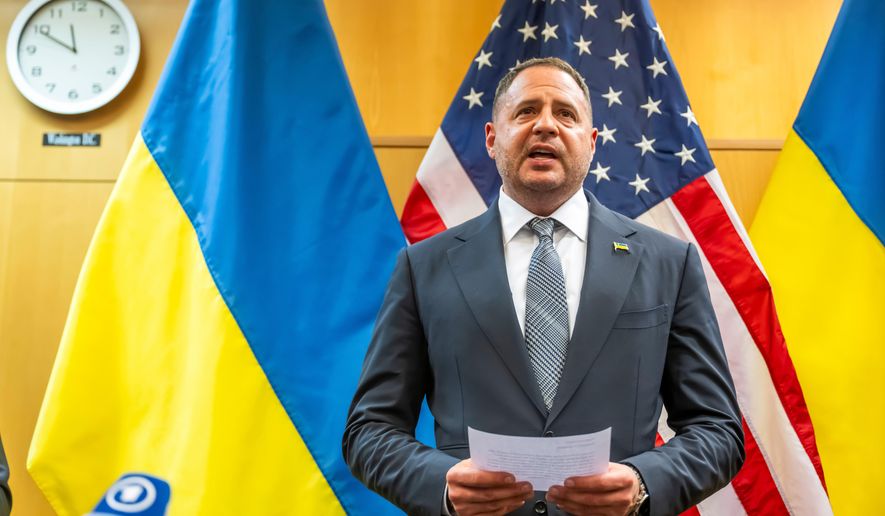

KYIV, Ukraine — Ukrainian President Volodymyr Zelenskyy’s all-powerful chief of staff, Andrii Yermak, resigned Friday as a high-profile anti-corruption investigation widened.
The exit of Mr. Yermak, who has been Ukraine’s lead negotiator in this week’s ongoing ceasefire discussions with the U.S., comes after his residence was searched by investigators.
The search is tied to a broad graft investigation centering on illicit schemes within Ukraine’s energy sector. The scandal has already led to the resignation of two ministers and is widely seen as an existential threat to the Zelenskyy administration.
In a public address, Mr. Zelenskyy thanked Mr. Yermak for his work, particularly for representing Ukraine’s position in negotiations, framing the resignation as part of a “reboot” of the presidential office: a move meant to preserve unity and avoid distractions during a delicate moment for Ukraine, as it navigates international diplomacy and wartime pressures.
Mr. Yermak’s exit came just hours after a predawn raid Friday by anti-corruption investigators. Long regarded as the most powerful member of Mr. Zelenskyy’s inner circle, the once-untouchable chief of staff has turned into the first high-profile victim of the sweeping Operation Midas corruption probe.
His abrupt departure ends a five-year period in which he concentrated more political authority than any presidential aide in independent Ukraine.
It also opens a period of deep uncertainty at the heart of Kyiv’s wartime decision-making.
Operation Midas, launched by Ukraine’s National Anti-Corruption Bureau and the Specialized Anti-Corruption Prosecutor’s Office, focuses on an alleged kickback scheme inside Energoatom, the state nuclear operator.
Investigators say millions of dollars may have been siphoned off through inflated contracts, with commissions worth 10 to 15% allegedly demanded in exchange for access to state tenders. Reuters and other outlets report that the suspected network may have diverted more than 100 million dollars.
Although investigators have not publicly named Mr. Yermak as a suspect, the search of his residence signaled that the inquiry had reached the center of political power.
During the raid, Mr. Yermak wrote on Telegram that he was “fully cooperating” and had “opened all premises” to investigators.
Mr. Yermak’s rise began with Mr. Zelenskyy’s landslide victory in 2019.
A lawyer and film producer with close ties to the president’s former production company, he was first brought into the administration as an adviser on foreign policy and humanitarian negotiations.
He handled prisoner-exchange talks with Russia, coordinated several sensitive diplomatic channels and gradually expanded his portfolio.
In February 2020, Mr. Zelenskyy dismissed his first chief of staff, Andriy Bohdan, and replaced him with Mr. Yermak. From that moment, the president’s inner circle began to revolve around a single trusted figure who controlled access to Mr. Zelenskyy, shaped government appointments and participated in key security decisions.
Over the next several years, Mr. Yermak accumulated influence across almost every domain of the state. He coordinated relations with the United States and Europe, oversaw negotiations on security guarantees and managed communications on domestic reform.
In Western and Ukrainian media, he was sometimes referred to as the “green cardinal,” a reference to the colors of Mr. Zelenskyy’s political party.
By 2024, he had become the president’s principal crisis manager, strategist and diplomat, playing a central role in negotiations on the U.S.-backed peace plan presented earlier this year.
The NABU and SAPO search at Mr. Yermak’s home triggered an immediate political reaction.
Opposition lawmakers demanded his dismissal. Some members of Mr. Zelenskyy’s own Servant of the People party joined those calls, arguing that the credibility of the government required a clean break.
The mood in Kyiv shifted quickly. For many in civil society, Mr. Yermak’s departure represented a long-awaited reckoning.
In a message shared shortly after the news broke, a prominent anti-corruption activist exulted: “This is huge. We have been waiting six years for this.”
Western partners, including the European Commission, publicly welcomed the anti-corruption agencies’ actions as evidence that Ukrainian institutions were functioning even during wartime.
Political analyst Volodymyr Fesenko told The Washington Times that removing Mr. Yermak would fundamentally shake the structure of power built since 2019. His assessment helps explain both the magnitude of the crisis and the uncertainty ahead.
“Yermak’s resignation is what the opposition demanded. Some members of the ruling party supported it as well,” he said. “But if Zelenskyy fires Yermak simply because the opposition demands it, that would be seen as a sign of weakness in the real politics of Ukraine.”
Mr. Fesenko emphasized how critical Mr. Yermak had become to the presidency. “For Zelenskyy, dismissing Yermak is like cutting off his right arm,” he said. “It would break the system of governance that has taken shape during these years.”
He also noted that the president does not currently have a replacement capable of performing Mr. Yermak’s many roles. “When Zelensky fired Andriy Bohdan in 2020, he already had Yermak prepared. Today, he has no equivalent candidate.”
Mr. Fesenko added that if NABU ultimately lists Mr. Yermak as a possible participant in the corruption scheme, the resignation would be seen as a preemptive move aimed at protecting the president. In that scenario, he warned, “the main target for the opposition would then become Zelensky himself.”
Mr. Yermak’s resignation comes at a time when Ukraine faces intense military and diplomatic pressure. Russian forces continue offensive operations along several axes, and Washington is pushing Kyiv to engage seriously with a new peace framework. Mr. Yermak had been leading those talks.
Replacing him may slow coordination with Western partners and complicate internal decision-making at a moment when unity and coherence are vital.
Ukraine’s anti-corruption bodies, widely supported by the United States and European Union, now face a test of their independence.
Washington and Brussels have repeatedly stressed that future support will depend not only on battlefield needs but also on sustained reforms and accountability at the highest levels.
For Mr. Zelenskyy, the fallout is profound. Removing his closest aide signals a willingness to cooperate with investigators, yet it also exposes the fragility of the administration wartime governing model. Mr. Yermak’s departure leaves a vacuum no obvious successor can fill quickly.
Operation Midas will continue to widen in the coming weeks. Whether the investigation stops at Energoatom or reaches deeper into the presidential circle will determine not only Mr. Yermak’s fate but also the stability of Ukraine’s leadership at a critical moment of the war.

Please read our comment policy before commenting.