



The Homeland Security Department announced strict new vetting of immigrants on Thursday, blaming a weak immigration system in the wake of this week’s attack on National Guard soldiers in the nation’s capital allegedly by an Afghan immigrant.
U.S. Citizenship and Immigration Services Director Joseph Edlow said on social media that he’s ordered a “full scale, rigorous reexamination of every green card for every alien from every country of concern.”
In a statement, he also said he has ordered the adoption of new vetting standards for all “immigration requests” from 19 “high-risk countries” where the U.S. has trouble verifying identities and checking criminal histories.
“My primary responsibility is to ensure that every alien is vetted and screened to the maximum degree possible,” Mr. Edlow said.
He said he made the moves at the direction of President Trump.
He pointed back to the 19 countries identified in a June presidential proclamation: Afghanistan, Burma, Chad, Republic of the Congo, Equatorial Guinea, Eritrea, Haiti, Iran, Libya, Somalia, Sudan, Yemen, Burundi, Cuba, Laos, Sierra Leone, Togo, Turkmenistan and Venezuela.
“Yesterday’s horrific events make it abundantly clear the Biden administration spent the last four years dismantling basic vetting and screening standards, prioritizing the rapid resettlement of aliens from high-risk countries over the safety of American citizens. The Trump administration takes the opposite approach,” Mr. Edlow said.
The new decisions announced Thursday come on top of his announcement Wednesday that he has paused all immigration processing for Afghans.
He said that pause is indefinite and will allow a “review of security and vetting protocols.”
The moves followed Mr. Trump, in a video address Wednesday, calling the massive surge of migrants to the U.S. during the Biden administration “the single greatest national security threat facing our nation.”
“No country can tolerate such a risk to our very survival,” the president said.
Homeland Security Secretary Kristi Noem said the shooting suspect arrived in the U.S. on Sept. 8, 2021, as part of the evacuation flights then-President Biden hastily arranged to try to get Afghans who helped America’s war effort out of danger as the Taliban retook control of the country.
SEE ALSO: Trump vows immigration crackdown after Afghan named as shooter in Guard ambush
Mr. Trump said the man later had his status extended under “legislation signed by President Biden” — though it’s unclear what that legislation was.
FBI Director Kash Patel said the suspect had since been approved for asylum but declined to say more.
He blamed the initial admission by the Biden administration of Afghan evacuees.
“You miss all the signs when you do absolutely no vetting, and that’s exactly what happened in this case,” he said.
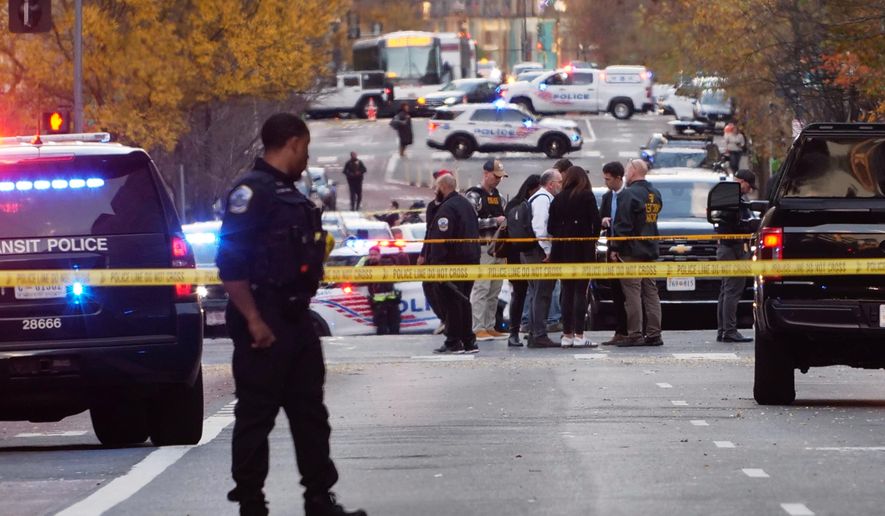
The shooting suspect, identified as Rahmanullah Lakanwal, was wounded by National Guard soldiers who responded to the ambush attack against Spc. Sarah Beckstrom, 20, and Staff Sgt. Andrew Wolfe, 24.
On Thursday evening, Spc. Backstrom died of her injuries.
Mr. Lakanwal worked with the CIA in Afghanistan and earned his place on an evacuation flight because of that assistance.
Mr. Biden’s 2021 airlift brought about 80,000 Afghans out of their country.
The stated goal was to deliver people who had helped the U.S. and risked the Taliban’s retaliation. But experts said at least half those rescued lacked ties to the American war effort and were instead from Kabul’s middle class and were lucky enough to make it through Taliban checkpoints to reach the airport.
U.S. troops and State Department officials who ran the evacuation effort have described serious problems. The U.S. emailed what it called “electronic visas” to people intended to be rescued, but Kabul residents quickly found the visas were easy to duplicate.
Some officials told a House investigation that the guidance on who to fly out changed on a daily basis.
“It was a matter of filling airplanes,” one senior State Department official told the House Foreign Affairs Committee.
Inspector general reports have said the U.S. failed to verify some of the arrivals through all security check databases, allowing some risky people to make it here.
Most of the Afghans were admitted to the U.S. under “parole,” a temporary exception to the legal immigration system.
In the four years since the airlift, immigration groups and some members of Congress have pushed to grant the Afghans more permanent status.
Sen. Patty Murray, Washington Democrat, said Thursday she hopes the shooting doesn’t derail those efforts.
“We must not attribute the actions of one person to an entire community,” Ms. Murray said.
She said the legislation would require an in-person interview and another security screening before Afghans can get on a pathway to citizenship.
Some congressional Republicans, though, wanted to head the other direction.
“We must IMMEDIATELY BAN all ISLAM immigrants and DEPORT every single Islamist who is living among us just waiting to attack,” Sen. Tommy Tuberville, Alabama Republican, posted on social media.
Vice President J.D. Vance said he criticized the Afghan airlift policy in 2021, but “friends sent me messages calling me a racist. It was a clarifying moment.”
“They shouldn’t have been in our country,” Mr. Vance said on social media.
The suspect in Wednesday’s ambush isn’t the first Afghan airlift participant to spark concern.
Nasir Tawhedi, who also arrived in the 2021 airlift, has pled guilty to a role in a plot to carry out an Election Day shooting attack last year. Authorities disrupted the plan before the attack could be carried out.
The Washington Times has reported on vetting difficulties, including even obtaining basic information on those brought in.
A startling number of Afghan evacuees were assigned birth dates of Jan. 1 in U.S. records because they claimed not to know their birth dates.
An unusual number also gave their birth dates as Sept. 11 — the date of the 2001 terrorist attacks that killed nearly 3,000 Americans and sparked the 20-year war.
• Mallory Wilson contributed to this report.
• Stephen Dinan can be reached at sdinan@washingtontimes.com.

Please read our comment policy before commenting.