


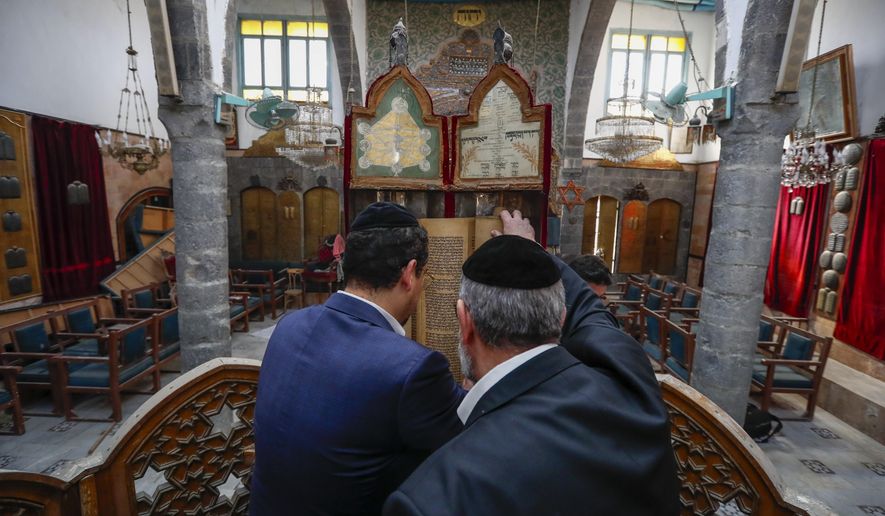

Rabbi Yusuf Hamra, a founding member of the Jewish Heritage in Syria Foundation, called on Congress to repeal the Caesar Act sanctions this week, echoing calls from Trump administration officials and activists looking to eliminate economic burdens on Damascus.
In a statement to the Commission on Security and Cooperation in Europe, Mr. Hamra wrote that the Syrian Jewish community in the U.S. is “deeply connected” to its roots in Syria and is desperate to see historic and religious sites rebuilt.
“The only thing preventing us from rebuilding one of the holiest sites to Jews, Muslims and Christians, and from reestablishing Jewish life in Damascus, is the Caesar Act,” Mr. Hamra wrote. “The Caesar Act was adopted in order to punish the Assad regime for its crimes against the Syrian people. It is a shame that today the Caesar Act punishes the Syrian people, Muslims, Christians and Jews, Arabs and Kurds, for the crimes of a regime that has been deposed.”
The Caesar sanctions were adopted through an act of Congress in 2019 and require a similar act to repeal.
The Jewish community in Syria has dwindled dramatically under the regimes of Bashar Assad and his father, with only a handful of Jewish people remaining in urban centers like Damascus and Aleppo.
Syrian Jewish community leaders have asserted that conditions have changed since Mr. Assad was deposed in December and that the current president, Ahmad al-Sharaa, has indicated his government will protect the rights of Jewish people.
“The new Syrian government has since welcomed multiple delegations coordinated by the Jewish Heritage of Syria Foundation, allowing us freedom of worship for the first time in many decades,” Mr. Hamra wrote.
Mr. Hamra’s comments stand at odds with some of the Syrian government’s critics, who say Mr. al-Sharaa has not done enough to curb violence against ethnic and religious minorities.
Specifically, members of Alawite minority advocacy groups have pointed to massacres carried out by Syrian troops in March as evidence of the al-Sharaa government’s failure to protect minorities.
According to some estimates, upward of 1,500 people, including civilians, were killed that month during clashes between Alawite militia members and Syrian armed forces. Mr. al-Sharaa has since condemned the violence, and Damascus is prosecuting nearly 300 people accused of participating in the atrocities.
Syrian forces have also come into conflict with Druze and Kurdish militia in the southern and northern provinces, respectively.
The recent outbreak in sectarian violence has led some in Congress to resist calls from activists and the Trump administration to remove the sanctions. Some have insisted that the repeal of sanctions must include a snapback mechanism, whereby restrictions could be reimposed if Syria fails to curb sectarian violence.
Advocates argue that foreign businesses that are interested in helping rebuild Syria would think twice before investing if there were such a mechanism.
• Vaughn Cockayne can be reached at vcockayne@washingtontimes.com.

Please read our comment policy before commenting.