



OPINION:
When he was confirmed in September, the new director of a little-noticed federal agency had an opportunity to remove a millstone from around the necks of companies working to promote the nation’s prosperity and security. Instead, he began his tenure by proposing rules that make the burden even heavier.
That agency is the U.S. Patent and Trademark Office, charged with protecting this country’s innovators and entrepreneurs, and its director is John Squires. The millstone is frivolous litigation brought by owners of low-quality patents who are not in the business of producing anything, but who purchase weak patents in order to sue companies they claim are guilty of infringement.
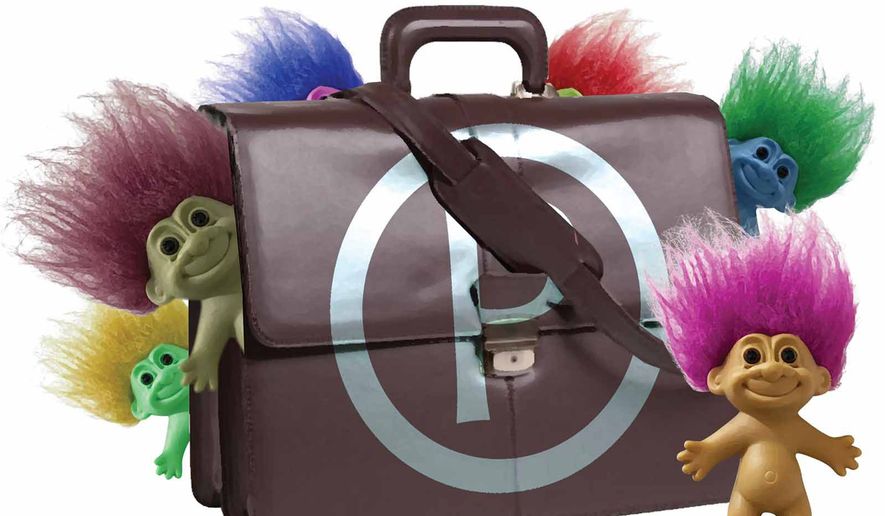
These claimants, known as patent trolls, account for more than half the patent cases filed in federal courts and more than 85% of such cases in high-tech industries. An entire ecosystem of patent trolls has matured, generating billions of dollars in increased costs for U.S. businesses and consumers over the years. Meanwhile, the sued companies have been shown to dramatically reduce future investments in research and development, the cost of which is impossible to quantify.
In 2011, Congress tried to head off patent troll litigation by establishing the Patent Trial and Appeal Board, a cadre of technically trained judges at the Patent and Trademark Office empowered to hear and quickly decide challenges to the validity of patent trolls’ patents. Here is an example of how it works: When a company offering an online checkout process is sued by a patent troll claiming that some part of that process infringes its patent, the company can petition the Patent Trial and Appeal Board to review the troll’s patent. If the troll’s patent is found invalid, the troll’s claim and related claims can be swept aside.
The Patent Trial and Appeal Board worked as intended. It costs participants a fraction of what it costs to litigate in district court and reaches final determinations much more swiftly, and its decisions are no more likely to be overturned on appeal than are district court rulings. The efficiency and reliability of the proceedings give patent trolls far less leverage to extort settlements from their victims.
The board stopped working when Mr. Squires’ predecessor — who held office for eight months on an interim basis without Senate confirmation and now serves as his deputy — started rejecting its petitions wholesale, asserting that they would violate the “settled expectations” of patent owners. Patents typically last 20 years, but the interim director decided that six years or less is enough to create “settled expectations.” Requests for review after that point are denied.
This policy has played insidiously into the hands of patent trolls in two ways. First, because patent trolls are not their patents’ initial owners and do not produce products, there is little incentive for their future targets to bring a review action during the first six years. Second, because patent trolls often sue late in a patent’s life, the illusion of “settled expectations” after six years, built into the policy, can more easily take on the appearance of reality.
The acting Patent and Trademark Office director created, seemingly out of thin air, a process in which she personally decided which requests for review would be considered. This change forced victims of meritless lawsuits to defend themselves in extraordinarily expensive litigation, and sometimes to give in to extortion and settle rather than avail themselves of the efficient review the law should have provided them.
The results of this new policy were dramatic. Since October 2024, 72% of petitions for review were denied; in comparison, less than 40% were denied in the eight months prior.
Mr. Squires had a chance to set this right by immediately rescinding the new practices and returning the Patent Trial and Appeal Board to operate as the law directs. Instead, he has taken a giant step in the opposite direction, releasing a set of rules in October that are a pure act of bureaucratic lawmaking and will unleash a new wave of legal abuses.
The agency proposes to deny patent reviews when there is litigation in district court related to the same patents (the opposite of what Congress intended), deny reviews if a patent’s validity has already been ruled on in a separate case (binding petitioners to decisions made in cases they weren’t party to and violating the principle of self-defense) and require petitioners to waive certain defenses in district court in order for review to proceed at the Patent and Trademark Office (which the office has no authority to do).
If implemented as written, the rules’ net effect will be making the Patent Trial and Appeal Board virtually inaccessible to businesses targeted by patent trolls. The trolls will be emboldened, abusive patent lawsuits will increase, American companies will be burdened with additional costs, and innovation will be delayed.
Mr. Squires should immediately put an end to his agency’s overreach, which will cost American companies and consumers dearly.
• Michael B. Mukasey served as attorney general of the United States (2007-2009) and as a U.S. district judge (1988-2006).

Please read our comment policy before commenting.