


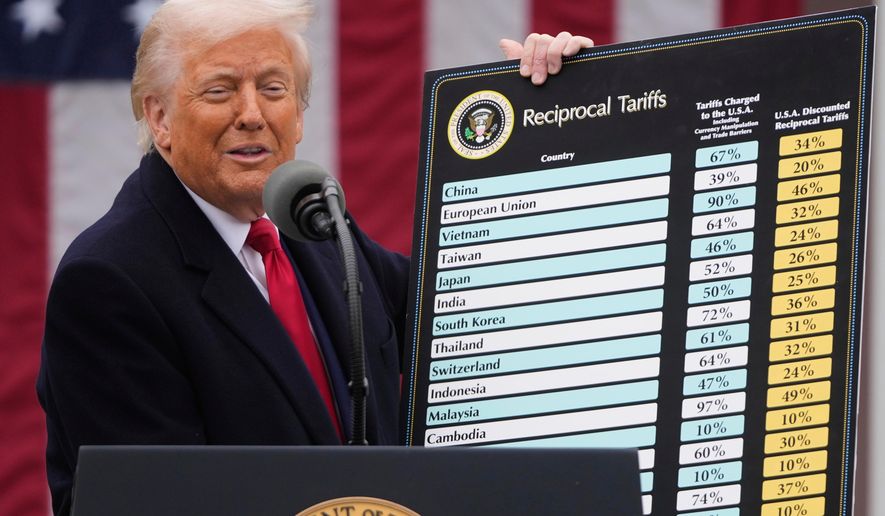

Small businesses that sued President Trump over his tariffs aren’t looking just to end them; they are also hoping to receive a refund from Uncle Sam to compensate for their losses over the past months.
The Supreme Court is set to hear their case Wednesday in what is shaping up as one of the significant cases this term, testing the limits of the president’s powers.
Michael McConnell, one of the attorneys for the five small businesses, said they have sustained serious setbacks since the president raised tariffs. One of the businesses is teetering on the brink of bankruptcy.
“They can’t enter into contracts with any degree of confidence — that the rules of the game won’t be changed in the middle,” Mr. McConnell told The Washington Times’ “Court Watch” podcast. “These tariffs are literally putting companies out of business.”
He said that’s one reason they hope the justices, who often wait on big decisions until the end of the term in June, will speed an opinion on this case.
“We want a fast answer,” said Mr. McConnell. Until the court rules, he said, Mr. Trump could issue more tariffs at any time.
The justices will hear two cases: Trump v. V.O.S. Selections Inc. and Learning Resources Inc. v. Trump.
At issue are a series of global tariffs Mr. Trump declared, as well as specific levies on China, Mexico and Canada that the president imposed because he wanted more action to curb the flow of fentanyl into the U.S.
Tariffs are taxes on foreign goods imported into U.S. markets. The importer of record, often a U.S. company, pays the duty, not foreign governments.
Mr. Trump has long been a fan of the tool. His affinity for tariffs has grown as other nations rush to renegotiate trade terms and cash has poured into the U.S. Treasury. Customs duties rose $118 billion in the just-completed fiscal year 2025.
Experts said the stakes of the cases are even bigger than Mr. Trump’s economic agenda.
Mr. McConnell has called the cases the biggest test of separation of powers issues since the 1952 Youngstown decision that struck down President Truman’s seizure of steel mills.
Truman said he needed to surmount a strike and keep the mills operating, given the ongoing Korean War. However, the justices, in a 6-3 decision, ruled that the president couldn’t commandeer private property without express authorization from Congress.
In this instance, Mr. Trump says he is acting under the International Emergency Economic Powers Act to impose the tariffs. He says the trade deficit and the flow of fentanyl trigger emergency tariff powers under that law.
The law doesn’t actually use the word “tariffs,” but U.S. Solicitor General D. John Sauer says it grants the president the authority to “regulate importation,” which is sufficient.
“The power to ‘regulate importation’ encompasses the power to impose tariffs or duties on imports,” he told the justices in briefs.
A series of lower courts disagreed. They include a district court, the U.S. Court of International Trade and the U.S. Court of Appeals for the Federal Circuit.
A president has never used the law in this manner to impose tariffs, said Mr. McConnell, a former federal appeals court judge.
“It is about economic sanctions on foreign nations. It is not about taxation on Americans,” he said.
Sector-specific tariffs on autos, steel and aluminum were imposed under alternate authorities and are not at risk in this legal fight.
Treasury Secretary Scott Bessent has said that if the court doesn’t rule until June and ultimately strikes down the tariffs, the government may have to refund $1 trillion in revenue.
Mr. Trump posted on Truth Social on Sunday that he won’t attend the Supreme Court arguments. The president previously said he had “an obligation” to attend the oral arguments.
Mr. Trump would have become the first president in recent history to attend a Supreme Court hearing.
“I will not be going to the Court on Wednesday in that I do not want to distract from the importance of this Decision,” Mr. Trump said.
“Tariffs have brought us Great Wealth and National Security in the nine months that I have had the Honor to serve as President. The Stock Market has hit All Time Highs many times during my short time in Office, with virtually No Inflation, and National Security that is second to none,” the president’s post said.
“Our recent successful negotiation with China, and many others, put us in a strong position only because we had Tariffs with which to negotiate fair and sustainable Deals. If a President was not able to quickly and nimbly use the power of Tariffs, we would be defenseless, leading perhaps even to the ruination of our Nation.”
Last month, Mr. Trump appeared eager to attend the hearing.
“It’s one of the most important decisions in the history of the Supreme Court, and I might go there. I really believe I have an obligation to go there,” Mr. Trump said at the time.
• Stephen Dinan and Thomas Howell Jr. contributed to this report.
• Alex Swoyer can be reached at aswoyer@washingtontimes.com.

Please read our comment policy before commenting.