



OPINION:
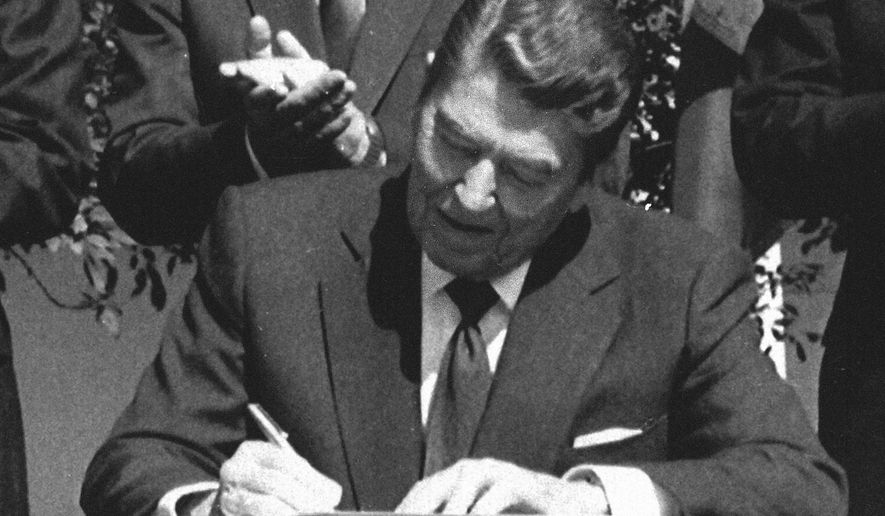
Throughout President Trump’s public career, he has vacillated on many issues, but he has consistently promoted a protectionist trade policy. President Reagan, on the other hand, was a free trader who occasionally and reluctantly used tariffs to hold America’s competitors to their promises.
For instance, in the 1980s, Reagan imposed narrow tariffs on Japanese imports in response to Japan’s continued dumping of semiconductor chips and failure to open its market to American companies. Reagan aimed for free trade, clearly articulating how both countries benefit. By contrast, Mr. Trump occasionally and reluctantly negotiates down tariffs for the sake of a deal. Therefore, no one was particularly shocked when Mr. Trump claimed in 2016 that Reagan was “far too weak on trade,” nor earlier this year when Mr. Trump once again claimed that Reagan was “very bad on trade.” In America, you do have the right to be wrong, even if this means disagreeing with the Gipper.
Recently, however, Mr. Trump has taken a different tone. He seems to have finally realized that direct disagreement with the 40th president is a losing proposition. Now, Mr. Trump is engaged in his own revisionist history. Instead of critiquing the most popular president of the past half-century, Mr. Trump is perpetuating what we might call “The 1987 Project,” rewriting the history books on Reagan’s trade dispute with Japan to conscript Reagan into his personal agenda.
Fans and critics of Reagan alike agree that the man was a free trader, love it or hate it. Yet today, under the specter of presidential displeasure, those most responsible for preserving Reagan’s legacy are now contorting it. When the Canadian government ran anti-tariff ads in the United States, our northern neighbors highlighted in Reagan’s own words the dangers of the current tariff policies.
Reagan was the godfather of the trilateral trade agreement with Mexico and Canada. Expanded markets have boosted American exports of goods and services by more than 400% since 1987 (in real terms) while inflation-adjusted typical family income skyrocketed 38% (nearly $29,000) as the overall tariff rate began a steady decline from 3.5% in 1987 to less than half by the turn of the 21st century.
That legacy, which began as a bilateral U.S.-Canada trade agreement brokered by Reagan, mutually benefited both our countries. As such, Canada’s reminder to the United States of what we seem to be forgetting about the merits of free trade is tragically poetic.
It’s sadly not too surprising that Mr. Trump threatened to impose an additional 10% tariff tax of nearly $500 per American family annually on Canadian products because he is agitated over a small ad buy from our northern neighbors.
It’s disconcerting to witness those entrusted with protecting and promoting Reagan’s legacy to join in the historic revisionism. One need only watch Reagan’s radio address from 1987 on free and fair trade or his 1982 radio address on international free trade to understand his commitment to trade.
The bottom line is clear: Free trade with free nations makes millions of people richer. Although some nostalgically long for a nonexistent past of a secure middle class buttressed by protectionism, Reagan knew that free trade leads to a more prosperous America. I trust that the American people still know this in their hearts. We honor his legacy by denouncing the historical revisionism that disparages his memory by denying Reagan’s very words.
• Marc Short is board chairman of Advancing American Freedom.

Please read our comment policy before commenting.