


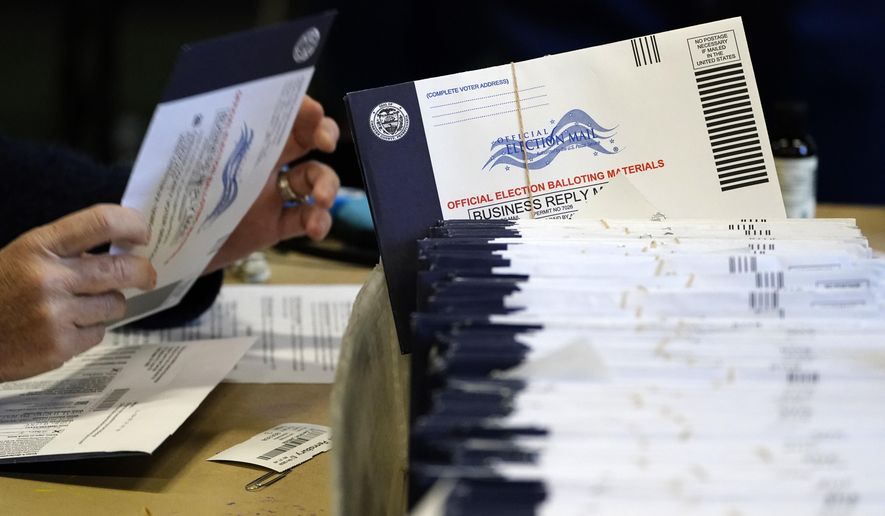

The Supreme Court said Monday it will take up a case that could settle whether states can count mail-in ballots received after Election Day, wading into an issue that increasingly divides Democrats and Republicans.
The justices agreed to hear a case challenging Mississippi’s policy, adopted during the height of the COVID-19 pandemic, which allows mailed-in ballots to be counted if they are cast on time and received within five days of Election Day.
The Republican National Committee challenged the law, and a lower appeals court ruled against the state. The 5th U.S. Circuit Court of Appeals said Congress set a single day for national elections and ballots must “be both cast by voters and received by state officials.”
Mississippi appealed to the justices, saying that if its law is illegal, then so are the laws in most other states. It warned of election “chaos” unless the high court intervened.
“The stakes are high: ballots cast by — but received after — Election Day can swing close races and change the course of the country,” Mississippi Attorney General Lynn Fitch argued in asking the court to take the case.
The battle over mailed-in ballots had been percolating for years. It gained nationwide headlines amid the pandemic emergency as states rushed to make it easier to vote without violating social distancing rules.
SEE ALSO: Supreme Court ponders Trump administration’s halt of food stamp program
States ditched policies that required voters to provide reasons for voting in person early or by mail. They also expanded the grace period for mailed-in ballots to arrive and be counted.
President Trump initially railed against early voting but has softened on its use.
He has come down firmly on the side of not counting ballots arriving after Election Day.
“This is like allowing persons who arrive 3 days after Election Day, perhaps after a winner has been declared, to vote in person at a former voting precinct, which would be absurd,” he said in a March executive order.
He ordered the Justice Department to find ways to punish states that violate the Election Day standard.
Federal district courts have largely halted that executive order.
SEE ALSO: Supreme Court won’t consider challenge to overturn same-sex marriage ruling
The Supreme Court has heard oral arguments this year on another case that touches on the same issue.
In that case, Rep. Mike Bost, Illinois Republican, had challenged his state’s law that allowed mailed ballots to be counted if they were received up to 14 days after Election Day.
Lower courts found that he lacked standing to sue.
In his appeal to the justices, he argued that a candidate in an election has a strong interest in ballot counting and must be allowed to sue.
During oral arguments, the justices seemed sympathetic to his case.
Roughly 30 states allow for at least some ballots to be counted if received after Election Day, according to data collected by the National Conference of State Legislatures. Some states allow it only for overseas military voters. Others are permissive for all voters.
Curiously, some Republican-led states are among the most generous while deeply liberal states such as Vermont and Hawaii do not allow ballots received after polls close on Election Day to be counted.
Advocates of expansive options complain of relatively low turnout and hurdles to voting. That has led to an increasing use of voting outside the polls on Election Day itself.
Mail ballots accounted for more than 30% of the vote in last year’s elections, according to the U.S. Election Assistance Commission’s report.
Most states require the ballot to be postmarked by Election Day.
Washington state allows ballots to be counted up to three weeks after Election Day, and Puerto Rico accepts ballots received as late as Dec. 30.
Late-arriving votes have swung elections.
In California, which has a high rate of voting by mail and allows ballots to be counted up to seven days after Election Day, congressional candidates have emerged on the night of the election in the lead, only to lose their races when all ballots are tabulated.
The 5th Circuit said in its March ruling that Congress in 1872 mandated a uniform day for federal elections. The question is what that means.
The appeals court panel said it marks the time when a ballot is cast, or when it is fully filled out by the voter and received by the vote talliers.
That doesn’t mean ballots can’t be voted before then, nor that they all have to be counted on Election Day. However, they all must be received, the judges said.
The Supreme Court addressed the issue in passing in 2020, when Wisconsin was holding an election in the early days of the pandemic.
A lower court ordered that mailed ballots could be postmarked and received up to six days after Election Day. The justices overruled that. They said ballots had to be postmarked by Election Day but could be received and counted within the ensuing six days.
Mississippi argued in its briefs that the ruling gave imprimatur to receiving ballots after Election Day. The 5th Circuit disagreed, saying the state was reading too much into the 2020 decision.
Tom Fitton, president of Judicial Watch, which has supported Mr. Trump’s position, urged the justices to uphold the 5th Circuit’s decision.
“Counting ballots received after Election Day not only violates federal law but encourages voter fraud and undermines voter confidence,” he said.
The case is Michael Watson, Mississippi Secretary of State, v. Republican National Committee, et al.
It took four justices to vote in favor of hearing the dispute.
Oral arguments are expected later this term, with a decision by the end of June.
• Stephen Dinan can be reached at sdinan@washingtontimes.com.
• Alex Swoyer can be reached at aswoyer@washingtontimes.com.

Please read our comment policy before commenting.