


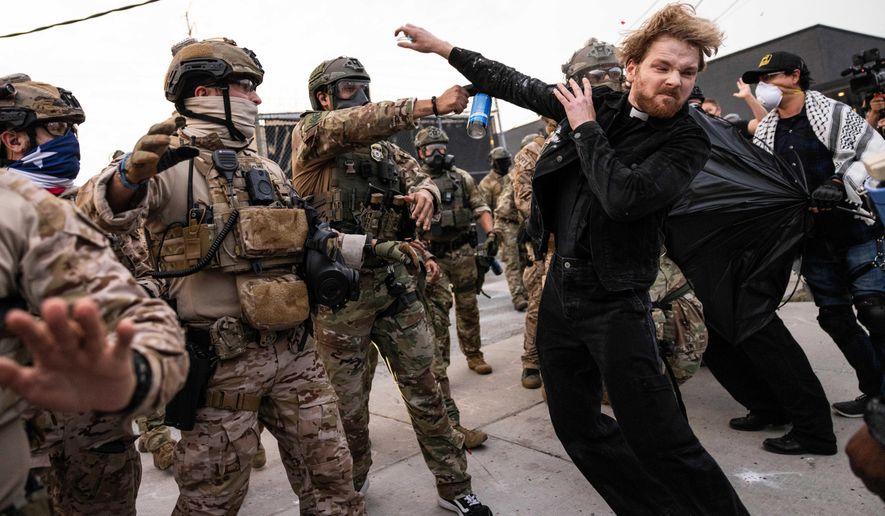

A report from Senate Democrats accuses Homeland Security of sweeping Americans up in its push to deport illegal immigrants, including some detained for more than a day, seemingly in defiance of Supreme Court guidance this year.
The report, released Tuesday, details 22 U.S. citizens who say they ended up detained by federal officers, including one Army veteran who said he was held for three days, missing his daughter’s birthday, and a woman held more than two days even though she said she had identification in her bag to prove she was a citizen.
It also described stark encounters between government agents and children.
In one August incident in Los Angeles, an American, Andreina Mejia, drove to the local high school to enroll her daughter. The mother sat in her vehicle with her 15-year-old son, who has mental disabilities, while the daughter went inside.
Ms. Mejia said masked federal agents swarmed her truck with guns and tasers drawn and took the boy into custody. Agents told the mother the teen “fit the description” of a Salvadoran criminal with ties to the MS-13 gang.
The agents released the boy after 15 minutes. Ms. Mejia recalled one agent telling him they were “mistaken, but at least you’ll have an exciting story to tell when you go back to school.”
Sen. Richard Blumenthal, the Connecticut Democrat who released the staff report, called the incidents “stomach-turning.”
“Masked ICE and CPB agents chillingly seizing Americans isn’t the nation we know and cherish. Totalitarian tactics have no place in our democracy,” he said.
Some of the incidents are hotly disputed.
Mr. Blumenthal’s report cites one 6-year-old autistic girl in Massachusetts, a citizen, who Senate investigators said ICE officers grabbed and used as “bait” to try to lure her parents out of their home to be arrested.
They detailed harsh words from the ICE officers, including demanding that the parents leave their home to show their identification to prove they were the girl’s parents. The mom and dad tried to show their ID through the door, but the agents insisted they leave their home — presumably making them eligible for an immigration arrest.
At one point, the report says, an ICE officer taunted the father: “You’re sure a real man, you know that? Hiding behind a lady, look at you.”
Homeland Security has denounced reports of that incident as misleading.
Spokeswoman Lauren Bis said the father was a valid target as a “criminal illegal alien” with previous arrests for domestic abuse and strangulation. She said he refused to stop for authorities and drove back to his home, abandoning the autistic girl in the vehicle while he dashed inside for safety.
“Officers helped rescue the child and called local police to report the abandonment,” Ms. Bis said.
Mr. Blumenthal said in his report that the father fled the car without the girl because he figured she was a U.S. citizen, and because of her autism, she “sometimes has problems talking with strangers or people she doesn’t know, but she can operate her seatbelt and get herself in and out of cars.”
The family said the girl was traumatized and missed a week of school. The father was detained by ICE officers two days later.
In a statement Tuesday, Homeland Security challenged Mr. Blumenthal’s conclusions.
“ICE does not arrest U.S. citizens. What makes someone a target for immigration enforcement is if they are illegally in the U.S. — NOT their skin color, race, or ethnicity,” the department said. “There are no ’indiscriminate stops’ being made. The Supreme Court recently vindicated us on this question. DHS enforces federal immigration law without fear, favor, or prejudice.”
Immigration enforcement tactics have come under political and legal scrutiny amid President Trump’s push for mass deportations.
In Los Angeles, a district judge ruled that Homeland Security was illegally using ethnicity or Spanish-speaking ability to target people for stops. In the District of Columbia and Colorado, federal judges have ordered agents to curtail warrantless immigration arrests, saying they must first prove a migrant would flee.
The Los Angeles case wound its way to the Supreme Court, where the justices blocked the lower court ruling, saying immigration officers had some leeway.
The majority didn’t explain its reasoning, but Justice Brett M. Kavanaugh issued a concurring opinion saying stops based on location, jobs, or presence at locations where illegal immigrants congregate are not automatically unconstitutional — as long as agents quickly sort out who’s who.
“If the officers learn that the individual they stopped is a U.S. citizen or otherwise lawfully in the United States, they promptly let the individual go,” Justice Kavanaugh wrote. “If the individual is illegally in the United States, the officers may arrest the individual and initiate the process for removal.”
Mr. Blumenthal said his report indicates that Justice Kavanaugh’s standard has been violated, though the incidents the senator’s report highlights seem to involve more than immigration stops. Often they were sparked by a person bird-dogging immigration officers, asserting a First Amendment right to observe and speak out on enforcement.
Then there was the case of George Retes, an Army veteran who said he was driving to work when he encountered a roadblock of immigration officers and military personnel. He told them he was trying to get to work.
After a brief encounter, he went back to his vehicle, where he said agents swarmed and gave conflicting directions. One said to get out of there, while another told him to pull over. Agents then smashed his window, pepper-sprayed him and dragged him out of his car.
He was released three days later after he missed his daughter’s third birthday.
Homeland Security has said its agents were raiding an illegal marijuana grow site when they encountered Mr. Retes. The department said he was “violent” and refused to comply with law enforcement directions, challenged agents and refused to move his vehicle when ordered to do so.
He was arrested for assault but was never charged. He has indicated he will pursue a Federal Tort Claims Act suit against the government.
• Stephen Dinan can be reached at sdinan@washingtontimes.com.

Please read our comment policy before commenting.