



Santa has come a little early this year, if you happen to be a chess columnist pressed for high-entertainment content during the holiday season.
Ed Schroeder, a trailblazer in the field of chess programming, has come up with a very cool new tool to find the most brilliant and spectacular games hiding in any general Portable Game Notation, or PGN, database of games. The semi-retired Dutch software engineer’s Best of Chess freeware unearths the games with the most sacrifices and the wildest king hunts — and the shorter the game, the better.
Best of Chess weeds out those long, “instructive” endgames, the opposite-bishop theoretical duels, the tedious closed-position scrums in search of a tiny positional edge. It’s like ordering up the pizza and then going straight to dessert, with all the vegetables and heavy-fiber offerings taken off the menu.
Schroeder told ChessBase.com in a recent interview that his program found more than 4,000 games getting the highest ranking for attacking, sacrificial chess just from ChessBase’s Mega-Base 2025 database, with offerings from the very earliest days of the modern game in 1610 to the latest brilliancies by former world champ Magnus Carlsen just last year.
American Paul Morphy and German Adolf Anderssen were the two premier stars of the great Romantic Era of the mid-19th century, when seeking out the sharpest lines and pulling of the most spectacular sacrifices was considered the only honorable way to play. Their greatest attacking games are widely anthologized and familiar to most players, but Best of Chess pulls up some less-appreciated gems that deserve to be better known.
Morphy’s triumphal European tour of 1858-1859 (including a famous decisive match win over Anderssen, the unofficial world champ at the time) included several fine victories over Paul Journoud, a celebrated Parisian master who proved no match for the young American in positional and tactical battles.
In a game from early 1859, Journoud meets Morphy’s beloved Evans Gambit with a countergambit of his own, but with 9. Re1 f5?! (better was 9…gxf6 10. d3 0-0 11. dxe4 Ng4!, with good counterattacking chances) 10. d3, Black gives Morphy the sharp, open position in which he thrived. After 11. Bg5 Qd6? (far more prudent was 11…0-0! 12. dxe4 fxe4 13. Bxd5+ cxd5, setting a trap on 14. Bxe4? Bxf2+! 15. Kxf2?? Nxe4+ 16. Kg1 Nxg5, winning) 12. Bxf6 Nxf6 13. Nbd2, Journoud’s king is marooned in the center with dire consequences.
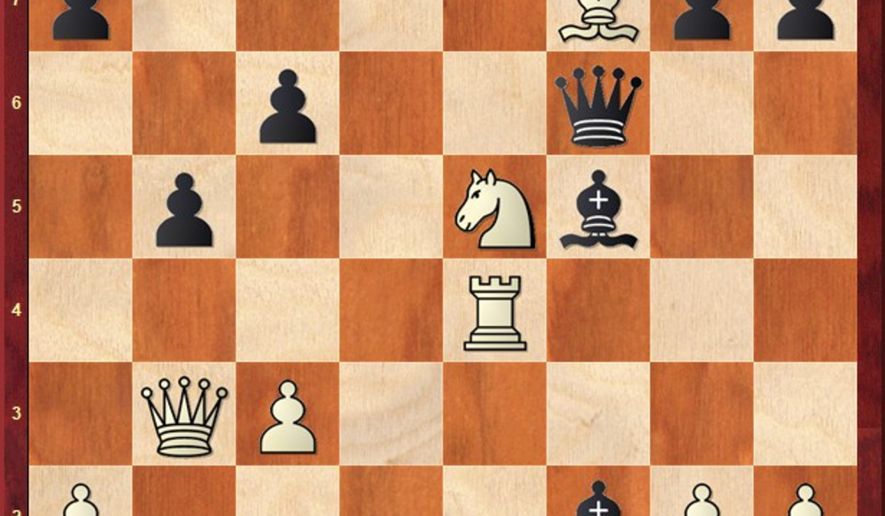
The center blasts open for good on 15. dxe4 fxe4? (Black can still defend with 15…Qe7 16. e5 Ng4 17. e6!? Bxf2+ 18. Kh1 Bxe1 19. Rxe1, with a messy position) 16. Nxe4 Nxe4 17. Rxe4 Bf5 18. Rd1! Qf6 19. Ne5! Bxf2+? (the engines say 19…g6 puts up a stingier defense) 20. Kh1 Rd8 (see diagram) 21. Nd7+!?; also good enough for the win was the straightforward 21. Rxd8+ Qxd8 22. Nxc6, but Morphy can’t resist the more inspired sacrificial route.
On 21…Bxd7 22. Rxd7! Rc8 (Rxd7?? 23. Re8 mate) 23. Bh5, Journoud is a pawn up, but his king is caught in a withering crossfire laid down by the attacking White pieces. Black gives up his queen for White’s rampaging rooks, but Morphy’s queen and bishop prove a potent final attacking force against the still-exposed Black king: 31. Bf3+ Kb6 32. h3 Rd1+ 33. Kh2, and Black resigns as his fortress cannot hold in lines such as 33…Rd6 34. a4 a6 (bxa4 35. Qb2+ Kc7 26. Qb7+, and mate in a few more moves) 35. a5+! Kxa5 (Kc7 36. Qxc5+ Kd7 37. Bg4+ Ke7 38. Qc7+ and the Black rook is lost) 36. Qxc5 Rdf6 37. Bb7 h5 38. Qa3+ Kb6 39. Qxa6+ Kc7 40. Qxb5+, with an easily won ending.
—-
Anderssen’s win in today’s second game, taken from a strong 1870 tournament he won in Baden-Baden, is perhaps even more impressive given the caliber of the opponent, longtime world champion Wilhelm Steinitz. Steinitz would earn a reputation as one of the best and most dogged defenders in the history of the game, but he comes up short against here in the face of Anderssen’s attacking prowess.
Steinitz as White actually gets much the better of the early play in this transposed King’s Gambit Declined, but the ever-aggressive Anderssen finds his way back into the game with some disruptive sacrifices: 20. b4 Bxb4! (White still is better, but now must shift from offense to defense to meet Black’s queenside push) 21. cxb4 Qxb4+ 22. Ke2 a2 23. Bd2 Qb5 (White would get the spectacular win on 23…axb1=Q? 24. Rhxb1 Qc5 25. Rxa6 h6 26. Rxc6! Qa3 [Qxc6?? 27. Ne7+] 27. Qh3 Ra8 28. Nxg7! Kxg7 29. Rxf6! Kxf6 30. Qxd7 hxg5 31. Qf5+ Kg7 32. Qxg5+ Kh7 33. Rb6 and wins) 24. Rxa2 Nc5 25. Rxa6! Qxa6 26. Bb4? (heading down the wrong path because of a tempting pin; 26. Qg3! posed a much greater threat to Black, as in lines like 26…g6 27. Ne7+ Kg7 28. Rf1 Rd6 29. Nf5+! gxf5 30. Ne6+ Kh8 31. Qg7 mate) Rb8 27. Bxc5? (27. Nh6+! gxh6 28. Qxf6 kept White’s attack alive) Rb2+ — now Anderssen has a king to target and he doesn’t miss.
The symphonic king hunt, in which every Black piece plays a part, drives the White monarch all the way to the h-file, where Anderssen has one last sacrificial trick to play: 41. Qc4 Rh4+! 42. Kg2 (Kxh4 Qh5 mate) Rxh2+! 42. Kxh2 (Kf1 Rf3+ 44. Kg1 Qxg3 mate) Qxg3+ 44. Kh1 Qh3+ 45. Kg1 Rg3+, and White finally packs it in just ahead of 46. Kf2 Rg2+ 47. Ke1 Qg3+ 48. Kf1 Qf2 mate.
Thanks again to Schroeder for a gift that will definitely keep on giving in this space for years to come.
—-
Quick notes: Uzbekistan chess is having a real moment: Just days after young Uzbek star GM Javokhir Sindarov won the FIDE World Cup knockout tournament and secured a berth in next March’s Candidates tournament, compatriot GM Nodirbek Abdusattorov scored a decisive victory in last week’s 15th XTX Markets London Classic, finishing two full points ahead of second-place finisher GM Firouzja Alireza of France. … And mark on your calendars for the landmark 50th running of the DMV’s annual Eastern Chess Classic, an eight-round Swiss to be held at the Hyatt Regency Crystal City in Arlington, Virginia, Dec. 26-29. Check out the tournament website at www.chesstour.com for more details. Hope to see you there!
(Click on the image above for a larger view of the chessboard.)
Morphy-Journoud, Paris, 1859
1. e4 e5 2. Nf3 Nc6 3. Bc4 Bc5 4. b4 d5 5. exd5 Nxb4 6. c3 Nxd5 7. Qb3 c6 8. O-O e4 9. Re1 f5 10. d3 Ngf6 11. Bg5 Qd6 12. Bxf6 Nxf6 13. Nbd2 b5 14. Bf7+ Kf8 15. dxe4 fxe4 16. Nxe4 Nxe4 17. Rxe4 Bf5 18. Rd1 Qf6 19. Ne5 Bxf2+ 20. Kh1 Rd8 21. Nd7+ Bxd7 22. Rxd7 Rc8 23. Bh5 g6 24. Ree7 Qxe7 25. Rxe7 Kxe7 26. Bg4 Rcd8 27. Qb4+ c5 28. Qe4+ Kd6 29. Qf4+ Kc6 30. Qxf2 Rhf8 31. Bf3+ Kb6 32. h3 Rd1+ 33. Kh2 Black resigns.
Steinitz-Anderssen, Baden-Baden, Germany, 1870
1. e4 e5 2. Nc3 Bc5 3. f4 d6 4. Nf3 Nf6 5. Bc4 c6 6. fxe5 dxe5 7. Qe2 Nbd7 8. d3 b5 9. Bb3 a5 10. a3 Qb6 11. Nd1 a4 12. Ba2 O-O 13. Ne3 Ba6 14. Nf5 b4 15. axb4 Qxb4+ 16. c3 Qa5 17. Ng5 Rad8 18. Qf3 Qb6 19. Bb1 a3 20. b4 Bxb4 21. cxb4 Qxb4+ 22. Ke2 a2 23. Bd2 Qb5 24. Rxa2 Nc5 25. Rxa6 Qxa6 26. Bb4 Rb8 27. Bxc5 Rb2+ 28. Ke3 Qa5 29. Rd1 Qxc5+ 30. d4 exd4+ 31. Kf4 h6 32. Nh3 Re8 33. Qd3 g5+ 34. Kf3 g4+ 35. Kg3 Rxe4 36. Qf1 Qe5+ 37. Kh4 gxh3+ 38. Kxh3 Rb3+ 39. g3 Rf4 40. Nxh6+ Kf8 41. Qc4 Rh4+ 42. Kg2 Rxh2+ 43. Kxh2 Qxg3+ 44. Kh1 Qh3+ 45. Kg1 Rg3+ White resigns.
• Got a hot tip or a cool game to share? David R. Sands can be reached at davidrsands18@gmail.com.

Please read our comment policy before commenting.