


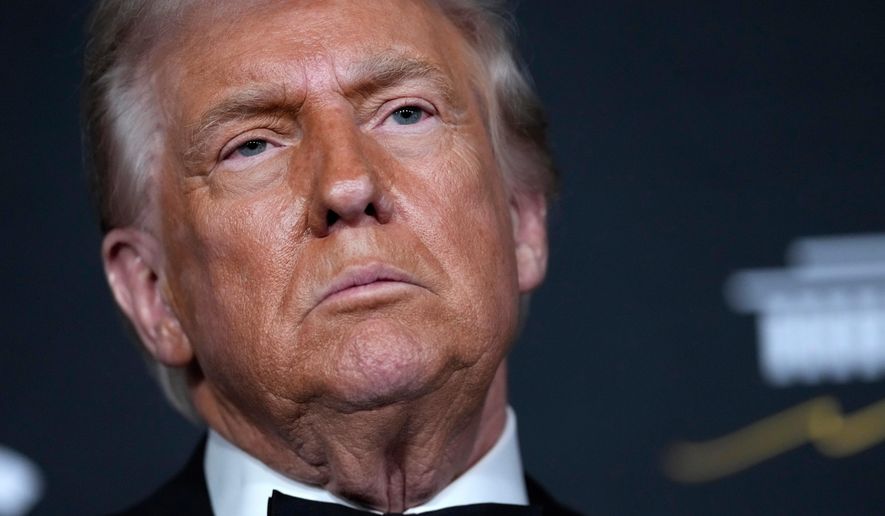

President Trump said on Monday that he will sign an executive order this week to block states from regulating artificial intelligence and establish federal guidelines that would dictate the nation’s artificial intelligence policy.
“There must be only one rulebook if we are going to lead in AI. We are beating all countries at this point in the race, but that won’t last long if we are going to have 50 states, many of them bad actors, involved in rules and the approval process,” Mr. Trump wrote on Truth Social.
“There can be no doubt about this. AI will be destroyed in its infancy! I will be doing a one rule executive order this week. You can’t expect a company to get 50 approvals every time they want to do something. That will never work,” Mr. Trump said.
The expected presidential order will establish an AI Litigation Task Force that would challenge state AI laws and preempt them with Mr. Trump’s federal policy, according to those familiar with the order.
Under the proposed order, Attorney General Pam Bondi would establish the task force, whose sole responsibility is to challenge state AI laws in court. Those challenges would be issued “on grounds that such laws unconstitutionally regulate interstate commerce, are preempted by existing Federal regulations or otherwise unlawful in the Attorney General’s judgment,” the order is expected to say.
Mr. Trump will also direct Commerce Secretary Howard Lutnick to notify states with challenged AI laws that they will be ineligible for funds under the federal Broadband Equity Access and Deployment program. The $42 billion program allocates federal technology funds to all U.S. states and territories.
Artificial intelligence is currently subject to little oversight, but is becoming increasingly omnipresent, influencing personal communications, health care and policing.
In the absence of overarching federal regulation, some states have passed laws to address the risky and potentially harmful uses of AI, such the creation of misleading deepfakes and algorithmic discrimination in hiring. Critics have raised concerns that if AI remains unchecked, tech companies could evade accountability if their products harm consumers.
Some tech executives, such as OpenAI CEO Sam Altman, have argued that leaving AI companies to navigate different and sometimes contradictory state laws harms innovation and reduces America’s competitiveness.
In July, Congress blocked an attempt by Republicans to prevent states from regulating AI. The Senate voted overwhelmingly to remove a 10-year moratorium on the enforcement of state artificial intelligence regulations from Mr. Trump’s tax, immigration and health care law known as the Big Beautiful Bill.
Earlier this summer, the Trump administration released a Silicon Valley-friendly AI action plan, which includes a stash of industry-backed recommendations, such as scaling back some AI regulations the White House says will increase competitiveness.
However, some have been critical of Mr. Trump’s plan for more lax AI regulation.
Florida Gov. Ron DeSantis, a Republican, last month blasted Mr. Trump’s AI recommendations as “federal government overreach.”
“Stripping states of jurisdiction to regulate AI is a subsidy to Big Tech and will prevent states from protecting against online censorship of political speech, predatory applications that target children, violations of intellectual property rights and data center intrusions on power/water resources,” he said.
Democratic Sen. Ed Markey of Massachusetts called out Republicans for “trying to sneak their AI regulation moratorium into the defense bill” and accused Mr. Trump of siding “with his billionaire Big Tech buddies” in an X post.
Mr. Trump last month hosted a dinner at the White House for business leaders, which included many of the leaders in the AI industry, including Elon Musk, Nvidia CEO Jensen Huang, OpenAI President Greg Bockman and White House AI and crypto czar David Sacks.
Scores of organizations, including tech safety, consumer protection and education institutions have pushed Congress to oppose the idea of blocking states from regulating their AI policy and have raised alarms about AI safety risks.
“This draft executive order isn’t about interstate commerce or American competitiveness,” said Alejandra Montoya-Boyer, vice president of The Leadership Conference’s Center for Civil Rights and Technology, in a statement. “It’s about giving the administration’s tech billionaire buddies and corporations a free pass rather than protecting the people it’s meant to serve.”
• Jeff Mordock can be reached at jmordock@washingtontimes.com.

Please read our comment policy before commenting.