


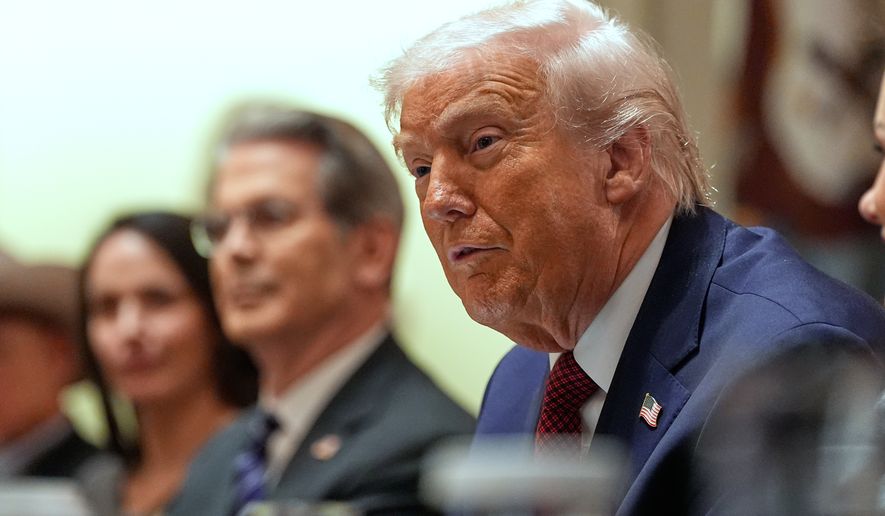

President Trump unveiled a long-awaited $12 billion bailout package Monday for farmers hurt by high prices and trade wars with China and other nations.
The package includes $11 billion in one-time payments to crop farmers under the Department of Agriculture’s newly designed Farmer Bridge Assistance program. The program helps row crop growers recover from years of trade actions by foreign governments, inflation pressures and other disruptions.
The remaining $1 billion will help farmers not covered by the bridge program.
Mr. Trump outlined the plan during a White House roundtable event with corn, cotton, sorghum, soybean, rice, cattle, wheat and potato farmers.
“This relief will provide much-needed certainty to farmers as they get this year’s harvest to market and look ahead to next year’s crops, and it will help them continue their efforts to lower food prices for American families,” Mr. Trump said.
He blamed the Biden administration for the challenges in farming communities.
“Farmers were crushed by the worst inflation in modern history and crippling restrictions on energy, water and countless other necessities for farmers, and what they did to the farmer in terms of putting the brakes on was just absolutely unacceptable,” the president said.
Mr. Trump criticized the Biden administration for causing inflation and increasing farm bankruptcies by 55%.
He claimed credit for improving trade relations, particularly with China, which he said has committed to purchasing more than $40 billion in soybeans and other agricultural products. He also mentioned Japan’s $8 billion in purchases of various U.S. farm products.
According to Agriculture Secretary Brooke Rollins, the $11 billion bridge payment will move by Feb. 28. By the end of December, every farmer that is able to apply for it “will know exactly what that number looks like,” Ms. Rollins said.
“So as you are going to your lender, as you are working to ensure and understanding what you can plant for next year, you will have that number in hand,” she said.
Treasury Secretary Scott Bessent said the direct payments to U.S. farmers will give “producers the breathing room they need to market this year’s harvest and plan for next season.”
He said Mr. Trump has lowered inflation, reduced costs for fuel and fertilizer, and eased credit, all of which are “helping farmers prepare for the next harvest.”
“President Trump scored a massive victory for America’s farmers when he secured an arrangement with President Xi at Busan to reopen China’s markets to U.S. agricultural exports, especially soybeans, sorghum and other commodities,” he said.
Mr. Bessent said under this framework, China committed to purchase at least 12 million metric tons of us soybeans this growing season, followed by a minimum of 25 million tons annually for the next three years.
Lawmakers and farmers attending the roundtable praised Mr. Trump’s efforts.
Iowa farmer Cordt Holub personally thanked Mr. Trump, saying that his two-year-old son wished the president instead of Santa Claus would visit the farm this year.
“I’m surrounded here by some of the greatest farmers in the area, and from across the country,” he said. “I want to say thank you for this bridge payment. It’s Christmas early for farmers … I was reading my little boy a story and … putting him to bed, and he said, ’Daddy, I don’t want Santa Claus to come to our house for Christmas. I want President Trump.’”
He added, “And I think, Mr. Trump, I think you brought Christmas to farmers with this bridge payment, we’ll be able to farm another year. Help us get by. It’s such an honor to be here with you.”
Mr. Trump also announced he wants to roll back regulations on farm equipment and machinery.
“It’s ridiculous, I know, because I buy a lot of that machinery for different things. We have a lot of big clubs with, you know, hundreds, thousands of acres, and I buy a lot of stuff,” the president said.
“And you buy it, it’s got so much equipment on it for the environment it doesn’t do anything except it makes the equipment much more expensive and much more complicated to work, and it’s not as good as the old days,” he said.
Mr. Trump and his team have hinted at a farmer bailout for months.
American growers are struggling because the cost of fertilizer and equipment rose during the Biden years and remained high this year, due in part to tariff costs under Mr. Trump.
Most notably, China stopped buying soybeans from U.S. growers, turning instead to South American sources.
The trade spat robbed U.S. soybean farmers of their top foreign buyer. However, China agreed to resume purchases as part of a recent trade truce.
Trump officials said they need to provide the special payments to help farmers plan for the future while they wait for the new purchases to take hold.
• Tom Howell Jr. can be reached at thowell@washingtontimes.com.
• Kerry Picket can be reached at kpicket@washingtontimes.com.

Please read our comment policy before commenting.