


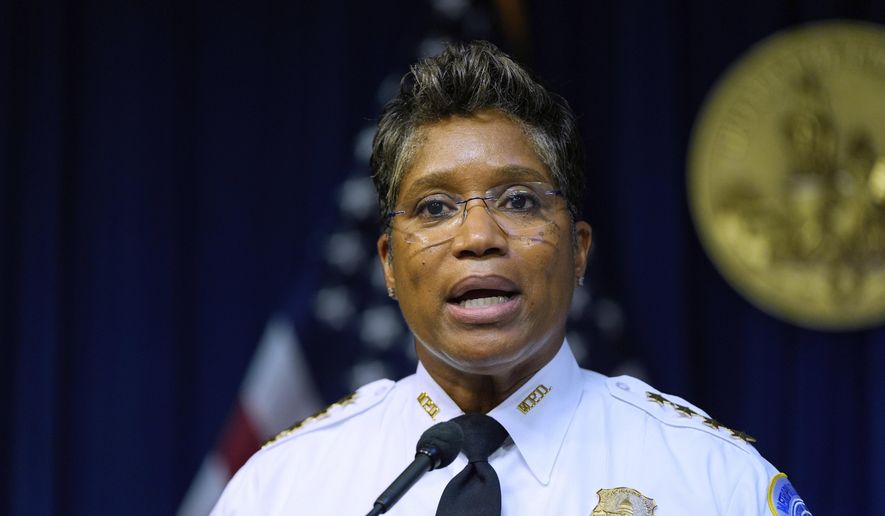

D.C. Mayor Muriel Bowser said Monday that Chief Pamela A. Smith is resigning from the Metropolitan Police Department, more than two years after leading the force through a generational crime wave that terrorized residents and prompted scrutiny from Capitol Hill.
Ms. Bowser credited Chief Smith, the first Black woman to serve as the District’s top cop, for righting the ship by bringing the murder rate to an eight-year low and dramatically reducing shootings, carjackings and muggings that plagued the nation’s capital in 2023.
“When Chief Smith stepped up to lead the Metropolitan Police Department, we had no time to waste.” Ms. Bowser said in a statement. “She came in at a very challenging time for our community, when there was significant urgency to reverse the crime trends our city was facing post pandemic.”
Chief Smith took over shortly after Congress had grilled D.C. officials about the violence and lagging prosecutions that led to the city’s highest homicide total since the 1990s.
Crime fell about 17% in early 2024, with Chief Smith directing patrols to high-crime areas and establishing juvenile curfew zones. MPD data shows the city has recorded 124 killings this year, down from the 274 documented in 2023.
Chief Smith oversaw the drop in violence despite the Metropolitan Police experiencing a 50-year low in officers on the street — a deficit that has persisted throughout her tenure.
The Democratic mayor did not say why Chief Smith is leaving the department and did not announce when her final day would be.
Chief Smith said in her own statement that she is “deeply humbled, grateful, and deeply appreciative of my time with the District of Columbia.”
“I am profoundly grateful for the opportunity to serve in this capacity as Chief of Police,” she said. “It has been an honor to lead the men and women of the Metropolitan Police Department, and I will always carry with me the pride of having served this city.”
The D.C. Police Union said it was grateful for Chief Smith’s time leading the department, but questioned the timing of her resignation since the Republican-controlled House Oversight Committee is looking into allegations of crime data manipulation to make the city appear safer than it is.
At a press conference Monday afternoon, the chief said the congressional investigation didn’t factor into her decision to step down. She said it was ultimately a personal one for herself and for her family.
Chief Smith became a national figure during President Trump’s summertime crime crackdown in the District. Mr. Trump said the federal operation was inspired in part by the accusations that MPD was fudging its crime numbers.
The 30-day emergency saw MPD officers patrolling alongside federal agents as they helped track down fugitives and conduct immigration sweeps, which broke with the city’s “sanctuary” status for illegal immigrants and piqued the ire of residents.
The month-long surge saw violent crime plummet, but Chief Smith echoed other D.C. leaders in saying the federal surge accelerated downward trends in killings and violent car thefts that had already been addressed by local initiatives.
Throughout her tenure, Chief Smith deployed more officers to high-crime areas and became a major proponent of the Real-Time Crime Center, a camera-laden surveillance hub that allows police to access live camera feeds when a crime occurs.
She further created the Robbery Suppression Units to address the scourge of carjackings and stick-ups gripping the nation’s capital, and championed the use of “drug-free” zones to clear up visible signs of disorder.
One of the chief’s most effective policies was establishing juvenile “curfew zones” to keep unruly youths out of the city’s most popular neighborhoods after dark.
Places such as Navy Yard, the Wharf and the U Street Corridor were favorite gathering points for rowdy, and sometimes criminal, teens and preteens until the zones took effect this summer.
The D.C. Council touted no juvenile arrests in any of the neighborhoods during the warmer months. But mayhem ensued in October after the emergency order establishing the zones lapsed and youths were allowed to roam around in the evening and nighttime hours.
A 17-year-old boy was charged in the mass shooting on Howard University’s campus that left five wounded, and the District made headlines when a Halloween night melee in Navy Yard saw National Guard troops trying to break up brawling juveniles.
The D.C. Council revived the zones until April at the urging of Chief Smith and Ms. Bowser.
Chief Smith has never been shy about speaking in support of MPD policies to the council. She advocated in support of legislation that rolled back some of the policing restrictions, such as broad definitions of neck restraints, that were put in place following the nationwide protests against police brutality in 2020.
The chief came to the Metropolitan Police in 2022 to serve as the department’s chief equity officer, a short time after she finished her year-long stint as the U.S. Park Police’s top cop.
Chief Smith joined the federal agency in 1998, spending time working in drug enforcement in San Francisco and canine and explosive ordinance in New York City.
She eventually became a firearms and driving instructor and gradually rose through the ranks of the Park Police before being named the department’s first Black woman to serve as chief.
• Matt Delaney can be reached at mdelaney@washingtontimes.com.

Please read our comment policy before commenting.