



Republicans never could unite around a health care plan to replace Obamacare, and now they are struggling to coalesce around short- and long-term fixes as Congress faces a year-end cliff.
For roughly 22 million Americans who purchase health insurance on the Obamacare exchanges, out-of-pocket premium costs are expected to more than double, on average, next year if enhanced Affordable Care Act subsidies expire as scheduled Dec. 31.
Most Republicans do not support extending the enhanced subsidies, but the party is having trouble finding an alternative around which they can unite.
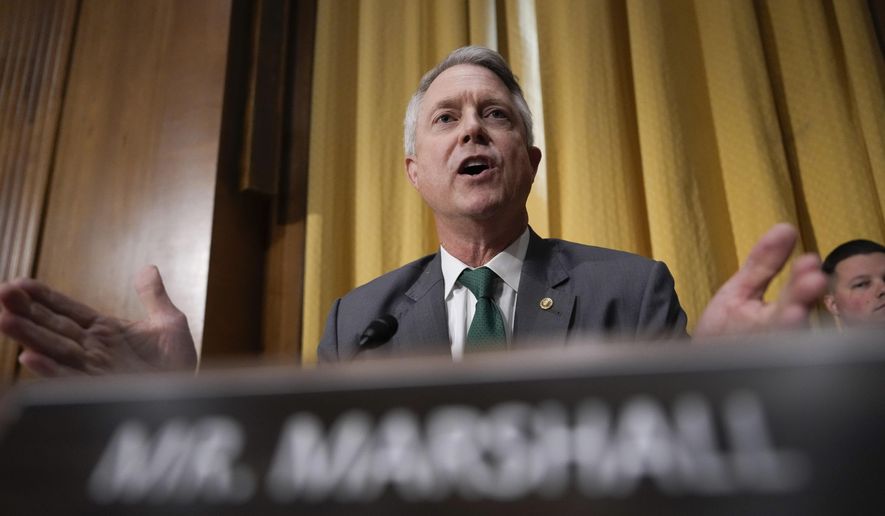
“It’s a $5 trillion-a-year industry, there’s a lot at stake,” said Sen. Roger Marshall, Kansas Republican. “Obamacare is so thick from the regulatory side, it’s really hard to unwind it.”
House Speaker Mike Johnson, Louisiana Republican, said his conference has been working for months to “put together the component pieces” and hopes to roll out a proposal midweek.
“Republicans are going to deliver, and it’s only our party that is going to bring down premiums, increase access to care and quality of care,” the speaker said Friday on Fox Business. “Democrats, all they do is break the systems and then subsidize the broken systems.”
SEE ALSO: Senate Republicans circulate health care proposals for averting year-end subsidy cliff
Republicans have said they want to move away from Obamacare subsidies because sending advanced tax credits directly to insurance companies does not incentivize them to lower premiums.
Some Republicans are skeptical.
“The insurance companies love Obamacare, and the insurance companies are one of the biggest donors to Republicans and Democrats,” said Rep. Thomas Massie, Kentucky Republican. “Most of the people up here have no interest in actually fixing it because they’re making too much money on not fixing it campaignwise.”
Rep. Jodey Arrington, Texas Republican, also cited “the political pressure of those who are in competitive districts.”
Vulnerable Republican incumbents “know that Democrats will not tell the truth in trying to tie health care affordability and the [enhanced premium tax credits] around their neck,” he said.
It’s these vulnerable incumbents who are working with Democrats to push a short-term extension of the enhanced subsidies.
“I think that there is a strong majority that exists for doing something to stave off the worst outcomes here,” said Rep. Kevin Kiley, California Republican.
Anyone looking for Obamacare coverage that begins Jan. 1 needs to enroll by Dec. 15, but there’s virtually zero chance Congress will act by then.
The only guaranteed vote is on Senate Democrats’ plan to extend the enhanced subsidies for three years. Republicans agreed to give them a vote on a bill of their choosing in a deal last month to end the 43-day government shutdown.
The base ACA subsidies do not expire. Democrats are proposing to renew their party’s pandemic expansion that temporarily extended the benefits to families earning more than 400% of the federal poverty level and made them more generous across the board.
The vote on Democrats’ plan is scheduled for Thursday.
Senate Republicans are debating whether to put up their own counterproposal for a vote as they struggle to unite around a single one. At least five plans are circulating in the Republican conference.
“We have too many good ideas,” quipped Sen. John Cornyn, Texas Republican.
Here are some of the proposals congressional Republicans are discussing:
Health savings accounts
One of the most popular Republican ideas is redirecting government aid to tax-exempt health savings accounts that will give consumers more control over how the money is spent.
HSA dollars cannot currently be used to pay premiums. Some Republican proposals would change that, including those from Sens. Rick Scott of Florida and Rand Paul of Kentucky.
Other HSA proposals, such as the Health Care Freedom for Patients Act by Republican Sens. Mike Crapo of Idaho and Bill Cassidy of Louisiana, would keep the current law limitations as an incentive for consumers to enroll in lower-premium, high-deductible Obamacare plans.
The bill from Mr. Crapo and Mr. Cassidy, who chair the two Senate committees with jurisdiction over health care, would have the government deposit money into HSAs for people who enroll in Obamacare bronze or catastrophic plans in 2026 and 2027. The annual amount would be $1,000 for individuals ages 18 to 49 and $1,500 for individuals ages 50 to 64.
Price transparency
Mr. Marshall and Mr. Scott also have included price transparency in their proposals.
Mr. Marshall’s bipartisan Patients Deserve Price Tags Act requires health care providers to publish the costs of their services, including cash prices for patients who want to pay out of pocket, in addition to rates providers have negotiated with insurers.
“If you give patients price tags, we put some money in their health care savings account, then we’re going to drive down the cost of health care for everybody,” Mr. Marshall said.
Association health plans
President Trump posted on social media a screenshot of a text message Mr. Paul sent him suggesting they partner on legislation to codify his first-term executive order on association health plans that was overturned in court.
The proposal would allow membership-based entities such as Amazon, Costco credit unions, churches and associations to provide new coverage options by negotiating with insurers for lower group rates.
Mr. Paul told The Washington Times that he spoke with the president and “he was very favorable and very open to the idea.”
Several House Republicans have also floated this as an option worth considering.
Cost-sharing reductions
Republicans tried to include a provision in their One Big Beautiful Bill Act this summer to provide funding for cost-sharing reductions that were authorized in the ACA to contribute aid for low-income enrollees, along with the premium tax credits.
That effort failed because of a ruling from the Senate parliamentarian that the provision did not comply with the rules for the budget reconciliation process that Republicans were using. They now want to include cost-sharing reduction funding in their developing health care plan.
The cost-sharing reductions, or CSRs, helped lower deductibles for families earning 100% to 250% of the poverty level who purchased silver-level Obamacare plans.
A federal judge ruled in 2016 that the government could not fund direct CSR payments without an explicit congressional appropriation. The ruling was stayed upon appeal, but the Trump administration chose to end the CSR payments in 2017 as Republicans worked to repeal and replace the ACA. The effort ultimately failed.
To compensate for the loss of the CSR payments, insurers inflated premium prices for silver plans. Republicans argue that funding CSRs will reverse the “silver loading” and lower premium costs for those plans.
The Crapo-Cassidy plan and Mr. Marshall’s proposal would both fund CSRs.
Temporary extension of subsidies
Despite all the other ideas in the mix, a minority of Republicans still want to temporarily extend the enhanced Obamacare subsidies for a year or two to prevent an immediate affordability crisis.
“I hate the ACA, but we have to use it right now as a tool to make sure people are held harmless,” said Rep. Jefferson Van Drew, New Jersey Republican. He said he had spoken with Mr. Trump and believes the president would be “amenable to a commonsense plan that created a bridge for now.”
Mr. Van Drew was part of a group of 15 Republicans and 20 Democrats who announced a health care framework Thursday. It calls for a one-year extension of the enhanced subsidies with some changes to protect against fraud.
The plan, led by Reps. Josh Gottheimer, New Jersey Democrat, and Jen Kiggans, Virginia Republican, would impose an income cap that phases out the subsidies at 600% to 1,000% of the federal poverty level. That means the full benefit would go only to individuals earning less than $93,900 and families of four earning less than $192,900.
If the enhanced subsidies expire, the income cap will revert to 400% of the poverty level: $62,600 for an individual or $128,600 for a family of four.
Rep. Brian Fitzpatrick, Pennsylvania Republican, plans to introduce a bipartisan bill that would extend the enhanced subsidies for two years with an income cap at 700% of the poverty level: $109,550 for an individual and $225,050 for a family of four.
His bill would impose a $5 minimum monthly premium, eliminating the $0 premium for the lowest-income households, which has led to increased fraud and brokers enrolling people on plans without their knowledge. It would also include a health savings account option.
Neither of these bipartisan House proposals includes Hyde Amendment language to prevent the government subsidies from being used to pay for health insurance plans that cover abortion. That has been a key demand for most Republicans.
Mr. Marshall proposes Hyde language in his plan to extend the enhanced subsidies for a year with an income cap at 700% of the poverty level, an ID verification requirement and minimum monthly premium payments of $10 to $40. Starting in 2027, his plan redirects the money that would be spent on the enhanced subsidies into HSA-style accounts, gradually reducing the amount until it ends in 2032.
Republican Sens. Bernie Moreno of Ohio and Susan M. Collins of Maine proposed a two-year extension of the enhanced subsidies that phase out the benefits for higher-income earners and end them altogether once household income hits $200,000. The proposal includes a minimum monthly premium of $25.
Crack down on pharmacy benefit managers
Mr. Fitzpatrick is including a bipartisan bill to crack down on pharmacy benefit managers, the intermediaries between drug companies and pharmacies that lawmakers blame for driving up prices, as an offset for his legislation to extend the enhanced subsidies.
That measure is also included in the Gottheimer-Kiggans group’s framework. Mr. Johnson has spoken about “PBM reform” as a component that is likely to end up in the broader House Republican plan.
• Lindsey McPherson can be reached at lmcpherson@washingtontimes.com.

Please read our comment policy before commenting.