


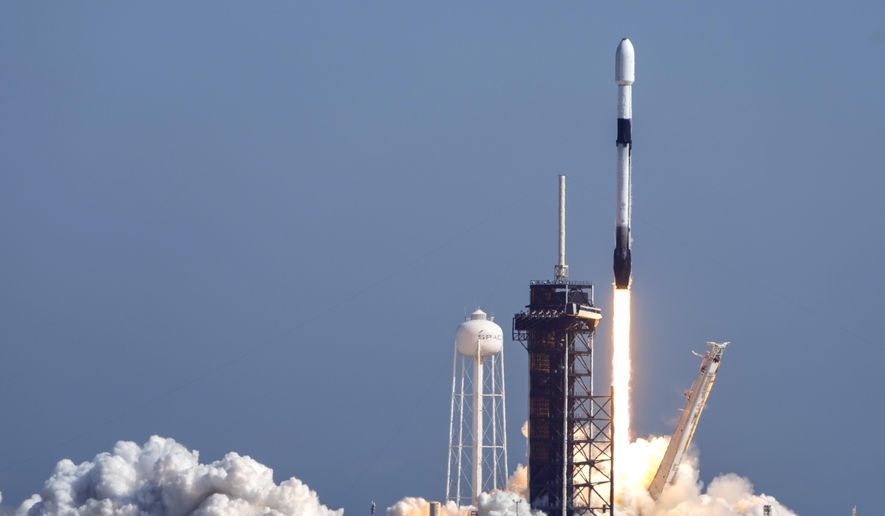

This scenario seems highly likely in a major 21st-century conflict: An adversary destroys some of the commercial space satellites on which the U.S. military relies.
Will the U.S. government pick up the bill to replace those satellites, given their vital roles in national security? Will each company with such assets in orbit be treated the same by an across-the-board federal policy or a new law? Or will individual firms negotiate with the Pentagon their own terms of financial protection and wartime reimbursement, depending on how badly the government needs the specific capability that only they can provide?
Those questions are a priority right now inside the Defense Department and in the C-suites of leading American defense companies. In many ways, they represent a uniquely American problem. The thin lines between government and industry in communist China, for example, erase any uncertainty about who is ultimately responsible for defense-related assets in space.
But for the U.S., it’s a much more nuanced proposition. And it’s on track to become infinitely more complicated in the years to come, when the U.S. Space Force by its own estimation could rely heavily on privately owned and operated satellites for everything from command and control to surveillance and reconnaissance and from navigation to communications.
“It’s obviously a question that’s been under debate a lot. It’s a slippery slope,” Air Force Secretary Troy E. Meink told The Washington Times recently.
Mr. Meink said similar questions are at play in other arenas, such as undersea cables that transmit data across the world and are typically owned by leading telecommunications companies, big tech firms or other private actors.
Uncertainty about targets
But nowhere will the questions be more prevalent in space, given both the rapidly expanding importance of the domain to virtually everything else that the U.S. military does and the relatively small number of companies capable of doing the complex and expensive work to launch, operate and maintain cutting-edge satellites.
“The challenge has always been trying to go in and specifically underwrite or front any commercial services. It kind of just opens up that can of worms,” Mr. Meink said during a media roundtable at the recent Spacepower 2025 conference in Orlando, Florida.
“Do you have to do that for every commercial service the government uses? That’s untenable at some point,” the secretary said in response to questions from The Times. “But that doesn’t mean there’s not something that should be done and something that can be done. But that’s a very tricky, kind of policy-infused … question that we have to work our way through.”
For war planners, one of the most difficult aspects is figuring out exactly what could become a target, as analysts say that a wide swath of space-related infrastructure could be viewed as de facto pieces of the American war machine, especially by an enemy.
“In a future conflict, other U.S. space operators may find themselves in an adversary’s crosshairs because of the possibility that they might provide service to the U.S. government, even if they were not currently doing so,” Clayton Swope, deputy director of the Aerospace Security Project at the Center for Strategic and International Studies, wrote in a recent in-depth analysis of how the U.S. government can protect commercial satellites.
The threats to those private satellites are no longer theoretical.
Russia is believed to be racing ahead with a program to field nuclear-armed anti-satellite weapons, which could use a nuclear blast in space to destroy satellites.
China has invested heavily in building space weapons that can destroy or disrupt satellites that would incapacitate U.S. communications, intelligence, missile warning and undermine the military’s ability to conduct joint operations and project power around the world.
Writing a space rulebook
In its 2024 Commercial Space Integration Strategy, the Space Force identified 13 mission areas — command and control, communications, intelligence, missile warning, space domain awareness, and others — in which the military “will seek to integrate commercial space solutions” when it makes sense for the mission and can be done while also maintaining direct government responsibility for some sensitive national security functions.
Current examples would be the Space Force’s buying of imagery from commercial satellites. Moving forward, it could involve privately owned satellites providing crucial tracking data and other information as part of the interwoven architecture comprising the Golden Dome missile shield.
That dynamic is different from most traditional warfighting assets, like artillery or fighter jets, in which the military buys the asset from a private manufacturer and is therefore responsible, financially and otherwise, for whatever happens to it.
There are well over 10,000 satellites in orbit right now. The exact number is tough to track because of how rapidly new satellites are being launched.
Tech billionaire Elon Musk’s company SpaceX owns the overwhelming majority of those satellites, many as part of its Starlink constellations that have already proven their worth in modern-day conflicts.
Ukraine, for example, has relied heavily on Starlink for internet service in war zones where internet otherwise would’ve been unavailable.
SpaceX did not respond to a request for comment from The Times for this article.
The company, along with several other key actors in the domain, would appear to have a great deal of leverage in future dealings with the government. They could, in theory, demand 100% taxpayer-backed financial reimbursement for any damage to their assets in orbit.
Right now, with no clear government policy dictating who is financially responsible for critical private assets in space, some insiders say such questions could become a key component of contract negotiations.
“I suspect what’s going to happen is, the Space Force … as they prioritize those critical capabilities they need, they could make some concessions based on how they need that critical capability,” said Bill Woolf, a retired Air Force officer and now the president and CEO of the Space Force Association, a nonprofit organization that advocates for the Space Force.
“That’s going to be the interesting conversation going forward, trying to figure out how do we predict this?” Mr. Woolf told the Threat Status weekly podcast on an upcoming episode. “And once we define what that capability is, what are the concessions we’ll make as a service? What will the Space Force concede and say, ’Just give us that today because we need that innovation tomorrow.’”
Evaluating the threat
Analysts say there are historical examples of military protection in one form or another for private assets, whether it be the Navy guarding commercial vessels at sea or government agencies helping to protect key pieces of privately owned infrastructure from cyberattacks.
Private companies also routinely take out insurance policies specifically tailored to assets that are either in a war zone or could become targets in a conflict.
Space-centric versions of such insurance policies are still an emerging market. In its commercial integration document, the Space Force acknowledged as much.
“U.S. government-provided insurance is statutorily available for the air and maritime domains but is not yet available for the space domain,” the document reads. “The department will evaluate gaps in protection from commercial insurance providers, the conditions under which U.S. government-provided insurance would be needed for the space domain, and whether those conditions have been met.”
The Space Force and other arms of the government already share information with private companies about potential threats to their assets in orbit. Some of those companies say the work of National Reconnaissance Office Director Chris Scolese and Space Force Chief of Space Operations Gen. B. Chance Saltzman is helping them protect their satellites.
“We greatly value the U.S. government’s partnership and information sharing, which help us protect our satellites and the services they provide. The government has institutionalized practices for sharing threat information with commercial satellite operators and we receive regular updates on adversary capabilities that help inform our operations and protect our systems,” said Dan Smoot, CEO of Vantor, a leading spatial intelligence company.
“Under the leadership of NRO Director Scolese and U.S. Space Force Chief of Space Operations Gen. Saltzman, information sharing with commercial satellite providers has increased significantly in recent years,” Mr. Smoot told The Times. “We view this collaboration as appropriate and increasingly important as threats from potential adversaries like Russia and China continue to evolve.”
From a military planning perspective, Gen. Saltzman said his goal is to make it exceedingly difficult for an enemy to cripple U.S. capabilities through an attack in space.
“If we’re talking about satellite communications, if you’re talking about thousands of satellites providing the communications, what’s the adversary going to attack?” Gen. Saltzman said during the Spacepower conference media roundtable, in response to questions from The Times.
“Are they going to shoot down one of those, which has no effect?” he said. “We think about, how do we build a resilient architecture so we can help commercial industry not be so vulnerable” to attacks.
• Ben Wolfgang can be reached at bwolfgang@washingtontimes.com.

Please read our comment policy before commenting.