



For such a logical game, chess can be quite contrary when it wants to be.
The Christmas-to-New Year’s Day lull, for instance, when much of the world slows down to focus on presents and parties, is paradoxically one of the busiest weeks on the global chess calendar, with players taking advantage of school and work breaks to clash in year-end tournaments near and far.
As we write, we’re still awaiting the winners of the huge National Open in Las Vegas and Washington area’s own traditional Eastern Open, where Texas GM Mikhail Antipov is clinging to a half-point lead in the Premier section with two rounds to go at the Hyatt Regency Crystal City in Arlington, Virginia.
We can report that former world champ Magnus Carlsen, still the world’s clear No. 1 despite voluntarily relinquishing his crown in 2024, has notched his sixth world rapid championship, besting an elite field to finish a point clear of Russian GM Vladislav Artemiev. Russian GM Aleksandra Goryachkina claimed her first women’s world rapid crown by winning a playoff over Chinese GM Jiner Zhu.
We’ll have a lot of the year-end action in upcoming columns, but for now let’s take a look back at some of the great players we lost in the fast-closing year. Among them were three stalwarts of the European chess scene who enjoyed long and accomplished careers: Germany’s Robert Huebner, Czech-born Vlastimil Hort and Iceland’s Fridrik Olafsson.
Two of the biggest losses in 2025 were players who experienced both triumph and hardship in their careers.
The first line of the obituaries for Boris Spassky after his death in February recounted his loss to Bobby Fischer in their epic Reykjavik, Iceland, match in 1972, and noted the Russian great’s struggles with his home country in the match’s aftermath.
But the 10th world champion, who only got to enjoy his throne for three short years, was never defined by those chaotic and stressful months in Iceland. In Spassky’s later years — many spent in self-imposed exile in France — there was a newfound appreciation for his greatness at the chessboard and his harmonious, flexible style of play.
He was at the height of his powers in his march to the world title in the late 1960s. Before defeating Armenian great Tigran Petrosian in 1969 to capture the crown, Spassky easily dispatched another Soviet rival, GM Efim Geller, in their Candidates match. In the match’s sixth game, Spassky holds his fire in a Closed Sicilian, then launches a lightning attack just as his queenside flank is collapsing.
White’s 13. Ne2 Bb7 14. b3! is a tiny psychological shot, varying from an earlier game in the match and forcing Geller to make an extra effort to break through on the wing.
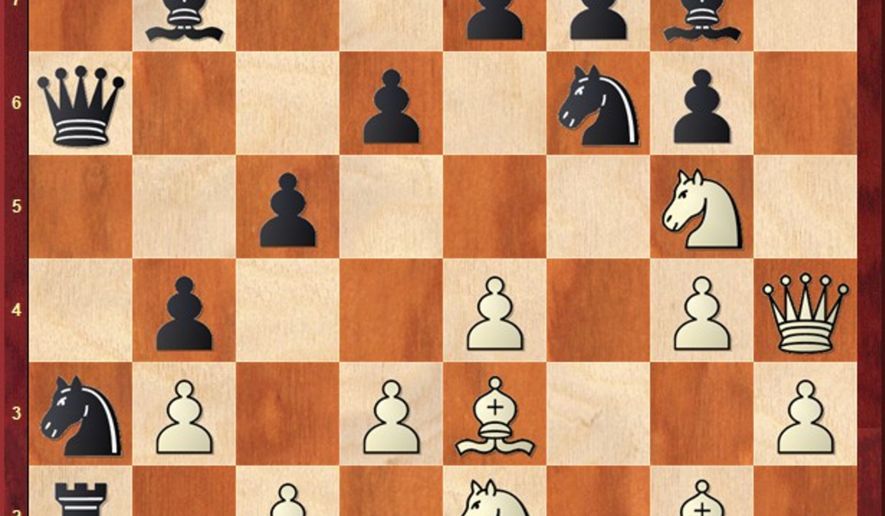
Black gets caught offside on 18. Qf2 (and not 18. Qh4? Rxc2! 19. Rxc2 Qxd3, winning) Na7?! (Black’s pieces are going the wrong way; Russian GM Alexey Bezgodov, in his 2023 anthology of Spassky’s best games, notes that possible here was 18…e6!? 19. f5 exf5 20. g5 Nh5 21. exf5 Bb2 22. Rce1 Ne7 23. Nh4 Bxg2 24. Qxg2 Qa8, and Black is holding his own) 19. f5 Nb5 20. fxg6 hxg6 21. Ng5! Na3? (sticking with the plan, but a tougher defense was 21…Nh7 22. Nxh7 Kxh7 23. Bg5 f6 24. Be3 e5, though White remains better) 22. Qh4 (threatening to take on f6 and then mate on h7) Rc8 (see diagram) — Geller clears an escape route for this king, but it is already too late.
Spassky now lands a series of hammer blows to crash through the enemy’s defensive fortress: 23. Rxf6! exf6 24. Qh7+ Kf8 25. Nxf7!!, the obligatory second punch that sends the opponent to the canvas.
Black’s king gets no relief in the finale: 25…Rxc2 (there’s no relief in lines such as 25…Kxf7 26. Bh6 Rg8 27. Nf4 Rxc2 28. Rf1! Ke7 29. Bxg7 Rxg7 30. Qxg7+ Ke8 31. Nd5! Bxd5 32. Rxf6 Rc1+ 33. Kh2 Nb5 34. Rf8 mate) 26. Bh6! Rxc1+ (Rxe2 27. Qxg7+ Ke8 28. Ng5 fxg5 29. Rf1 and wins) 27. Nxc1 Kxf7 28. Qxg7+ Ke8 29. g5 f5 30. Qxg6+ Kd7 31. Qf7+ Kc6 32. exf5+, and Geller resigned since the White’s kingside pawns decide the game after the simplifying line 32…Kb6 33. Qxb7+ Qxb7 34. Bxb7 Kxb7 35. f6 Rg8 36. f7 Rh8 37. f8=Q Rxf8 38. Bxf8.
—-
Closer to home, we still mourn the loss of young American GM Daniel Naroditsky, who found fame and success as a chess prodigy, as an author and online commentator, and as a genial and popular pioneer of chess streaming. Naroditsky loved the game but was also clearly unmoored by vague and unsubstantiated accusations of online cheating when he was found dead under still-unclear circumstances at his North Carolina home in October, just weeks shy of his 30th birthday.
We looked at a game from early in Naroditsky’s career in an earlier column, but Bulgarian former world champ Veselin Topalov has just analyzed what is widely regarded as “Danya’s” finest game for Chess Life magazine, and it’s worth recounting here.
Employing the Jobava London System (3. Bf4) against strong Cuban GM Isan Reynaldo Ortiz Suarez at the 2019 U.S. Chess Masters, Naroditsky as White claims a clear advantage after Black’s 9. Bg3 c5?! 10. c4! unwisely opens up the position while Black is still developing his army.
As in Spassky-Geller, White here translates a positional advantage into a winning attack with a well-timed exchange sacrifice: 21. c5 g5 (Black can only mark time as White steadily improves his position, and his weak e6-pawn now proves an irresistible target) 22. Rxe6! Bxe6 23. Rxe6 a6 24. Bb1! (Rd6 was also strong, but Naroditsky plans a direct assault on the Black king along the undefended light squares) Rc6 25. Rxe7!!, going Spassky one better with a second exchange sac that will leave White’s queen, knights and dominating pawn center in total control of the board.
Ortiz Suarez makes a desperate play for breathing space with 30. d6 Bxd6 (giving back a piece but otherwise he faces death by suffocation) 31. cxd6 Rc1+ 32. Kh2 Rxb1 33. Qxb1 Qxd6. Black has gotten a rook back for two minor pieces, but now White’s knight pair run riot around the cornered black king: 37. Nh6 Rf8 38. Ndf5 Qe6 39. Qf3! (hitting the pawns on b7 and h5, neither of which Black can afford to lose) Qe8 40. Qxb7 Qg6 41. Qe7!, and Black resigns as he is lost in lines such as 41…Rb8 42. Nf7+ Kg8 (Kh7 43. Ne5+ Kh8 44. Nxg6+ Kg8 45. Qg7 mate) 43. Qe6 Kh7 44. Qd7 Rg8 45. Nxg5+ Kh8 46. Nf7+ Kh7 47. Ne5+ Rg7 48. Nxg6 Rxd7 49. Nf8+ and wins.
(Click on the image above for a larger view of the chessboard.)
Spassky-Geller, Candidates Quarterfinal Match, Sukhumi, USSR, April 1968
1.e4 c5 2.Nc3 d6 3.g3 Nc6 4.Bg2 g6 5.d3 Bg7 6.f4 Nf6 7.Nf3 O-O 8.O-O Rb8 9.h3 b5 10.a3 a5 11.Be3 b4 12.axb4 axb4 13.Ne2 Bb7 14.b3 Ra8 15.Rc1 Ra2 16.g4 Qa8 17.Qe1 Qa6 18.Qf2 Na7 19.f5 Nb5 20.fxg6 hxg6 21.Ng5 Na3 22.Qh4 Rc8 23.Rxf6 exf6 24.Qh7+ Kf8 25.Nxf7 Rxc2 26.Bh6 Rxc1+ 27.Nxc1 Kxf7 28.Qxg7+ Ke8 29.g5 f5 30.Qxg6+ Kd7 31.Qf7+ Kc6 32.exf5+ Black resigns.
Naroditsky-Ortiz Suarez, U.S. Chess Masters, Greensboro, North Carolina, August 2024
1. d4 d5 2. Nc3 Nf6 3. Bf4 e6 4. Nb5 Na6 5. e3 Be7 6. Nf3 O-O 7. a3 Nh5 8. Be5 f6 9. Bg3 c5 10. c4 g6 11. Bd3 cxd4 12. exd4 Nb8 13. O-O Nc6 14. Re1 Nxg3 15. hxg3 Rf7 16. Nc3 Bf8 17. b4 Ne7 18. Qb3 Kg7 19. Re2 Bd7 20. Rae1 Rc8 21. c5 g5 22. Rxe6 Bxe6 23. Rxe6 a6 24. Bb1 Rc6 25. Rxe7 Qxe7 26. Nxd5 Qe6 27. Qd3 Kh8 28. Ne3 Rc8 29. d5 Qd7 30. d6 Bxd6 31. cxd6 Rc1+ 32. Kh2 Rxb1 33. Qxb1 Qxd6 34. Nf5 Qe6 35. Qd3 h5 36. N3d4 Qe5 37. Nh6 Rf8 38. Ndf5 Qe6 39. Qf3 Qe8 40. Qxb7 Qg6 41. Qe7 Black resigns.
• Got a hot tip or a cool game to share? David R. Sands can be reached at davidrsands18@gmail.com.

Please read our comment policy before commenting.