



A version of this story appeared in the daily Threat Status newsletter from The Washington Times. Click here to receive Threat Status delivered directly to your inbox each weekday.
OPINION:
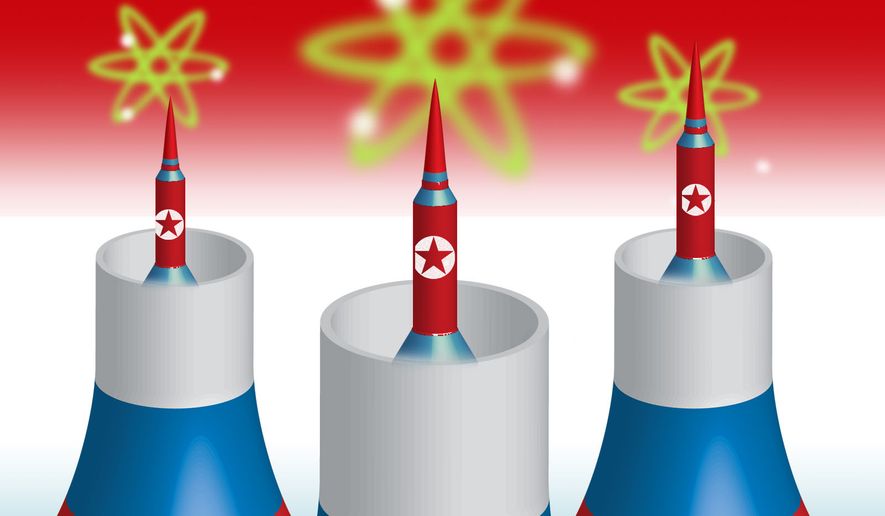
On Christmas Day, North Korea’s Central News Agency announced that leader Kim Jong-un had inspected the construction of an 8,700-ton-class, nuclear-propelled submarine, a crucial step in the modernization and nuclear armament of North Korea’s navy.
The country said it plans to arm the vessel with nuclear weapons — a “strategic nuclear attack submarine.”
Two days later, on Dec. 27, the agency said Mr. Kim sent New Year’s greetings to Russian President Vladimir Putin, saying North Korea and Russia share “blood, life and death, and are in the same trench” in the war with Ukraine. In April, Mr. Kim confirmed that North Korea had sent troops to the Kursk region of Russia to assist its fighters against Ukraine and that it had suffered casualties. The troops were in addition to the artillery shells, ballistic missiles and long-range rockets North Korea was providing to Russia for its war of aggression with Ukraine.
On June 18, 2024, during Mr. Putin’s visit to North Korea, he and Mr. Kim signed the Treaty on Comprehensive Strategic Partnership, which included a mutual defense clause committing both countries to provide immediate military aid if either is attacked. In the fall of 2024, North Korea reportedly sent an initial 10,000 troops to the Kursk region to wage war against Ukraine, Mr. Kim confirmed in April.
Russia’s mutual defense treaty with North Korea is a major setback for the U.S. and our European allies and partners. Indeed, it was the U.S. and the European Union — with South Korea, Japan and Australia — that were building two light water reactors in Kumho, North Korea, in exchange for North Korea’s 1994 agreement to dismantle its indigenous nuclear facilities.
This cooperation ended in 2006, with North Korea building more nuclear weapons and ballistic missiles. In 2024, it signed a mutual defense treaty with Russia and then militarily assisted Russia against Ukraine, to which it had given security assurances.
The concern is that Russia will not stop with its war against Ukraine. An emboldened Mr. Putin may attack other European nations in his attempt to reestablish the Soviet Union, the collapse of which Mr. Putin has lamented signaled the demise of “historical Russia.”
Russia now has a nuclear North Korea, a country with which the U.S. and Europe were working, to assist it with any potential military adventurism in Europe, in addition to its war in Ukraine.
The irony is that North Korea wanted (and still wants) a normal relationship with the U.S. Negotiations with North Korea formally ended in 2009 when it pulled out of the six-party talks. Since then, the nation has been on a race to build more nuclear weapons and ballistic missiles while the U.S. has pursued a policy of “strategic patience,” an attempt to contain and deter the country while sanctioning it for repeated violations of United Nations Security Council resolutions.
Strategic patience failed because we thought North Korea would acquiesce and voluntarily return to credible denuclearization talks. It didn’t. It ignored the U.S. and built more nuclear weapons and missiles while continuing illicit activities: cryptocurrency theft worth billions of dollars and counterfeiting U.S. currency, pharmaceuticals and cigarettes, to name just a few, all created to generate cash for nuclear and missile programs.
Indeed, North Korea has formidable such programs. According to South Korea’s Institute for Defense Analysis, North Korea has up to 150 nuclear weapons. By 2030, it will have 200. Its 2017 nuclear test was assessed as a successful two-stage thermonuclear device.
North Korea’s progress with its intercontinental ballistic missiles has been equally impressive. At the recent 80th Workers’ Party celebration, it displayed the Hwasong-20, a solid-fuel, road-mobile ICBM with a likely MIRV (multiple independently targetable reentry vehicles) capability. This and the Hwasong-15, -17 and -18 can all strike the continental U.S. and Europe.
In addition to ICBMs, North Korea has a formidable intermediate and regional missile program that can strike South Korea and Japan, with low-yield nuclear weapons for regional combat use. The country’s nuclear doctrine recently was changed to permit a nuclear-first use policy if there’s an imminent threat to leadership.
North Korea is expected to hold its ninth party congress in early 2026, when Mr. Kim will again declare that it is exponentially increasing its nuclear and ballistic missile programs while reinforcing its close, allied relationship with the Russian Federation.
President Trump has said he is prepared to meet with Mr. Kim to continue the dialogue they had in 2018 in Singapore and in 2019 in Hanoi. Continuing this conversation, with the goal of offering North Korea better (and potentially normal) relations with the U.S., is something we should pursue.
• The author is a former associate director of national intelligence. All statements of fact, opinion or analysis expressed are those of the author and do not reflect the official positions or views of the U.S. government. Nothing in the contents should be construed as asserting or implying U.S. government authentication of information or endorsement of the author’s views.

Please read our comment policy before commenting.