


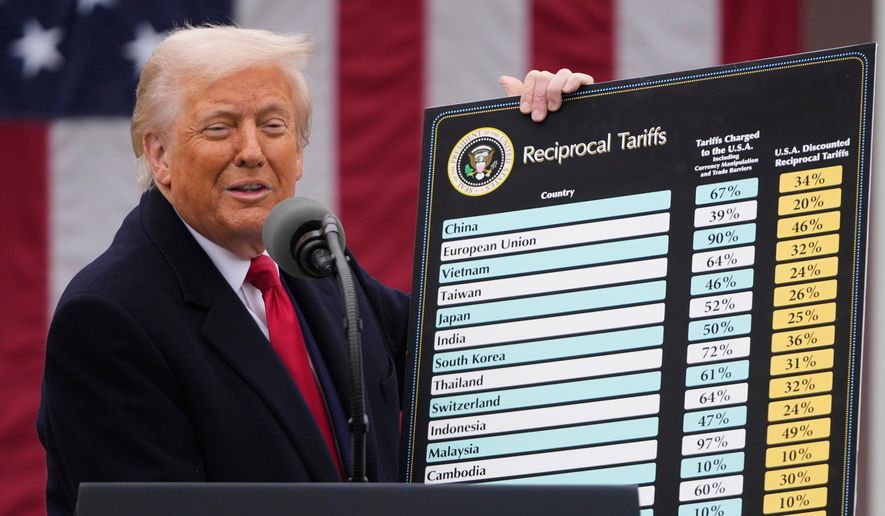

A Supreme Court ruling canceling President Trump’s ability to impose tariffs on other nations unilaterally would open the floodgates to refunds and economic upheaval.
But it would have another, less-obvious impact: depriving the president of the diplomatic leverage he prizes.
The president said his threat to impose duties on Indian and Pakistani goods got the nuclear-armed nations to stop attacking each other in May.
Mr. Trump recounted how he told both sides they could “go at it, but I’m putting a 350% tariff on each country. No more trade with the United States.”
Mr. Trump this year threatened new sanctions on Russia to try and stop its invasion of Ukraine, characterizing them as crushing tariffs, and slapped 50% levies on India to get New Delhi to stop buying Russian oil.
The president said his tariff threat forced China to take the fentanyl problem more seriously.
He also tried to punish Brazil for the prosecution of its former president, Jair Bolsonaro, by imposing a 50% tariff on Brazilian goods.
The justices could take away Mr. Trump’s most direct lever of persuasion if they conclude that he usurped Congress’ taxing powers by imposing tariffs under the International Emergency Economic Powers Act of 1977.
Mr. Trump has other tariff authorities at his disposal. But they take more time and hinge on national security risks or key sectors, rather than tit-for-tat trade with individual nations.
Mr. Trump said alternative tariff mechanisms are “slow and cumbersome.”
“We have other methods, but they’re not as powerful, not as quick. Some of the wars that I solved wouldn’t have been solved using those methods,” Mr. Trump said at a December event with farmers. “The decision of the Supreme Court is a very important thing.”
Nearly one-third of U.S. imports are subject to tariffs imposed by Mr. Trump under IEEPA.
But small businesses and blue states sued Mr. Trump, saying he unlawfully imposed significant cost burdens when he invoked IEEPA for nation-by-nation tariffs. The companies said they must cover the costs of the levies when importing foreign goods into the U.S.
Key justices seemed skeptical of Mr. Trump’s position during oral arguments in early November. They focused on the revenue-raising nature of tariffs and how Congress typically sets taxes, not the executive branch.
The president has described the plaintiffs as “dark and sinister forces.”
Mr. Trump, writing on social media, said that if other countries thought he lacked the tariff powers at issue in the case, “they would have said so, LOUD AND CLEAR!”
The administration estimated it would have to refund $750 billion to $1 trillion in tariff revenue if the court rules against it. The opinion doesn’t arrive until June.
“The economic and national security consequences of the failure to uphold President Trump’s lawful tariffs are enormous,” White House spokesman Kush Desai told The Washington Times. “The White House looks forward to the Supreme Court’s speedy and proper resolution of this matter.”
Mr. Trump’s affinity for tariffs has sparked debate about the dollars-and-cents aspect of his trade agenda, including the impact on trade deficits and consumer prices.
But the president makes clear, again and again, how much he values them as a tool for regulating other nations’ actions.
In mid-December, he threatened an extra 5% tariff to force Mexico to expedite water deliveries under a 1944 treaty that governs water-swapping from the Rio Grande and Colorado rivers and their tributaries.
His top economic officials say they are confident of a win before the Supreme Court.
At the same time, they’re pointing to alternative authorities that Mr. Trump can use to backfill the tariffs, even if Mr. Trump finds them a bit clunky and less efficient.
These authorities allow the president to set tariffs to protect national security and intellectual property, or to address dollar depreciation.
“We can recreate the exact tariff structure with [sections] 301, with 232, with 122,” said Treasury Secretary Scott Bessent, who attended oral arguments, during an onstage interview at The New York Times DealBook Summit.
However, these authorities typically involve investigations by the Commerce Department and other agencies that can take months.
They also have “limited durations and maximum rates,” said Wayne Winegarden, a senior fellow in economics at the Pacific Research Institute.
“These restrictions limit the president’s discretion to unilaterally impose tariffs under these authorities,” he said. “Consequently, while attempting to impose tariffs under these other authorities will still be disruptive, these are undoubtedly weaker tools.”
Mr. Winegarden also said a loss before the Supreme Court could have a ripple effect on trade negotiations, as nations question Mr. Trump’s ability to leverage other authorities.
“From a negotiation perspective, there will now be greater uncertainty that any threatened tariffs will be authorized. This uncertainty will undoubtedly impact any future negotiation,” he said.
Commerce Secretary Howard Lutnick said everything will work out.
“If the unfortunate thing happens, the crazy thing happens where the Supreme Court didn’t side with the president, which I think they will, then we have other tools, and we’ll put them right in place,” Mr. Lutnick recently said on CNBC. “Tariffs are here to stay, the deals are here to stay.”
• Tom Howell Jr. can be reached at thowell@washingtontimes.com.

Please read our comment policy before commenting.