


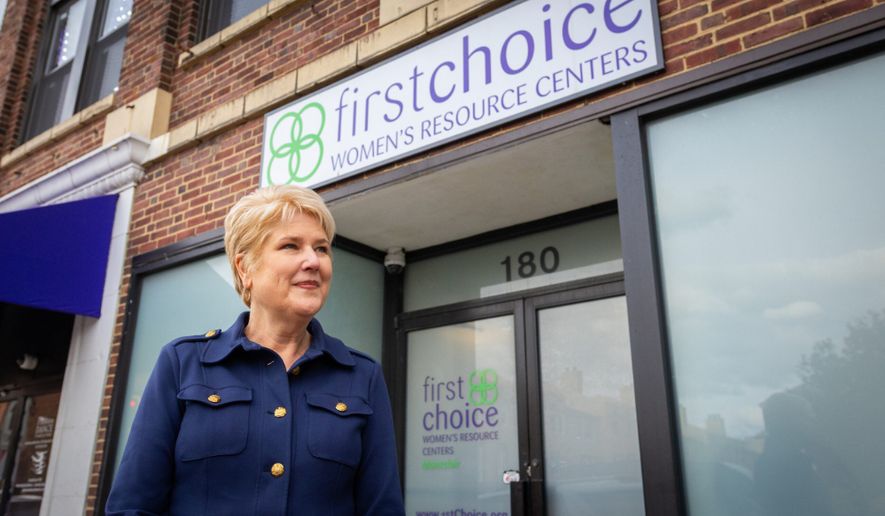

The Supreme Court grappled Tuesday with a challenge from a network of pro-life pregnancy centers against New Jersey’s demand for the names and contact information of the group’s donors.
First Choice Women’s Resource Centers argued that the threat of litigation if it chooses not to comply with the state’s 2023 subpoena has burdened the group and that it should be able to defend its First Amendment rights in federal court.
Erin Hawley, senior counsel with Alliance Defending Freedom representing First Choice, said the subpoena “violates the right of association.”
“The attorney general does not dispute that First Choice faces a credible threat of enforcement, and there’s no question that First Choice’s First Amendment interests are arguably burdened by the subpoena,” she told the court.
The Trump administration, siding with First Choice, told the court that the pro-life group has clear standing, or the legal right to challenge the state’s subpoena.
“The threat here is that the state will begin — in fact, has already begun — a suit to enforce the subpoena if the materials are not turned over, imposing litigation costs on First Choice,” said Vivek Suri, assistant to the solicitor general for the Justice Department.
SEE ALSO: Judge blocks part of Trump’s Big Beautiful Bill that targeted Planned Parenthood
The issue immediately before the justices is whether First Choice may defend its First Amendment rights in federal court, rather than first seeking to do so through state court.
The 3rd U.S. Circuit Court of Appeals ruled last year that the pregnancy center’s First Amendment claim wasn’t “ripe” because it first had to challenge the subpoena in state court.
Sundeep Iyer, chief counsel to the New Jersey Attorney General representing the state, said there were no allegations that the subpoena “objectively chilled [First Choice’s] First Amendment rights.”
“The state court has repeatedly declined to order production [of the donor data] over two years of litigation. That helps explain why petitioner never alleged below that anyone actually has been or is objectively likely to be chilled by this subpoena,” Mr. Iyer said. “Instead, at most, the complaint alleges that the subpoena itself ‘may cause’ donors to stop contributing.”
In an exchange with Chief Justice John G. Roberts Jr., he suggested that a donor could come forward and say they felt chilled from challenging the state’s request for the data.
Chief Justice Roberts pointed out that the subpoena was sought against a pro-life center, a politically fraught group, not a “car dealership.”
“Counsel, you referred to the fact that you addressed these subpoenas to car dealerships and things like that. Your friends on the other side don’t represent a car dealership. Do you think there is a credible chilling effect from the state?” he asked.
Some of the other justices also appeared skeptical of Mr. Iyer’s defense.
Justice Neil M. Gorsuch said the state’s law suggests forceful and threatening acts against the center.
“Just looking at the statute, if the AG’s subpoenas have the force of law, and if a person fails to obey the subpoena, the AG may apply to the Superior Court and obtain an order adjudging such person in contempt of court,” he said.
Justice Clarence Thomas noted that the state had received no complaints suggesting the need for such data.
“You had no basis to think they were deceiving any of their contributors?” Justice Thomas asked. “You had no factual basis?”
Democrats have long accused pro-life pregnancy centers of deceiving clients by masquerading as abortion clinics, which the centers deny.
New Jersey Attorney General Matthew Platkin, a Democrat, issued a “consumer alert” about crisis pregnancy centers in December 2022. The warning said the centers may “provide false or misleading information about abortion” and offered “tips on how to spot a CPC.”
About a year later, Mr. Platkin zeroed in on First Choice.
He issued a subpoena seeking documents dating back 10 years on the pro-life center’s advertising, statements on abortion pill reversals, and the identities of its donors, arguing that the clinics may be “misleading donors and potential clients” in violation of state law.
Pro-life advocates were cautiously optimistic after oral arguments. They said the justices appeared concerned about whether the state’s demand for donor disclosure was necessary, given that there were no complaints about the five-center network.
“Today, the Supreme Court seriously engaged with the danger of government overreach targeted at pro-life ministries,” said David Bereit, executive director of the Life Leadership Conference. “Regardless of where the justices land on the technical legal theories, the concern for donor privacy, free speech, and First Amendment freedom was unmistakable.”
Marjorie Dannenfelser, president of SBA Pro-Life America, framed the state investigation as the latest attempt by Democrats to persecute pro-life pregnancy centers for their refusal to support abortion.
“From AG Platkin to Elizabeth Warren to Kamala Harris, Democrats have waged a campaign of harassment towards pregnancy centers and seek ultimately to shut them down, proving they are not ‘pro-choice’ but merely pro-abortion,” Ms. Dannenfelser said in a Tuesday statement.
Free speech groups, including the American Civil Liberties Union and Foundation for Individual Rights and Expression, also have thrown their support behind First Choice.
“Even before they’re enforced, law enforcement subpoenas seeking sensitive donor information threaten to scare away supporters essential to any nonprofit’s work,” said Brian Hauss, deputy project director of the ACLU’s Speech, Privacy and Technology Project. “At a time when government officials throughout the country abuse regulatory powers to punish their ideological opponents, federal courts must remain a venue in which people can vindicate their First Amendment rights.”
The Supreme Court has previously batted down attempts to obtain donor information from nonprofit groups.
In 2021, the high court rejected in a 6-3 decision a policy initiated by California Attorney General Kamala Harris to require nonprofit groups to disclose their donors, an effort challenged by the Americans for Prosperity Foundation and the Thomas More Society.
The court noted in its decision that hundreds of nonprofit organizations, on both the left and right, filed briefs in support of the lawsuit, citing concerns that the disclosure policy would deter donor support.
• Valerie Richardson can be reached at vrichardson@washingtontimes.com.
• Alex Swoyer can be reached at aswoyer@washingtontimes.com.

Please read our comment policy before commenting.