


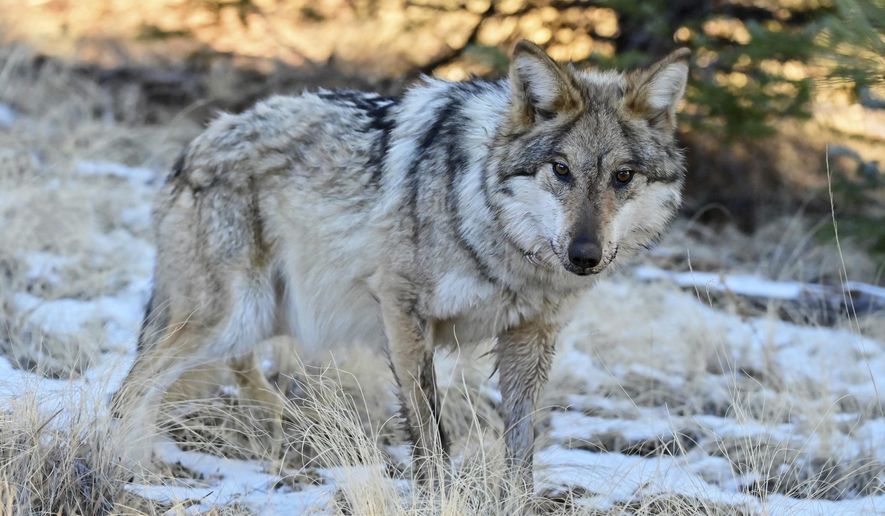

Five years after gray wolves were last removed from the endangered species list, the House passed a bill to delist the wolves again.
Introduced by GOP Reps. Lauren Boebert of Colorado and Tom Tiffany of Wisconsin, the Pet and Livestock Protection Act directs the Interior Department to remove protections for the gray wolf under the Endangered Species Act of 1973.
In 2020, the Interior and the U.S. Fish and Wildlife Service delisted the gray wolf in the lower 48 states, but a California judge overturned the rule in 2022.
In a press release, the lawmakers said their bill would “remove the ability of progressive judges to get in the way of science and allow states to set their own rules and regulations for managing their gray wolf population.”
There were more than 6,000 wolves at the time of delisting.
“The science has been clear for years: gray wolves are fully recovered, and their resurgence deserves to be celebrated as a true conservation success story,” Ms. Boebert said in the press release. “It’s long past time to delist them and empower states to set their own management policies.”
This legislation also ensures the delisting could not be overturned through judicial review, preventing judges from relisting the gray wolf by judicial fiat.
When federal protections were first established for gray wolves in the Great Lakes region, populations were only in the hundreds, Mr. Tiffany said in the press release. Now, populations are in the thousands.
“Despite this recovery, activist judges continue to ignore the science, leaving livestock and pets to be slaughtered and rural communities vulnerable,” he said.
The environmental law nonprofit EarthJustice said the legislation “would open the door to unrestricted harm like wolf hunts, hinder efforts to recover wolves within their historic range, and risk destabilizing ecosystems that wolf recovery have improved.”
The Endangered Species Act’s restrictions on ranchers and pet owners protecting their livestock and pets are nuanced, as those who shoot at, injure or kill protected wolves that endanger their animals can face potential prosecution.
Colorado’s agricultural producers reported $580,000 in losses linked to gray wolves in 2024.
“We should listen to our farmers and ranchers and finally delist the gray wolf,” Ms. Boebert and Mr. Tiffany said.
After a species is delisted, the Endangered Species Act requires the U.S. Fish and Wildlife Service and states to monitor it for at least five years.
If officially delisted, state and tribal wildlife management agency professionals would resume responsibility for the sustainable management and protection of gray wolves.
“This legislation restores a common-sense, science-based approach to wolf management, returning decision-making to states,” Bruce Westerman, chair of the House Natural Resources Committee, said in the press release.
The legislation has 36 co-sponsors and dozens of supporters from stakeholders, such as the National Rifle Association and the Public Lands Council.
“Hunters of all stripes care deeply about being good stewards of our land, and this bill lets them do just that,” John Commerford, the executive director of NRA-ILA, said in the press release. “By passing this bill, the U.S. House has taken an important step to allow states to better manage wolves, in conjunction with hunters, just as they do successfully with nearly all species.”
• Mary McCue Bell can be reached at mbell@washingtontimes.com.

Please read our comment policy before commenting.