



OPINION:
Europe occasionally needs a good talking to and a reminder that the United States of America is not subservient to the continent.
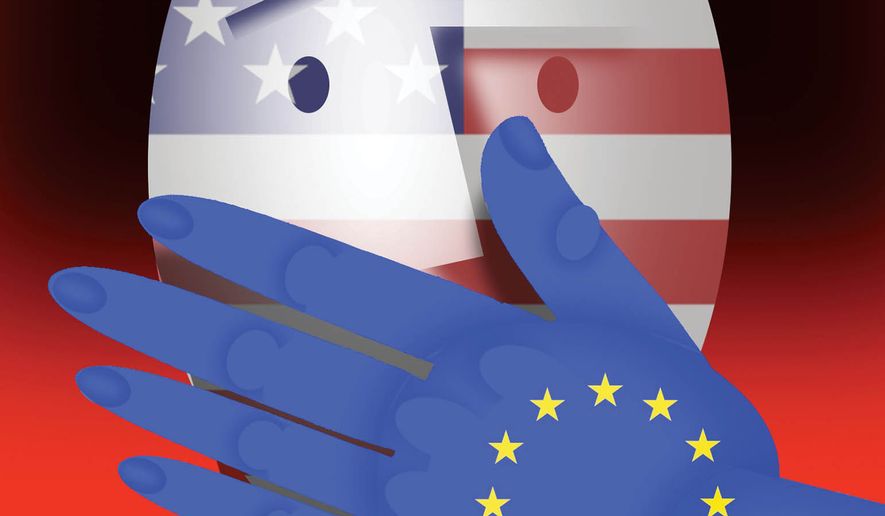
The European Union, a technocratic superstate where laws are written by committees no one elected and enforced by regulators no one can fire, has adopted two radical regulatory schemes based on environmentalism and social justice. They apply to any company with a European presence of any kind. With them, the EU is trying to reach into America and impose its leftist ideals on private companies here.
The names of the regulations are so spectacularly bureaucratic that they sound like they were made up.
The Corporate Sustainability Reporting Directive requires vast, audited “sustainability” disclosures for companies that do any business in the EU. The Corporate Sustainability Due Diligence Directive goes even further, forcing companies to police their entire global supply chains for environmental and social compliance, even when “offending” suppliers are thousands of miles away and fully outside EU jurisdiction.
Compliance would require American firms to restructure internal data systems, hire armies of consultants and auditors, and produce reports in formats dictated by the suits in Brussels. There is tremendous legal exposure to requirements Americans have never encountered before, and companies can face fines, lawsuits or reputational attacks if they fail to comply. It’s also likely that many smaller U.S. companies will simply elect not to engage in commerce with Europe so as not to tangle with EU red tape.
The environmental, social and governance regulations naturally affect American energy companies, making it significantly more difficult and expensive for them to deliver oil and liquefied natural gas to Europe. This makes absolutely no sense for a continent that claims to want to escape its dependence on Russia for energy.
A report by the Hudson Institute states that the Corporate Sustainability Reporting Directive and the Corporate Sustainability Due Diligence Directive will result in more than $1 trillion in additional business costs that can be measured and likely a significantly higher amount that can’t be calculated. Unmeasurable harm would be done to consumers in the U.S. and elsewhere through “higher prices, lower quality of products and services, and a reduced range of available products and services.”
This is not a regulation for Europeans. It’s regulation by Europeans for the rest of us.
Call it EU imperialism or something else, but it’s an exact parallel to what Europe is doing to free speech, which is just another thing it is trying to strangle out of existence.
Speech codes across the continent, including in the non-EU United Kingdom, are out of control.
People have been arrested in England for silently praying near abortion clinics. This is literally criminalizing the thoughts inside someone’s head.
In Germany, police routinely raid people’s homes while conducting investigations into online speech. People have had their doors kicked in and computers seized because they posted memes that someone in the government found offensive.
In Spain, rappers and comedians have been prosecuted for insulting the police or the monarchy.
In terms of being anti-speech, the EU itself really takes the prize. The Digital Services Act imposes the EU’s view of what’s acceptable speech, not only on its own citizens but on the rest of the world as well. If objectionable content can be viewed online by the EU, it wants the platform to shut it down, regardless of where it is based.
The free speech video platform Rumble, which is a client of my public affairs firm, has received and refused censorship demands from a variety of governments around the world, including in Europe. Rumble’s position is always that no foreign government can reach into the United States and deactivate the First Amendment.
Vice President J.D. Vance got it right at the Munich Security Conference earlier this year when he called out Europe’s dangerous crackdown on free speech and likened it to the former Soviet Union.
“You can’t mandate innovation or creativity, just as you can’t force people what to think, what to feel or what to believe,” he said.
The EU autocrats didn’t react well to being scolded by the American VP, but Europe’s poor record on issues involving freedom is obvious to all.
Just as then, the Trump administration is on the case of the EU regulations. Commerce Secretary Howard Lutnick promised earlier this year to consider “all available trade tools at our disposal” to combat the crushing mandates. President Trump, as we know, would not be shy about imposing tariffs to defend American interests if he felt the need.
If Europe wants to regulate itself into oblivion, that’s its choice, but it shouldn’t try to siphon $1 trillion out of the American economy while it’s at it. That would be taxation without representation, and that’s definitely a conversation we’ve had with folks across the pond before.
• Tim Murtaugh is a Washington Times columnist and founder of Line Drive Public Affairs. He served as a senior adviser on the 2024 Trump campaign and as communications director on the 2020 Trump campaign.

Please read our comment policy before commenting.