


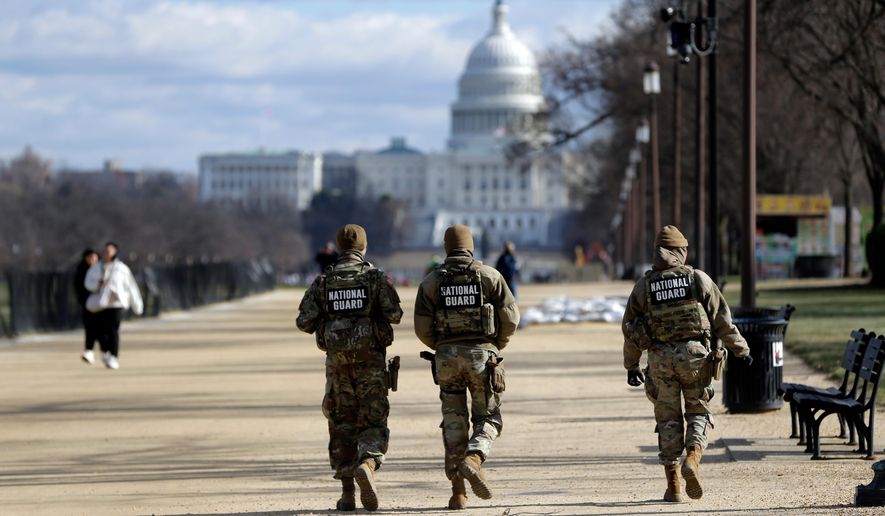

A federal appeals court permitted President Trump to keep National Guard troops deployed to the streets of the District of Columbia for the foreseeable future, ruling that presidents have unique powers regarding the capital city.
The ruling Wednesday by the U.S. Circuit Court of Appeals for the District of Columbia puts on hold a lower court injunction ordering the troops to stand down.
Judge Patricia Millett, an Obama appointee to the court, said federal and city law appear to allow Mr. Trump expansive powers to call up the Guard on his own, even if the city’s elected leaders oppose it.
“Given the special security needs of the District as the seat of federal government and the nation’s capital, defendants have likely shown that the D.C. code affords the president authority for this deployment,” Judge Millett wrote.
The ruling does not address the exact duties the Guard is performing and whether troops are doing, or are allowed to do, traditional police work.
It does permit Mr. Trump, for now, to keep the troops in place. Under the current schedule, they are to remain through the end of February, though the mission could be extended.
The deployment has involved more than 2,000 soldiers from the D.C. Guard, as well as those from South Carolina, West Virginia, Mississippi, Louisiana, Tennessee, Ohio, Georgia, Alabama and South Dakota.
On Nov. 26, a gunman ambushed two members of the West Virginia National Guard.
Spc. Sarah Beckstrom was slain, and Staff Sgt. Andrew Wolfe was grievously wounded.
An Afghan migrant brought to the U.S. during President Biden’s chaotic 2021 airlift out of Kabul has been charged with the attack.
The D.C. Circuit will revisit the issue more fully later, but the ruling Wednesday means that, barring intervention from the full appeals court or the Supreme Court, the troops can remain until that final judgment.
The attorney general’s office for the District said in a statement that it will keep pursuing the case.
“This is a preliminary ruling that does not resolve the merits. We look forward to continuing our case in both the District and appellate courts,” the office said.
Mr. Trump also has deployed National Guard troops to Los Angeles and sought to send them to the Chicago area and to Portland, Oregon. Each of those has faced court challenges.
The Los Angeles deployment has been allowed to continue while that case develops.
The Portland and Chicago deployments have been put on hold pending the Supreme Court’s consideration of the matter.
In the District, the deployment began in August as part of Mr. Trump’s summer focus on crime in major cities, particularly those run by Democrats, where sanctuary policies limit cooperation with federal authorities on immigration enforcement.
Troops have patrolled the streets around the District’s core, monitored subway stations, and taken over patrols in the city’s extensive network of national parklands, freeing up U.S. Park Police officers to focus on other missions.
Reports of major crimes have decreased since the deployment, although city officials argue that the numbers were trending downward before Mr. Trump’s involvement.
Judge Jia Cobb, a Biden appointee, ruled Nov. 20 that the deployment was illegal under city law. She said the provisions granting the president the power to call up the National Guard appear to be limited to training and ceremonial duties.
Judge Millett, though, said that was a misreading. She said the section repeatedly cites “other duty” in addition to training.
She said the law was rewritten in 2006 to give the Guard an expanded purview in the wake of Hurricane Katrina.
Judge Cobb had stayed her own ruling to allow for an appeal, so the troops have been in place continuously despite the adverse decision last month.
Judge Millett was joined in her ruling by Judges Gregory Katsas and Neomi Rao, both Trump appointees.
Judge Rao wrote a separate opinion, joined by Judge Katsas, questioning whether the city — which, despite having some home rule powers, is a sub-unit of the federal government — even has the power to sue the president.
She said the issue wasn’t challenged in the district court but needs to be addressed.
“Permitting the district to sue the president and other federal officials based on a sovereign injury is unprecedented and likely at odds with the unique legal status of the District,” Judge Rao wrote. “In subsequent proceedings, this important jurisdictional question should be given further consideration.”
• Stephen Dinan can be reached at sdinan@washingtontimes.com.

Please read our comment policy before commenting.