



A version of this story appeared in the daily Threat Status newsletter from The Washington Times. Click here to receive Threat Status delivered directly to your inbox each weekday.
OPINION:
The political right has a reflexive hesitation to endorse any government action on artificial intelligence. The muscle memory of fighting overregulation in virtually every industry remains strong. Thus, it is unsurprising that President Trump clearly wants to prohibit states from regulating AI.
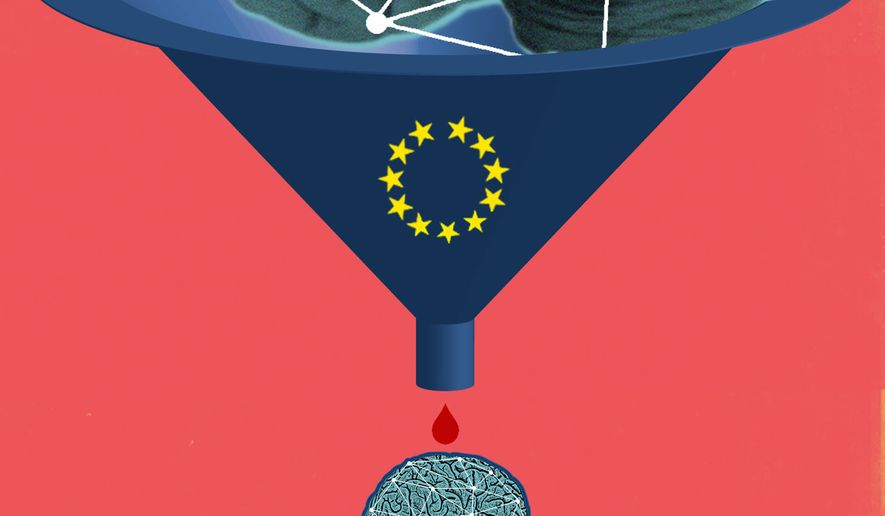
Here’s the uncomfortable truth: AI is already regulated, and the most comprehensive AI regulations are not coming from Congress, your governor or anyone else accountable to the American people. They are coming from Brussels.
Europe’s sweeping Artificial Intelligence Act, a sprawling, risk-tiered regulatory regime, is now entering enforcement. Because of its extraterritorial reach, the AI Act applies to any AI system with outputs used within the European Union. That jurisdictional trigger gives EU regulators the ability to dictate the behavior of American companies, models and platforms, even if those companies aren’t domiciled in Europe.
Brussels’ hidden hand
Under the AI Act, American companies can face fines of up to 7% of global revenue if their model generates content European bureaucrats deem “manipulative,” “exploitative” or “biased.” This vagueness isn’t coincidental; these are ideological judgments dressed up as safety standards.
The law doesn’t regulate just companies operating in Europe. It regulates whatever version of a model might reach a European user, even accidentally. In practice, this forces companies to standardize to the strictest European interpretation across all markets, including the U.S. domestic market. The EU has done this before, with the Corporate Sustainability Due Diligence Directive, which requires companies worldwide to conform to their ESG-like practices. This is the same playbook, just on AI.
The AI Act’s structure allows Brussels to claim jurisdiction over any U.S. AI model “accessed by European users, integrated into European services, or generating outputs consumed by EU individuals.” This is foreign rulemaking exported globally through coercive penalties.
Conservatives mustn’t ignore an already present threat
Another headwind faced by those advocating for action on AI is how to consider the threats it poses. Many conservatives seem to downplay the seriousness of AI threats, writing off the groundbreaking technology as a “chatbot” or just “Google on steroids.” Still, AI presents very real dangers to the rights of individuals and society at large.
Long before Europe stepped into the mix, Silicon Valley had already hardwired powerful ideological biases into the AI systems Americans use every day. Studies consistently show that leading U.S. large language models produce heavily left-leaning outputs, reflecting the political homogeneity of the companies that build and train them.
At the same time, the concept of digital privacy hangs precariously, as these systems feed on personal data and information about people’s beliefs, habits, preferences, etc. AI is increasingly capable of shaping identity, filtering reality and nudging individuals toward predetermined conclusions.
When AI systems can curate what citizens see, filter the ideas that are acceptable and steer decision-making in subtle but important ways, democratic self-governance becomes increasingly fragile. In this environment, especially in the wake of the era of “Big Tech censorship,” it is entirely appropriate to question who controls these powerful levers of influence.
What conservatives get wrong about AI regulation
When we hear “AI regulation,” many on the right immediately picture the worst: heavy-handed federal agencies, speech policing or California’s bureaucracy creeping into national technology policy. We’re right to fear those things.
Yet doing nothing while the EU imposes its rules on American AI companies is not a defense of liberty or free markets. In this case, it’s a surrender to the will of EU policymakers.
Let’s be crystal clear: AI is already being regulated, just not by Americans. The EU’s AI Act effectively exports the worldview of Brussels to the United States and every other country. In this environment, the “hands off” approach is no longer a limited-government position.
Conservatives often fear that regulation means empowering bureaucrats. In most cases, they are right. However, the greater threat is allowing Silicon Valley and the EU to jointly determine the moral framework underlying the AI systems that will be embedded in the foundations of virtually all our institutions.
This is why the political right must reject the false choice between overregulation and no regulation at all. The real choice is between foreign regulators setting global norms with no American input and America establishing pro-liberty guardrails rooted in constitutional principles. This should include protections for free expression, privacy, due process and individual autonomy.
A warning, not a blueprint
AI is transforming society faster than any other technology in modern history. It will reshape the economy, our information environment and even our relationships. Whether it becomes an instrument for liberation or a tool for tyranny may rest on whether we act now.
Europe has already made its move. China has already weaponized AI. Big Tech has already embedded ideological filters deep into major platforms.
The question is whether the United States will assert a pro-liberty, pro-Constitution approach or wake up one day and realize the rules governing our own technology were written in Brussels.
Those worried about the potentially coercive nature of a biased and woke-aligned AI shouldn’t write off regulation that’s narrow, principled and rooted in the rights of the individual. If conservatives fail to engage, America will effectively be handing the regulatory reins to the EU bureaucracy.
• Donald Kendal (dkendal@heartland.org) is the director of the Emerging Issues Center at The Heartland Institute. Follow @EmergingIssuesX.

Please read our comment policy before commenting.