



A version of this story appeared in the daily Threat Status newsletter from The Washington Times. Click here to receive Threat Status delivered directly to your inbox each weekday.
Somali pirates are again stalking commercial shipping in the Indian Ocean, but this time they are not operating alone. U.S. and regional security officials warn that pirate gangs are coordinating with Iran-backed Houthi militants and terrorist groups operating in the Horn of Africa.
“Some of the Somali pirate groups have received GPS devices and weapons from the Houthis or Houthi-aligned actors in Yemen,” said Mohamed Muse Abulle, deputy intelligence director of the Puntland Maritime Police Force. “Some of them we believe have even conducted training in Yemen.”
Somalia has been a key focus of the Trump administration’s counterterrorism efforts in Africa. It is believed to be the first country for which President Trump authorized a military strike after his return to office.
The distance between Yemen and Somalia is just a few hundred miles across the Red Sea. These waters remain critical for U.S.-linked trade and military logistics transit. The two countries have long been linked culturally and economically by the trade conducted via traditional dhows — small sailing vessels used along both shores. Those maritime links have also served smugglers trading in narcotics, people and weapons. Chinese- and Iranian-made small arms can sell in Somalia for five times their value in Yemen.
On Dec. 12, Puntland Maritime Force, a regional security group in Somalia, announced it had intercepted a small vessel attempting to smuggle chemicals used to make explosives on board. The Puntland Maritime Force arrested Somali and Yemeni nationals aboard the vessel.
Yemen’s Iran-backed Houthis, a U.S.-designated terrorist organization, are a Zaydi Shiite movement. Despite ideological differences, the group has cultivated new ties with Sunni extremist organizations, including al-Shabab and ISIS-Somalia, regional security officials say.
Reviving Somali piracy is part of a broader campaign of regional instability and asymmetric warfare in which Houthis seek to develop new proxies in Africa. In December 2023, Somali pirates seized a merchant vessel for the first time since 2017. The operation coincided with the first Houthi attacks on maritime traffic in the Red Sea.
Mr. Trump announced a ceasefire with the Houthis on May 6 after the group agreed to halt attacks on American shipping. In a separate announcement, the Houthis said in November that they would end all maritime attacks in the Red Sea, though security officials remain skeptical about the durability of the pledge.
“After several years of relative calm, piracy activity off Somalia has flared again since late October,” wrote Skuld, the maritime insurance firm, “with coordinated pirate action groups operating far offshore in the Somali Basin and adjacent Indian Ocean. The most serious event occurred on 6 November 2025.”
During that attack, the Malta-flagged tanker Hellas Aphrodite was fired upon by Somali pirates armed with rocket-propelled grenades and automatic weapons.
The crew retreated to the ship’s citadel, a hardened safe room stocked with food and water designed to protect crews until naval assistance arrives.
The following afternoon, the Spanish frigate ESPS Victoria, operating under NAVFOR, the EU’s anti-piracy operation, intercepted the vessel. After a show of force, the pirates abandoned the vessel, leaving the crew unharmed.
In a separate incident that same day, the Qatari-owned LNG tanker Al Thumama detected and outran a suspicious approaching skiff.
Both incidents, along with several others, have been linked to the same pirate network, experts say.
“A small craft with three persons onboard came to within [2 nautical miles] of the vessel before returning to a suspected mother ship,” said an Office of Naval Intelligence report on the Al Thumama incident. This report and others indicate that Somali pirates are again using dhows as mother ships for pirate attacks from fast skiffs on large merchant vessels.
“The pirate attacks in recent months occurred while ISIS-Somalia was under significant military pressure from Puntland forces,” said Mr. Abulle, deputy intelligence director of the Puntland Maritime Police Force. “We suspect pirates have been encouraged to launch such operations by terrorist groups in order to distract regional and international forces.”
Despite billions of dollars spent on counter-piracy operations and years of international naval deployments, Somali pirates have struck with renewed force this year. Over the past decade, shipping companies have reduced their defensive measures. Armed guards are now less common, as are barbed wire barriers and water cannons.
“These recent attacks are meant to test the waters. Somali pirates are also aware that the international naval forces are still in theater and able to respond to these incidents,” said Cyrus Mody, deputy director of the International Maritime Bureau, the International Chamber of Commerce’s maritime risk and piracy watchdog. “The continued presence of these navies is vital to prevent a full resurgence of piracy in the region.”
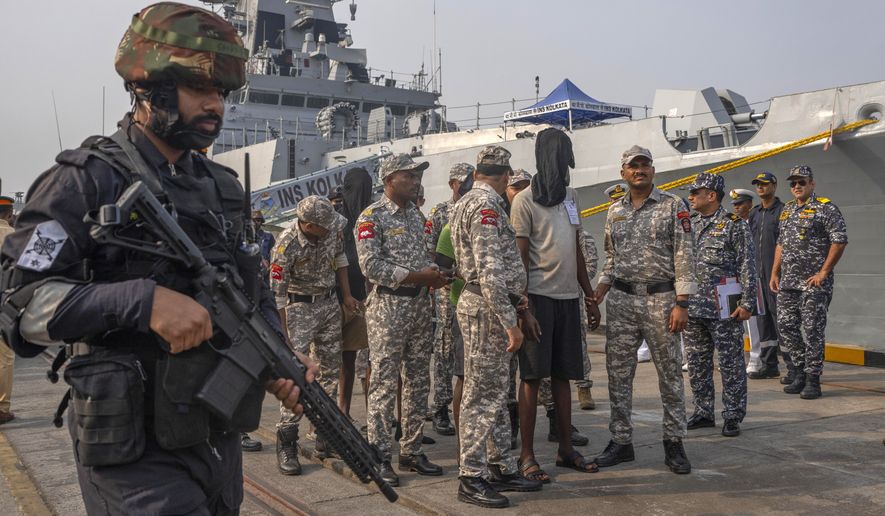
Mr. Mody pointed out that the Indian navy acted aggressively in 2024 in support of the EUFOR mission. An Indian navy operation last year rescued the hijacked ship MV Ruen, freeing 17 hostages and capturing 35 Somali pirates. India has agreed to serve as a rapid-response force in support of the Somali government’s anti-piracy objectives.
Meanwhile, Turkey is set to train and equip Somalia’s naval forces to fight illegal fishing in exchange for 30% of the revenue from Somalia’s exclusive economic zone and hydrocarbon exploration rights.
“The destruction of the blue economy through illegal dumping and [illegal] fishing in Somalia drives piracy,” said Sonkor Geyre, former director general of the Somalia Ministry of Defense and now head of the Heritage Institute, a Somali think tank. “Often it’s Chinese, Korean and Iranian vessels that are involved in these activities. There are thousands of vessels today. You can call them pirates, but often local people consider them more like coast guards.”
Mr. Geyre shared with The Washington Times satellite images that he said showed large numbers of vessels operating in Somalia’s national waters without the permission of the federal government.
The fate of the MV Abdullah, which Somali pirates released in April 2024 after a payment of $5 million ransom, also offers a cautionary tale. That ship had no barbed wire fencing, water cannons or other basic anti-piracy measures when it was captured.
Experts say Somali piracy will persist in some form because of limited economic opportunities ashore. Financial and logistical support from the Houthis and al-Shabab could further sustain pirate operations. United Nations estimates suggest al-Shabab generates $200 million annually from its territory and illicit taxation.
According to data from Lloyd’s, the maritime intelligence firm, commercial traffic transiting the Bab el-Mandeb Strait and the Suez Canal has risen steadily in recent months, underscoring the renewed strategic importance of one of the world’s most vulnerable shipping corridors.
A U.N. Security Council report warned in 2024 that the Houthis may have earned as much as $180 million per month at the height of their Red Sea maritime campaign by extorting “protection fees” from shipping companies.
The Houthis’ extortion model mirrored practices long used by Somali pirate networks, blurring the line between terrorism and organized maritime crime. Regional officials warn that terrorist-linked protection rackets could again take root in the region’s sea lanes.
For now, the region is likely to have a temporary respite. The northeast monsoon, which began last month, has brought rough seas and high winds. Such conditions have traditionally made it difficult for high-speed skiffs to catch larger, more stable maritime traffic.
When seasonal conditions improve, the convergence of increased maritime traffic and new terrorist networks could rapidly turn the warm waters of the Horn of Africa into a global maritime security flash point.

Please read our comment policy before commenting.