


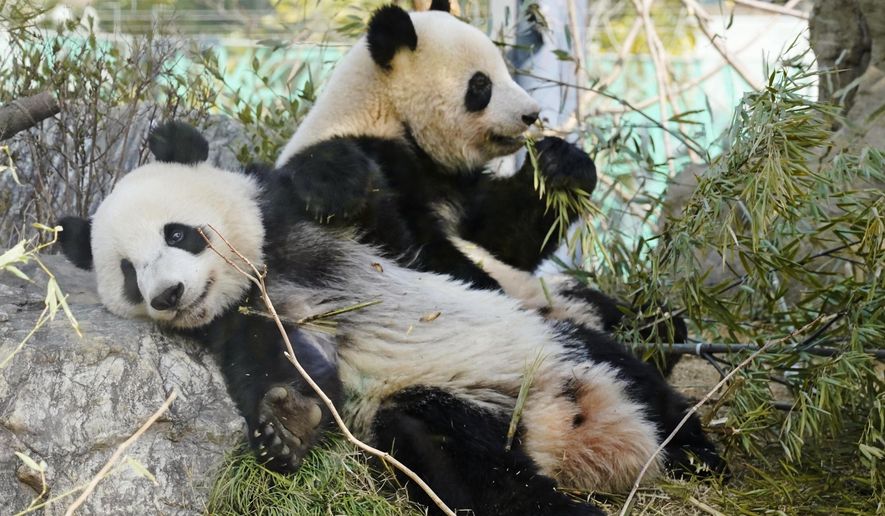

SEOUL, South Korea — Japanese fans of cuddly, black-and-white bamboo-eating bears are reportedly in despair as two giant pandas from Tokyo Zoo are prepared to depart for China.
Although the removal of Xiao Xiao and Lei Lei is not directly related to Beijing-Tokyo tensions, there are fears that the pair of pandas will not be replaced as China’s multipronged assault on Prime Minister Sanae Takaichi expands into all domains.
Ms. Takaichi is noted for her take-no-prisoners personality, her nationalistic leanings and her lack of expertise in foreign policy.
After taking office in October, she said on Nov. 7 that a Chinese naval contingency around Taiwan would pose a “survival-threatening” situation for Japan.
Her statement, a response to an opposition lawmaker’s question, infuriated Beijing, which claims the democratically governed island as part of China.
Tokyo’s constitution restricts military activity, but existential threats permit the activation of Japan Self-Defense Forces.
In the weeks since, China has retaliated with diplomatic slurs, the halting of tourism to Japan, an embargo on Japanese seafood imports, pop concerts and, most recently, naval-aviation provocations in waters close to Okinawa.
Okinawa and the islands to its south dominate strategic naval choke points northeast of Taiwan. Japanese units are fortifying them with area-denial weaponry.
With tensions high, action has shifted to the fate of lovable mammals.
Xiao Xiao and Lei Lei are set to depart Tokyo’s Ueno Zoo for their ancestral homeland in February, though both were born at the zoo to parents lent by Beijing.
Per agreements known colloquially as “panda diplomacy,” China, which is responsible for the species’ conservation, retains control of all the animals globally. Even pandas born overseas must be sent to China by the age of 4, when they reach adulthood.
China first lent pandas to Japan in 1972, the year Beijing and Tokyo opened diplomatic relations, and Japan has always had pandas since then. That changes when Xiao Xiao and Lei Lei depart.
With Ms. Takaichi refusing to accede to Chinese demands that she retract her November remarks, bilateral relations remain strained. There are no current indications that the pandas will be returned or replaced.
In Japan, the concept of “kawai” — “pretty things” or, more simply, “cuteness” — is entrenched deeply in national culture. The impending departure of the pandas has dominated Japanese news this week.
Because of long queues, viewing times at their enclosure have been limited to one minute. As they prepare to go into quarantine, Jan. 25 will be the last day of public exhibition. In the final days, only the winners of a lottery will be permitted to view the pair.
Fans “just can’t bear it,” wrote Reuters. A poster on the “Deep In Japan” Facebook forum dubbed the situation “Panda-monium.”
Sad sayonaras to Xiao Xiao and Lei Lei do not camouflage wider tensions in the region.
In December, China’s People’s Liberation Army Navy, which outnumbers the U.S. Navy in ship count, conducted its largest regional drills ever.
Beijing’s maritime assets, comprising the navy, the coast guard and “maritime militias” of centrally directed fishing fleets, variously menace Taiwan, Japan and the Philippines, the three democracies that constitute the strategic First Island Chain.
Ms. Takaichi is not alone in her defiance of these formidable forces.
In the Philippines, there is public indignation against China’s forceful intimidation of local fisherman and Manila’s overmatched forces in the disputed waters west of their nation.
In Taipei, policy pushback is underway.
On Tuesday, ahead of the release of its National Defense Report on Wednesday, Taipei revealed that it had devolved combat command, freeing local officers to act on their own initiative.
That ensures speed of response and combat sustainability. In the event of hostilities, Taiwanese units could fight independently even if communications are knocked out by electronic warfare or if the country’s political leadership is decapitated.
National Security Bureau Director General Tsai Ming-yen and Minister of National Defense Wellington Koo spoke to lawmakers of the Foreign Affairs and National Defense Committee at the Legislative Yuan in Taipei on Wednesday.
Given China’s diplomatic and economic muscle and its proven track record of wielding related powers against nations that displease it, such as Japan, many capitals decline to raise their voices over Taiwan. Most countries, including the United States, pay lip service to the “One China” policy.
However, many also maintain “strategic ambiguity” over what they would do in the event of a security crisis in the Taiwan Strait. That position indicates considerable sotto voce sympathy for the democratic island.
On Wednesday, Mr. Tsai revealed in the chamber that Taiwan held nearly 100 bilateral meetings with leaders of national security agencies from 45 countries in 2025, Taipei media reported.
• Andrew Salmon can be reached at asalmon@washingtontimes.com.

Please read our comment policy before commenting.