



A version of this story appeared in the daily Threat Status newsletter from The Washington Times. Click here to receive Threat Status delivered directly to your inbox each weekday.
The Pentagon does not plan to release the full video of strikes conducted on a drug-smuggling boat in the Caribbean in September.
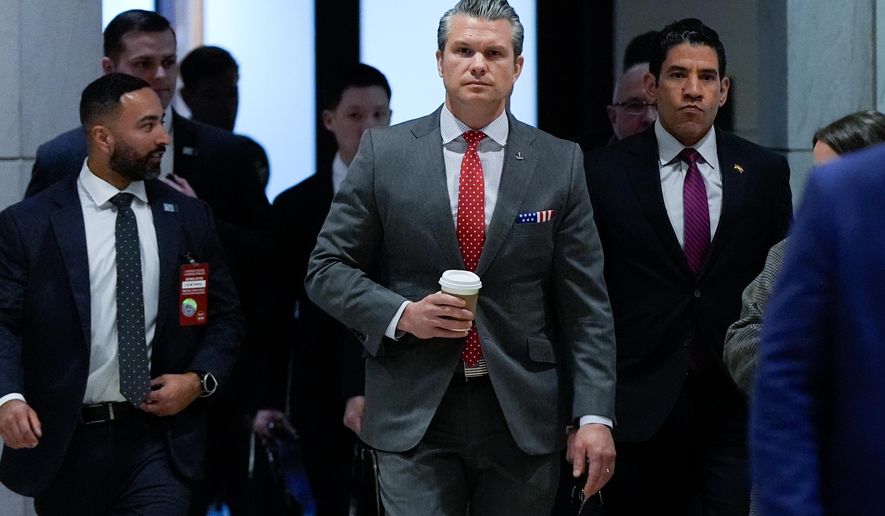
After a meeting with lawmakers on Capitol Hill on Tuesday, Defense Secretary Pete Hegseth told reporters that the unedited video will remain classified for the foreseeable future.
“We’re not going to release a top secret, full, unedited video like that to the public,” Mr. Hegseth said, adding that it was in keeping with department policy.
The House and Senate Armed Services committees will see it, he said, but not the “general public.”
Mr. Hegseth and Secretary of State Marco Rubio were briefing lawmakers Tuesday on the ongoing, lethal strikes against alleged drug-smuggling vessels in the Caribbean and eastern Pacific.
President Trump initially said he would have “no problem” with releasing the video, before he reversed course and left the decision up to Mr. Hegseth.
The Sept. 2 attack killed 11 “narco-terrorists,” including two survivors in a follow-up strike that sparked the ire and speculation of public officials. The strike, as well as the rest of the military’s anti-drug quest, has provoked legal inquiries.
The core of the current debate and demand for the video evidence is whether the strikes violated the Geneva Conventions.
The original video of the strike shows two alleged drug runners in a boat in the Caribbean being attacked by a U.S. Special Operations Command aircraft. Both men survive the initial strike, calling into question whether the second strike was legal.
Adm. Frank Bradley is said to have authorized the second strike that killed the two survivors, but the third and fourth strikes are what sank the vessel.
He is reportedly slated to brief lawmakers on the House and Senate Armed Services committees on Wednesday about the operation.
Republican lawmakers leaving the briefing said they’re unconcerned about its release. Sen. Lindsey Graham, South Carolina Republican, said the video is the least of his worries because it was a “lawful” strike, and it should be released.
Democrats were not so reassured by the content of the briefing, and they have demanded the release of the video.
“One hundred senators in the room, maybe six of us got to ask questions of the group,” said Sen. Mark Kelly, Arizona Democrat. “Then they left. So my takeaway from this is I have more questions now than when I walked in.”
Sen. Richard Blumenthal, Connecticut Democrat, called for a congressional subpoena for the video and all documentation on the strikes.
Sen. Rand Paul, Kentucky Republican, said he is “for everyone seeing the video — not just the Senate, but the American public should see the video.”
The Justice Department’s legal justification for the strikes is that the alleged drug runners were considered an “imminent threat,” according to sources who have seen the document.
Much of the conversation on Capitol Hill not only revolves around the legality of the strikes, but also whether the strikes and any further action in Venezuela would require congressional authorization for the use of military force.
An authorization for the use of military force (AUMF) has not been approved for the actions in the Caribbean or off the coast of Venezuela.
The mounting questions around the legality of the administration’s actions will continue to grow as speculation persists over Mr. Trump’s desire to overthrow the Nicolás Maduro regime in Venezuela.
The Trump administration has labeled Venezuela a “narco-state,” accusing Mr. Maduro of leading a cartel and facilitating cocaine shipments to America.
Mr. Graham says he’s confident that what’s happening now in the Southern Hemisphere is “no different than what President Bush did,” referencing the 1989 Operation Just Cause in Panama.
Then-President George H.W. Bush ordered the U.S. invasion of Panama to remove dictator Manuel Noriega, who was involved in drug trafficking.
Noriega spent the rest of his life in custody — first in the U.S., then in France and finally under house arrest in Panama.
At the time, the senior Mr. Bush also claimed the invasion and Noriega’s incarceration were to “protect the lives of American citizens.”
• Mary McCue Bell can be reached at mbell@washingtontimes.com.
• John T. Seward can be reached at jseward@washingtontimes.com.

Please read our comment policy before commenting.