


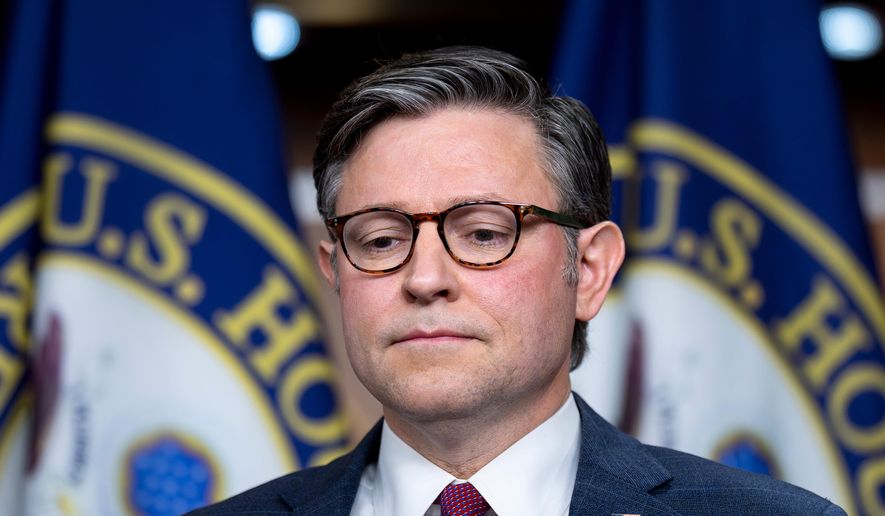

House Speaker Mike Johnson predicted swing-district Republicans who are upset about not renewing expiring Obamacare subsidies will still support the party’s bill to provide alternative ways to lower health insurance costs for all Americans.
The House is scheduled to vote Wednesday on the GOP bill, which includes provisions designed to provide consumers more choices when shopping for health insurance and price transparency on prescription drug costs.
Republicans wanted to use the bill to talk about ideas beyond extending Democrats’ COVID-era expansion of Obamacare premium tax credits, which are set to expire Dec. 31.
But the conversation keeps coming back to the subsidies, as swing-district House Republicans demand a vote on a bipartisan proposal to temporarily extend the pandemic expansion, with changes to guard against waste and fraud.
“House Republican leadership will not allow a vote. It is idiotic and shameful,” said Rep. Mike Lawler, New York Republican, said in a passionate floor speech.
He also hammered House Democratic leaders for refusing to back one of the two bipartisan bills that have been floated and instead pushing a clean three-year extension of the subsidies that the Senate already rejected.
“This place is disgraceful,” Mr. Lawler said. “Everybody wants the upper hand. Everybody wants the political advantage. They don’t want to actually do the damn work.”
Republicans discussed over the weekend how to give swing-district lawmakers a vote to extend the enhanced subsidies amid opposition from others in the conference, but they could not reach an agreement on the language or a spending offset, as required by House rules.
“We looked for a way to try to allow for that pressure release valve, and it just was not to be,” Mr. Johnson said.
The speaker said the hang-up would not derail the broader health care bill.
“They will all join in unity on voting for this bill,” he said. “Instead of just trying to assist 7% of Americans [on Obamacare], this is for 100% of Americans.”
Reps. Brian Fitzpatrick of Pennsylvania and Jen Kiggans of Virginia, who led the two bipartisan bills to extend the enhanced Obamacare subsidies, and other swing-district Republicans were still pushing their proposals as amendments to the bill as the House Rules Committee considered it on Tuesday.
A third proposal from Rep. Nick LaLota, New York Republican, was thrown into the mix at the last minute. His amendment would redirect money the government would spend on the extra subsidies to create a temporary above-the-line health care tax deduction.
Mr. LaLota said he will vote for the Republicans’ health care bill regardless of whether his or any of the other proposed amendments get a vote, because it provides “good long-term solutions.”
But he said “the best approach, and the approach most likely to get 60 votes in the Senate, is a bifurcated approach, with both short- and long-term solutions.”
Ultimately, the Rules Committee rejected all the amendments offered, so none will receive votes on the floor.
It likely won’t be the last word on the topic as Mr. Johnson wants to take up additional health care proposals in the new year. Swing-district Republicans will still push for solutions that provide some kind of a bridge for consumers who have relied on the Obamacare subsidies to afford their health insurance.
The Senate is also not letting the topic die after it failed last week to advance a Democratic bill to renew the enhanced subsidies for three years, and a Republican alternative to direct that government aid into tax-exempt Health Savings Accounts.
A bipartisan group of senators has started discussing a potential hybrid approach marrying the two proposals.
“We’re heading in the right direction,” said Sen. Bernie Moreno, Ohio Republican, suggesting a bipartisan bill could come together in the new year.
Senate party leaders had different assessments on the feasibility of a January deal.
“It’s a complicated issue, no doubt about it,” said Senate Majority Leader John Thune, South Dakota Republican, citing the two parties’ “very different visions about what health care ought to look like.”
He said a path to a bipartisan agreement exists if Democrats are “willing to accept changes that actually would put more power and control and resources in the hands of the American people and less of that in the pockets of the insurance companies.”
Senate Minority Leader Charles E. Schumer, New York Democrat, said Republicans’ insistence on Hyde Amendment language preventing the subsidies from paying for health insurance plans that cover abortion remains a roadblock to a deal, in addition to the timing.
“You can’t do it after Jan. 1,” he said. “It’s not the same as it was before. Once it expires, the toothpaste is out of the tube.”
Mr. Schumer and House Minority Leader Hakeem Jeffries, New York Democrat, are still pushing for a three-year extension of the enhanced subsidies without any tweaks.
Only four Senate Republicans backed Democrats’ bill to do that, nine short of the 60 needed to overcome the filibuster.
Mr. Jeffries’ discharge petition to force a vote on a clean three-year extension in the House has no Republican support and he is not backing discharge petitions on the bipartisan Fitzpatrick and Kiggans’ bills for shorter extensions with changes.
Mr. Fitzpatrick warned the Rules Committee that if none of the bipartisan amendments to extend the subsidies were given votes, that “there will be consequences.”
Although he opposes a clean extension of the enhanced subsidies “without any income limits and any reforms,” Mr. Fitzpatrick left the door open to backing Democrats’ discharge petition as an option of last resort.
“The only thing worse than that would be expiration, and I would make that decision,” he said.
Democrats have made no secret of their plans to use the issue to their advantage in the 2026 midterm elections.
“Donald Trump and extremist Republicans have zero interest in extending the Affordable Care Act tax credits. That’s the reality,” Mr. Jeffries said. “The American people know it.”
• Lindsey McPherson can be reached at lmcpherson@washingtontimes.com.

Please read our comment policy before commenting.