


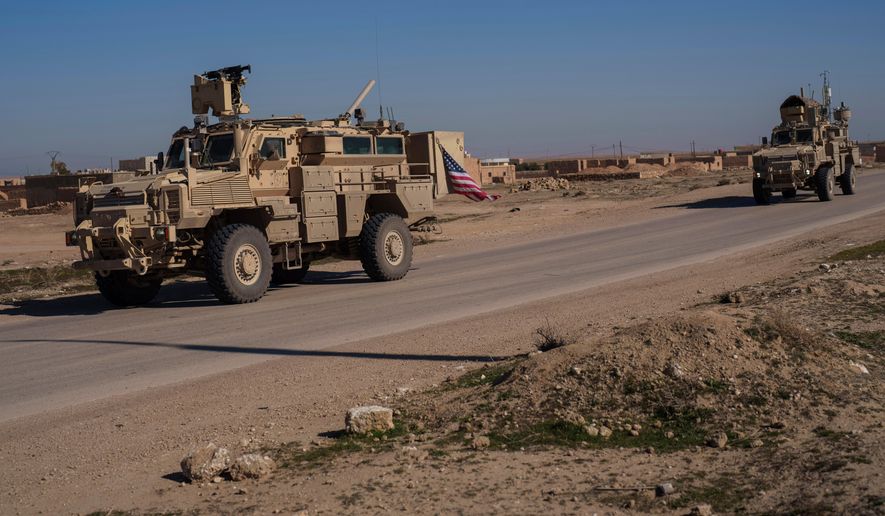

A deadly Islamic State attack in Syria over the weekend has reignited a debate about why U.S. troops are still in the country at all and whether their presence is actually making the Middle East even more dangerous.
Pentagon officials said an ISIS gunman killed two American soldiers and a civilian interpreter and wounded three other service members in a Saturday ambush near the Syrian city of Palmyra. It happened at a delicate moment for the Trump administration and its new ally in Damascus.
U.S.-backed Syrian President Ahmad al-Sharaa, who took over in December 2024 after the toppling of longtime dictator Bashar Assad, will now face tough questions about whether he and his fledgling government are capable of containing the terrorist groups operating on Syrian soil.
Mr. al-Sharaa visited the White House last month amid a full-throated embrace by the Trump administration, which views him as the right leader to bring calm to war-torn Syria despite Mr. al-Sharaa’s past ties to the terrorist group al Qaeda.
In a Truth Social post Saturday after the attack, President Trump suggested that the U.S. and the government of Mr. al-Sharaa will work closely together to retaliate against the perpetrators.
“This was an ISIS attack against the U.S., and Syria, in a very dangerous part of Syria, that is not fully controlled by them,” Mr. Trump wrote. “The President of Syria, Ahmed al-Sharaa, is extremely angry and disturbed by this attack. There will be very serious retaliation.”
The Pentagon said the attack was carried out by a single gunman, who was then “engaged and killed” by U.S. partner forces.
The Associated Press on Sunday reported that the gunman joined Syria’s internal security forces as a base security guard two months earlier and was recently reassigned amid suspicions that he might be affiliated with the Islamic State group.
Pentagon spokesman Sean Parnell said on social media that the troops were conducting a “key leader engagement” at the time as part of U.S. counterterrorism operations.
It wasn’t immediately clear whether the U.S. believes any others were involved in planning the attack.
The identities of the deceased U.S. soldiers and the civilian were withheld until the families were notified.
Iowa Gov. Kim Reynolds said on social media that the two soldiers were members of the Iowa Army National Guard.
Their mission in Syria has remained somewhat mysterious.
The U.S. has kept a contingent of troops in Syria for years, even after Mr. Trump declared in his first term that the Islamic State had been “territorially defeated.” Defeating ISIS, which during its height last decade controlled a vast swath of territory across Syria and neighboring Iraq, was the stated reason for the U.S. putting ground forces in Syria.
In the years since, the U.S. has maintained a force of around 900 to 1,000 troops in the country. That number rose to about 2,000 around the time the Assad government fell to a rebel alliance in December 2024 but is believed to have dropped back down to around 1,000.
The troops are in Syria to conduct counterterrorism operations against the Islamic State, Pentagon officials said.
Some key lawmakers argue that the latest incident proves U.S. forces are also targets, making the entire region more dangerous.
“I don’t think they deter war. I think they basically, because Americans are targets and jihadists around the world think they can get great glory and provoke terrorism by killing an American, that they become potential targets and tripwires to more interaction,” Sen. Rand Paul, Kentucky Republican, told NBC’s “Meet the Press” on Sunday. “Yes, the people who killed our soldiers should be punished. But really, we need to reassess whether or not we should have troops in Syria to begin with.”
Mr. Trump tried to pull all U.S. troops out of Syria during his first term. Pentagon officials and some hawkish leaders in the Republican Party ultimately persuaded him to change course.
Some key Republicans believe those U.S. troops remain crucial to a much broader counterrorism mission. In fact, they argue, the ability of American forces to now partner with the Syrian government against the remnants of ISIS is a positive development.
Until the fall of the Assad government, the chief U.S. partner in Syria was the Kurdish-led Syrian Democratic Forces, which has since reached an agreement with Mr. al-Sharaa’s government to be folded into the Syrian armed forces.
“The United States has, you know, roughly around 2,000 soldiers in Syria, on an important mission to continue the fight to completely defeat ISIS,” Rep. Michael Turner, Ohio Republican and member of the House Armed Services Committee, told ABC’s “This Week” program Sunday.
“President Trump, having had the president of Syria in White House … getting his support for continuing that effort. For the first time, Syria is joining with others to continue that fight to defeat ISIS,” Mr. Turner said. “This is an important mission. We’re training to ensure … the stabilization of the area, both Iraq and Syria, that it’s completed. This is a mission that the White House is committed to and will certainly continue.”
• Ben Wolfgang can be reached at bwolfgang@washingtontimes.com.

Please read our comment policy before commenting.