



If America’s relationship with Europe defined the 20th century, then the 21st century will be marked by Washington’s connections to the Indo-Pacific.
However, the former commander of U.S. Army troops in the region said some people can’t grasp its complexities or immense distances without a map.
In an address to the Gold Institute think tank, retired Gen. Charles Flynn on Thursday noted that the flying time from Hawaii to Guam, America’s farthest western territory, is roughly the same as a flight from Hawaii to the District of Columbia.
“When you’re in Guam, you’re in the second island chain. That’s how big this area of operations is. It’s massive,” Mr. Flynn said.
The Indo-Pacific encompasses two continents — Asia and Australia — and the Southeast Asia archipelago, which serves as a land bridge connecting both. By some estimates, 7 out of 10 people on the planet will be in the region by 2040, he said.
China, which the Biden administration referred to as America’s “pacing challenge,” is amid a construction frenzy. The buildup is part of its Belt and Road Initiative, a Beijing-led global infrastructure and investment program launched in 2013 by President Xi Jinping that aims to connect Asia, Europe, Africa and beyond through land and sea routes.
China is moving ahead with explicitly military building projects as well, including along its mountainous border with India, known as the Line of Actual Control. About 20,000 to 30,000 Chinese troops regularly rotate in and out of the area, Mr. Flynn said.
“In the last five to seven years, they’ve built rail and road infrastructure to move laterally. They’ve also put surface-to-air missile systems there,” he said.
China is continuing to flex its economic muscles by applying pressure to several countries in Southeast Asia, from Cambodia and Laos to Bhutan and Myanmar. Beijing’s coercive campaign is becoming a dangerous security situation, Mr. Flynn said.
“That is why it’s really important for the United States to maintain relations with Vietnam, Thailand and India, the sort of bookends of countries in South Asia,” he said. “And by the way, Thailand is a treaty ally of the United States.”
China’s strategy is to float high-interest construction loans to countries it wants to exploit. When the country can’t repay the loan, Beijing moves in and assumes control over the project, whether it’s a port facility or an airfield. That also means access to its information technology system or electrical grid.
“We have one hell of a time getting them out of these small countries,” Mr. Flynn said.
The U.S. is an Indo-Pacific country not just because of its far-reaching military power, but also because “it has skin in the game.” The people living in Guam and the Northern Marianas are U.S. citizens.
“We can’t forget about this part of the homeland,” Mr. Flynn said.
Retired South Korean Gen. Leem Ho-young, a former deputy commander of the U.S.-Korea Combined Forces Command, said most discussions about possible military action in the Indo-Pacific seem to focus on whether China will invade neighboring Taiwan.
“It seems like they don’t really discuss much about the threat that exists on the Korean peninsula because the two Koreas — the North and the South — are charging up,” Mr. Leem said.
He said President Trump — whom he called “The Global Peacemaker” — will likely prevent any cross-strait invasion of Taiwan.
The Korean Peninsula is another story. Mr. Leem said he spent most of his military career along the tense Demilitarized Zone between the North and South.
“For 50 kilometers to the north and 50 kilometers to the south [of the DMZ], there are about 1 million soldiers there pointing their guns at each other,” he said.
While North Korean officials mouth communist slogans, Mr. Leem said it would be more accurate to call the country a feudal dynasty. The Kim family has run the country since its founding in 1948 by Kim Il-sung.
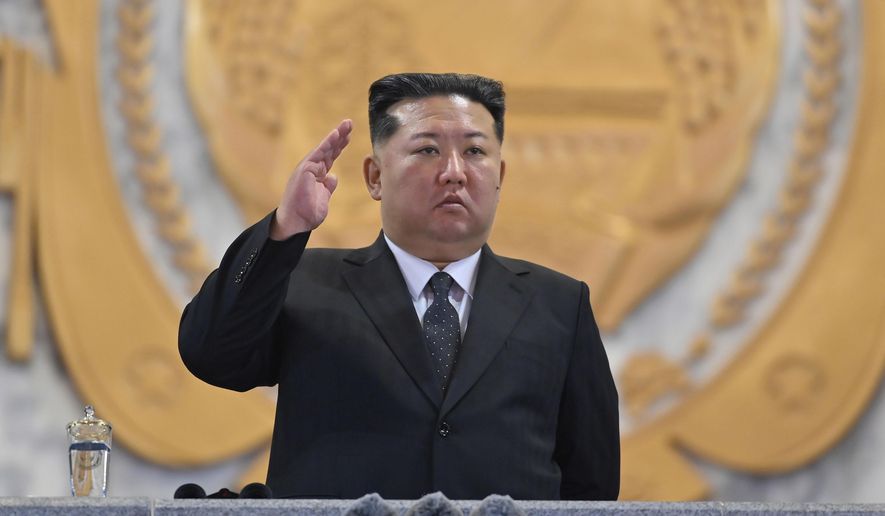
The current supreme leader, Kim Jong-un, has signaled that his chosen heir is his daughter, Kim Ju-ae, who is believed to be 12 or 13. That could be a problem for stability in North Korea, Mr. Leem said, where women are looked down upon.
Mr. Kim is overweight, smokes four packs of cigarettes a day and drinks up to 10 bottles of wine daily. Mr. Leem noted that his father and grandfather died as a result of bad hearts.
“It’s in his bloodline. It wouldn’t be surprising at all if he dropped dead today,” he said. “If that happens, there’s going to be a power struggle in North Korea. The power will be given to the person with a gun. China will pick a faction and support that faction.”
Mr. Leem said he wouldn’t be surprised if the other side in a North Korean internal dispute reaches out to South Korea or even the U.S. for backing.
“If that happens and there are two different military factions in conflict in North Korea, this could lead to a conflict between China, which represents communism, and the U.S. and South Korea, which represent the powers of freedom,” he said. “The issues surrounding Taiwan will seem small by comparison.”
• Mike Glenn can be reached at mglenn@washingtontimes.com.

Please read our comment policy before commenting.