



SEOUL, South Korea — The senior U.S. officer in South Korea on Friday made clear that the conditions for a transfer of wartime operational control of Korean troops from Washington’s to Seoul’s command are not yet in place.
U.S. Forces Korea Commander Gen. Xaiver Brunson was speaking one day after local reports revealed that the U.S. military was taking full control of access to a joint air base recently raided by Korean investigators on a search-and-seizure mission.
Hovering in the background of both developments are high-profile domestic issues. Both have ramifications for the degree of trust uniting or dividing the two allies.
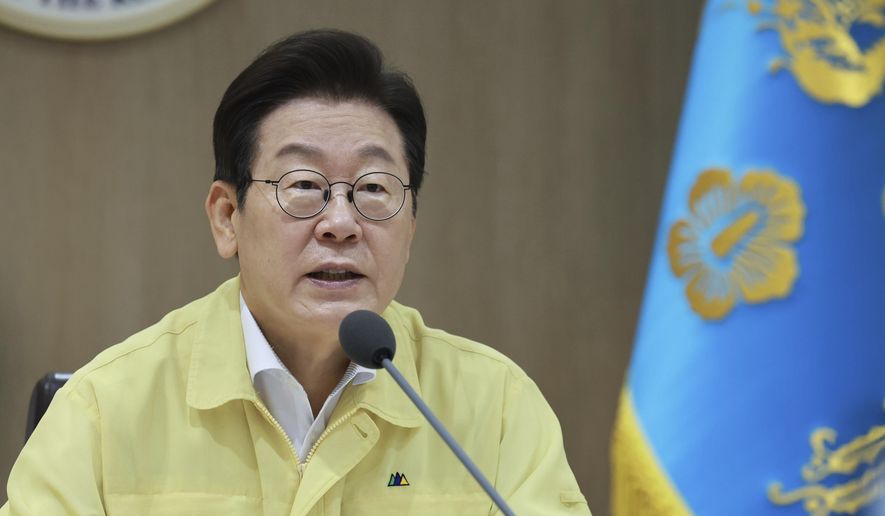
One of those issues is President Lee Jae-myung’s push to realize “OPCON Transfer” by the end of his term, in 2030.
“I know that, right now, President Lee says he wants to do this during his term of office,” Gen. Brunson told a webinar co-hosted by the Korea Defense Veterans Association and the Korea-U.S. Alliance Forum. “We cannot say we’re going to slide away from the conditions, just so that we can get this done in time.”
The full details of the conditions to be met by the South Korean armed forces have never been made public but are believed to include proven command and control skill sets and technologies, and the acquisition of advanced intelligence, reconnaissance and surveillance assets.
The conditions also shift as developments on the peninsula shift. The last set of conditions, The Washington Times understands, dates back to the Moon Jae-in administration, in office between 2017 and 2022.
Since then, North Korea has signed a mutual defense treaty with Russia, fought in the Ukraine War and is obtaining Russian military technologies, while also advancing its nuclear stockpile and delivery vehicles.
“The conditions were written for a reason, but we also have to make sure that those conditions are contemporary conditions, because things change,” Gen. Brunson said. “That is, when the conditions were laid out, we had a plan. We now have a new plan. What is going to be required to meet the new plan?”
Seoul controls its own forces in peacetime, but the concept of a wartime command transition from Washington to Seoul was initiated by the liberal Roh Moo-hyun administration (2003-2008).
It was subsequently slow-walked by conservative governments.
Customarily, liberal Seoul presidents have sought greater defense sovereignty and autonomy. They include Mr. Lee, who has not only reinvigorated the OPCON Transfer process, but also won approval from U.S. President Trump for the development of a Korean nuclear-powered submarine force during their summit in October.
Conservative Korean presidents, by contrast, have made subordination to the U.S. alliance central to their defense policies — downplaying sovereign capabilities such as nuclear subs and aircraft carriers.
Defense pundits are wary of OPCON Transfer, which would — on paper, at least — make the 28,000 Americans in U.S. Forces Korea subordinate to a Korean general.
At present, the allies’ joint warfighting mechanism, Combined Forces Command, is led by a U.S. four-star general, with a Korean general as his deputy.
Pundits do not believe that Washington would permit U.S. forces to be commanded by a foreign general. They also fret that, if CFC were disbanded, unity of command would be lost.
These factors speak to broader fears: That OPCON Transfer could trigger a downsizing of U.S. forces in Korea and a related dilution of Washington’s commitment to Seoul’s defense.
The other domestic issue that has generated alliance friction stems from Mr. Lee’s wide-ranging probe into the botched attempt by former President Yoon Suk Yeol’s government to install martial law in December 2024.
Mr. Yoon, his wife and several of his senior officials are in jail, pending trials. The investigation has also ensnared religious groups, civil servants and private citizens.
It is being conducted by empowered and zealous prosecutors, who, in July, raided Osan Air Base. South of Seoul. Osan houses major U.S units, including the 7th Air Force HQ, fighter squadrons and intelligence assets, as well as Korean commands.
Leading vernacular media, the Chosun Ilbo, citing informed sources, reported Thursday that the U.S. is taking full control of base access. The Chosun’s exclusive was fleshed out by other media reports, which confirmed the report with U.S. units, who said new gate controls would enhance security.
At the time of the raid, the U.S. controlled two gates to the base, while a third gate, through which the investigators entered, was jointly operated.
Prosecutors were reportedly seeking radar data to confirm suspicions that the Yoon administration deployed drones over Pyongyang in October 2024 to stoke inter-Korean tensions, laying a firm foundation for martial law.
While the early U.S. response was muted, the raid clearly caused ripples.
In October this year, U.S. 7th Air Force Commander Lt. Gen. David Iverson reportedly wrote to South Korea’s Foreign Ministry, stating that the prosecutors’ entry had violated the Status of Forces Agreement between the two allies.
Prosecutors responded that they encountered no U.S. personnel during their raid, had only investigated Korean personnel and records, and did not violate SOFA.
Yang Uk, a security specialist at Seoul think tank the Asan Institute, is critical of what he considers unrealistic expectations surrounding OPCON Transfer.
Under the current plan, “everyone expects the CFC to be led by a Korean four-star, but the hard truth is, we cannot lead U.S. armed forces,” he said. “I am not even sure there would be a U.S. reinforcement from the U.S. mainland if something happened” in terms of combat with North Korea.
If a contingency did break out, and the CFC was defunct, the presidents of South Korea and the United States would have to bilaterally agree on a joint command agreement — hardly an ideal situation amid a security crisis.
“If there is wartime — nobody declares war anymore — what are the conditions?” wondered Daniel Pinkston, a Seoul-based academic who teaches international relations at Troy and Yonsei universities. “The Korean president and U.S. president would have to agree to stand up war-fighting structures to maintain unity of command.”
Mr. Yang was grateful to Gen. Brunson for his plain talking.
“He is trying to make people see that we are not there yet; he is trying to speak up,” he said. “USFK is a four-star command, but it could shrink to a three-star command.”
He was critical of the Korean investigators.
“These prosecutors thought they could go all the way into restricted areas,” he said. “USFK was kind of offended, and they should have been. It’s absurd!”
Mr. Pinkston, a U.S. Air Force veteran, offered a different view.
“Yoon was trying an autocoup and declared martial law, and any participation in that is unconstitutional, so why would anyone obstruct [an investigation]?” he wondered. “If the prosecutors had tipped anyone off, they could have removed any incriminating evidence.”
He warned that U.S. resistance to a Korean domestic investigation, conducted by lawful authorities, on sovereign soil, would present a very bad optic.
“If the Americans are being oversensitive, what does that signal?” he asked.
• Andrew Salmon can be reached at asalmon@washingtontimes.com.

Please read our comment policy before commenting.