


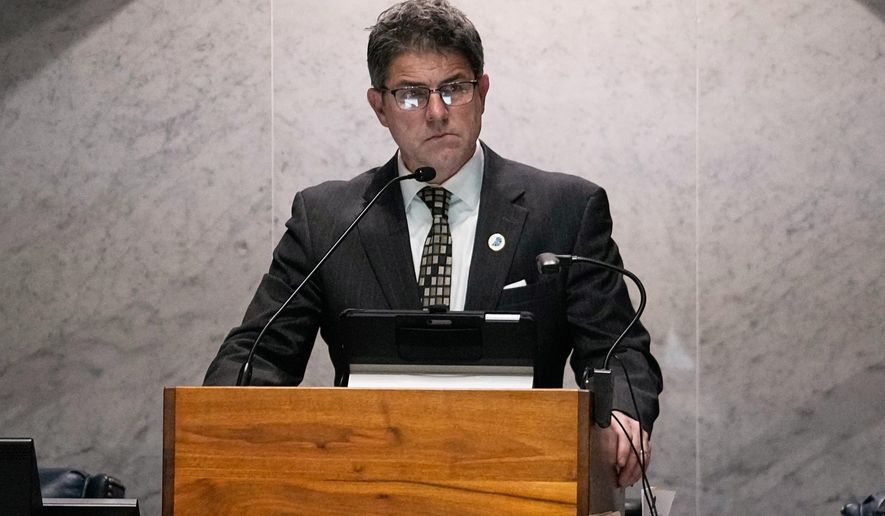

President Trump and his allies are mounting a final full‑court press on Republican holdouts in the Indiana state Senate as the fight over new congressional maps hangs in the balance.
On the eve of Thursday’s vote, Mr. Trump zeroed in on Senate leader Rodric Bray, blasting him as “either a bad guy, or a very stupid one” and accusing him of siding with “radical left” Democrats.
On Truth Social, the president warned that any Republican who votes against redistricting could expect a MAGA‑backed primary challenge. “Rod Bray and his friends won’t be in politics for long, and I will do everything within my power to make sure that they will not hurt the Republican Party, and our country, again,” Mr. Trump wrote.
Mr. Bray, whose father and grandfather represented Indiana in public office, isn’t up for reelection until 2028.
Still, he and other Republicans who oppose the maps — or have been coy about their plans — have come under immense pressure to fall in line. Some have even faced threats of pipe bombs, firebombs and swatting.
House Speaker Mike Johnson, Louisiana Republican, has also weighed in, urging Indiana GOP senators to support the plan, which the state Senate is expected to take up on Thursday.
Meanwhile, the Fair Maps Indiana Action super PAC pledged to spend “seven figures” backing lawmakers who vote for redistricting while working with other groups to recruit primary challengers against those who don’t. The group’s leaders include Chris LaCivita, a senior adviser to Trump’s 2024 campaign.
Brett Galaszewski of Turning Point Action warned that if the Indiana Senate rejects the maps, it will trigger “a multiyear primary bloodbath.”
“We’re talking more money pouring in than many congressional races ever see,” he said. “These Republican senators will go from hero to zero overnight.”
Despite the pressure, several of Indiana’s 40 Republican senators have signaled they won’t budge — a display of what observers call “Hoosier individuality,” a refusal to act simply because Washington demands it.
“I’m a no, and there’s no way — absolutely no way — I’ll change my mind,” state Sen. Mike Crider told reporters in Indianapolis this week.
The Republican said the pressure campaign has left a bad taste in his mouth, lamenting how his wife felt the need to close the drapes of their home and found herself reading emails that said their house was going to be “firebombed in the middle of the night.”
“When you get kind of bullied and threatened, if that tactic works, you can expect to deal with that for the rest of your political career,” he said. “You start pushing on me, you are going to get a reaction.”
Political observers note that even if the maps pass, the GOP would likely net only two seats — hardly a game changer for the 2026 midterms.
Mr. Trump himself acknowledged this week that redistricting may not save Republicans.
“For whatever reason, and no one has been able to give me an answer, when you win the presidency, you seem to lose the midterms — even if you win the presidency a lot, and you do a great job as president,” he said. “It doesn’t make sense. Usually, I can figure things out.”
An AP‑NORC poll released Thursday underscored the challenge: Mr. Trump’s approval rating is stuck at 36%, the lowest of his term. Just 31% approve of his handling of the economy, and his marks on immigration — once a strength — have slipped as well.
The survey caps a year of Republican setbacks at the ballot box, energizing Democrats as they prepare for midterms in which the GOP must defend its slim House majority.
For now, all eyes are on Indiana, which is serving as the latest test of Mr. Trump’s political reach.
“Redistricting has become a de facto measure of approval for President Trump,” said Laura Merrifield Wilson, a political science professor at the University of Indianapolis. “While his work in office could be evaluated on many metrics, the maps have subsumed all other issues in state policy right now.”
• Seth McLaughlin can be reached at smclaughlin@washingtontimes.com.

Please read our comment policy before commenting.