



A version of this story appeared in the daily Threat Status newsletter from The Washington Times. Click here to receive Threat Status delivered directly to your inbox each weekday.
KYIV, Ukraine — Russia’s barrage of missile and drone attacks against Ukraine’s energy infrastructure has intensified just days ahead of Christmas and the cold winter months that follow. In recent weeks, wave after wave of strikes have pounded power stations, substations and heating networks across the country, triggering blackouts on a scale not seen since early 2024.
The attacks have forced Kyiv to lean on emergency U.S. natural gas imports as engineers race to keep the lights on. Residents in the capital city have described “explosions echoing for hours” as air defenses struggle to intercept drones launched in swarms of dozens at a time.
“We do our laundry at 2 a.m., or we go to work at our colleagues’ when we don’t have power at home. We survive,” said Iulia, a resident of Kyiv.
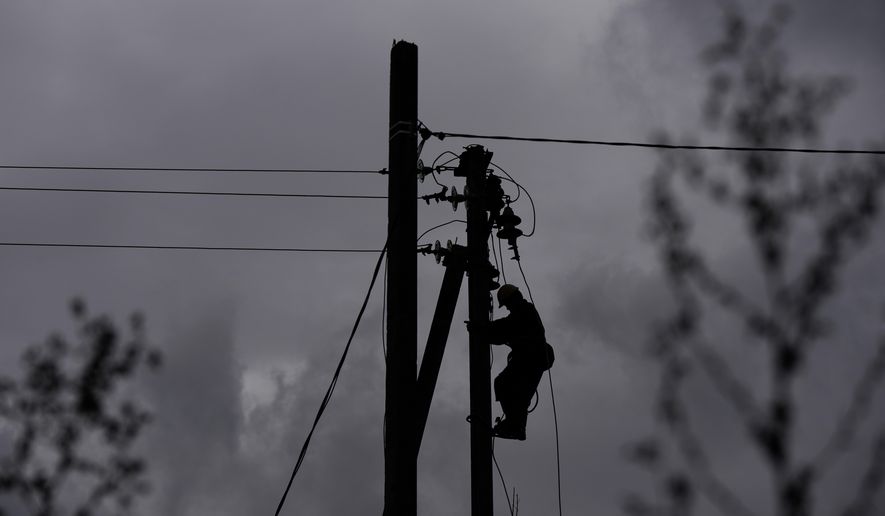
For Ukrainians such as Iulia, checking the local energy provider’s website to find out whether there is an outage and planning accordingly is now part of their daily routine. On the sometimes pitch-black streets of Kyiv, the hum of diesel generators is now a fixture.
“This is done so people stay cold and in the dark,” a tactic that “perfectly fits the basic definition of terrorism,” Maksym Timchenko, the CEO of DTEK, the country’s largest private energy operator, told The Washington Times.
“These attacks have become much more intense. They now hit one power station with 10 to 15 drones, plus cruise and ballistic missiles, all launched in waves,” Mr. Timchenko said. “They use the full diversity of weapons against purely civilian infrastructure. Nothing they target is related to military facilities.”
Ukrainian President Volodymyr Zelenskyy has repeatedly asked Western allies, especially the United States, for additional air defense systems to be supplied to the embattled nation.
“Russia is not changing its tactics here and is still trying to inflict such pain on Ukraine before winter. It is important that we are fighting back. It is important that there are shoot-downs,” Mr. Zelenskyy said in a recent video address.
The strikes have made Ukraine’s already fragile situation even more perilous. Months of systematic shelling have destroyed key elements of the power grid, including the Trypilska and Zmiivska power plants, and repeated hits on high-voltage substations have forced the grid operator to impose rolling cuts.
According to recent assessments by the International Energy Agency, on the worst days of Russian assaults, Ukraine’s power grid has fallen to about half the capacity it produced when Russia launched its full-scale attack in February 2022.
Although not a single sector of Ukraine’s economy can be said to have been spared by Russia’s wanton destruction, the country’s energy sector has borne a disproportionate share of war damage. According to the latest joint assessment for 2022-2024 by the World Bank and the United Nations, the total reconstruction needs across the country now stand at $524 billion, of which the energy and extractives sector alone represents roughly $68 billion.
Reconstruction efforts have restored some capacity. In the fall, Ukraine regained several gigawatts, and imports from neighboring grids helped bridge part of the gap. Still, even with improvements, the system remains fragile, with a heavy dependence on a shrinking number of large plants and on imported electricity.
“There is a feeling that Russia has changed its tactics,” Oleksandr Kharchenko, a leading Ukrainian energy strategist, said in a recent interview with the Ukraine Media Center. “During the last strikes, there were attempts to tear front-line regions away from power supply. Substations that no one paid attention to before are now intensely targeted, and they remain unprotected.”
Mr. Timchenko echoed his assessment: “They are trying not only to destroy power generation but to break our energy system into parts. They want to make it impossible to move power from west to east.”
Thermal power operators have become frequent targets, and their capacity to absorb repeated strikes is reaching limits.
According to DTEK, repairs that once took a week can now require a month because of equipment shortages and escalating damage.
“We rebuild each time the Russians destroy,” Mr. Timchenko said. “But this truly requires time, much effort, equipment and gas imports to compensate for the destruction. Without these, the risks this winter are enormous.”
As Russia intensifies its aerial offensive, Ukraine is accelerating efforts to secure alternative fuel supplies. In November, Kyiv received its first cargo of U.S.-sourced liquefied natural gas through Lithuania’s Klaipeda terminal. DTEK described the delivery as a “critical step” in diversifying Ukraine’s winter supply routes.
The government has since signed a separate agreement with Greece to transport additional volumes of American LNG through the “Vertical Corridor,” a pipeline complex that moves gas from Greece north to European destinations. Shipments are set to continue throughout the winter.
Domestic production alone cannot cover Ukraine’s needs after months of Russian strikes. Natural gas output has fallen by up to 40% in some regions, forcing Kyiv to rely increasingly on imports from the United States and European partners. According to Naftogaz, Ukraine could import as much as 1 billion cubic meters of U.S. LNG in 2026.
Yet even these emergency measures face risks. Russian missiles have struck the infrastructure that links Ukraine’s western regions to European power and gas grids, essential lifelines for households and industry.
With each attack, the country’s energy planners must decide which facility to protect, which to restore and which to sacrifice.
As Russia intensifies its bombardment of Ukraine’s power grid, Kyiv is also facing mounting diplomatic pressure from its Western partners to explore potential off-ramps to the conflict, including trading land for peace.
According to The Associated Press, Ukraine was expected to hand its latest peace negotiation counteroffers to the U.S. on Wednesday, one day ahead of a round of talks between Mr. Zelenskyy and leaders and officials from about 30 other countries supporting Kyiv’s effort to end the war with Russia on acceptable terms.
A U.S. national security strategy released last week made clear that Mr. Trump wants to improve Washington’s relationship with Moscow and “reestablish strategic stability with Russia” — a potential shift that has European leaders scrambling.
Several have described the coming weeks as a “pivotal phase” in diplomacy, though they emphasize that any agreement must avoid rewarding Russian aggression or legitimizing Moscow’s battlefield gains.
On the ground, however, the military situation remains volatile. Russia has intensified pressure along several axes, including renewed assaults in the Zaporizhzhia region and persistent probing attacks in Ukraine’s northern border regions. In the east, Moscow’s forces continue to push around Pokrovsk and other contested towns, incrementally advancing despite heavy losses.
For the Kremlin, freezing Ukraine into submission has become a central objective. Meanwhile, for Kyiv and its allies, ensuring the lights stay on has become an essential front in the struggle for survival.

Please read our comment policy before commenting.