


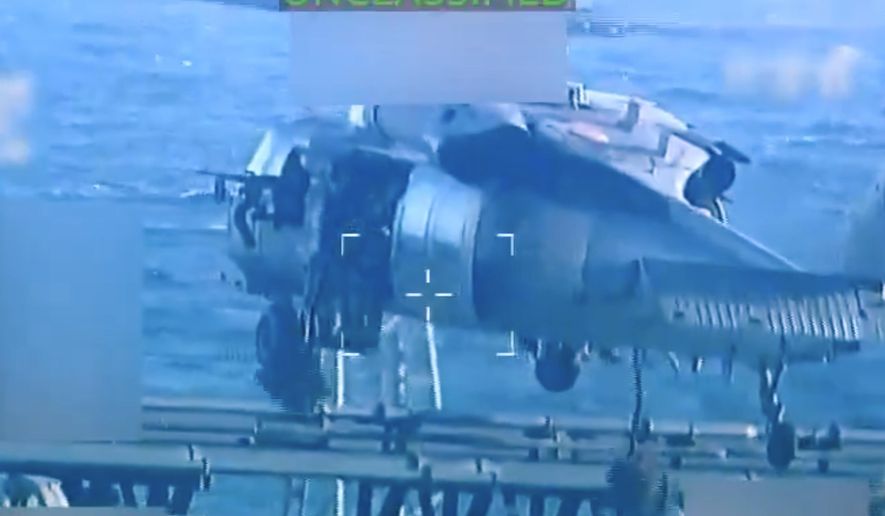

President Trump said Wednesday that U.S. forces seized a sanctioned oil tanker off the coast of Venezuela, a move that will likely inflame an already tense standoff between Washington and Caracas.
U.S. officials said the seizure was a “judicial enforcement action” carried out by the Coast Guard with support from the Navy.
“We’ve just seized a tanker on the coast of Venezuela,” Mr. Trump said at a White House roundtable to talk about the economy. “Large tanker. Very large. Largest one ever seized, actually.”
“It was seized for a very good reason,” Mr. Trump said.
As for what will happen to the oil, Mr. Trump said, “We’ll keep it, I guess.”
The president declined to disclose who owned the tanker, under which flag it flew or where it was headed. He did hint that more developments were forthcoming, saying, “Other things are happening.”
The Navy and the Coast Guard referred requests for comments to the White House, which did not respond.
The USS Gerald R. Ford, an aircraft carrier Mr. Trump dispatched to the region last month, was said to be involved in the seizure, according to The Associated Press.
The seizure of the oil tanker signals that Mr. Trump is turning up the pressure for regime change against Venezuela’s socialist dictator, Nicolas Maduro. The Trump administration has repeatedly accused Mr. Maduro of running a massive drug trafficking operation, a claim the Venezuelan leader denies.
Crude oil futures jumped on the news of the seizure. Prices on the New York Mercantile Exchange rose from roughly $58 per barrel at noon to $59 per barrel by late afternoon trading.
The seizure will make it significantly more difficult for Venezuela to export its oil to other countries. Other shippers, fearing additional seizures, will be unlikely to load Venezuelan oil onto their vessels.
Venezuela exported more than 900,000 barrels per day of oil last month, its third-highest monthly average so far this year. State-run oil company PDVSA has been producing oil at a rapid pace as Venezuela offers deep discounts to its leading buyer, China, in an effort to avoid competition from discounted oil from sanctioned Russia and Iran.
The South American nation has the world’s largest oil reserves but has been crippled by U.S. sanctions that have left China and Cuba (which is also subject to U.S. sanctions) as its most lucrative markets.
Venezuela produces about 1 million barrels of oil per day. Locked out of global oil markets by U.S. sanctions, the state-owned oil company sells most of its output at a steep discount to refiners in China.
Caracas has sought to evade those sanctions by using a complex web of shell companies registered in jurisdictions known for secrecy. The buyers deploy “ghost tankers” that conceal their locations and transport the oil in the middle of the ocean before it reaches its final destination.
In 2020, during the first Trump administration, the U.S. seized 1.1 million barrels of Iranian fuel from four vessels that were headed to Venezuela. The Justice Department said the action disrupted a multimillion-dollar shipment by the Islamic Revolutionary Guard Corps, which the State Department designated as a foreign terrorist organization. It was the largest-ever seizure of fuel from Iran.
The oil tanker seizure was announced hours after Venezuelan opposition leader Maria Corina Machado missed the Norway ceremony to collect her Nobel Peace Prize. Ms. Machado has been in hiding in Venezuela since January and has been barred by the government from leaving the country. She has dedicated the prize to Mr. Trump “for his decisive support of our cause.”
Mr. Trump has turned up the heat on Mr. Maduro in recent months. Since September, the U.S. has carried out more than 20 strikes against alleged drug-trafficking vessels in the waters near Venezuela and Colombia, killing more than 80 people.
The arrival of the USS Gerald R. Ford increased the number of U.S. military forces in the region to a level not seen in decades. In addition, Mr. Trump has dispatched 11 warships, scores of airplanes and thousands of troops to the region.
On Monday, U.S. fighter jets buzzed the Venezuelan coastline, the closest the military has come to breaching the nation’s territory.
The president said he is considering military action against Venezuela, including strikes on land, as part of his administration’s campaign against drug trafficking. During a call last month with Mr. Maduro, Mr. Trump reportedly told him to resign and leave or else.
Mr. Trump reportedly rejected Mr. Maduro’s demands that he be allowed to maintain control of the Venezuelan military if he allows free elections and is given amnesty for his crimes.
• This article is based in part on wire service reports.
• Jeff Mordock can be reached at jmordock@washingtontimes.com.

Please read our comment policy before commenting.