



A version of this story appeared in the daily Threat Status newsletter from The Washington Times. Click here to receive Threat Status delivered directly to your inbox each weekday.
NEWS AND ANALYSIS:
President Trump this week allowed Nvidia to sell its advanced H200 microchips to China — a decision that came the same day his Justice Department announced arrests in connection with a criminal ring smuggling the same chips to China, where the Chinese military was to use the high-end contraband.
Mr. Trump said on social media he informed Chinese President Xi Jinping that the Nvidia artificial intelligence chips will be sold to “approved customers” in China under conditions that will “allow for continued strong National Security.”
“President Xi responded positively!” the president stated, noting that Nvidia will pay the government 25% of the sales.
The Justice Department, meanwhile, called the smuggling ring arrests a victory in preventing China from building up its military through the use of advanced American AI chips.
Two Chinese nationals in custody in the case are accused of smuggling cutting-edge Nvidia H200 and H100 chips to China in violation of U.S. export controls and smuggling laws, the department said in a statement.
“These chips are the building blocks of AI superiority and are integral to modern military applications,” said Nicholas J. Ganjei, U.S. attorney for the Southern District of Texas. “The country that controls these chips will control AI technology; the country that controls AI technology will control the future.”
Mr. Trump, in his Truth Social post, said his decision to allow the legal export of the advanced chips will support American jobs, strengthen U.S. manufacturing and benefit taxpayers. “We will protect National Security, create American Jobs, and keep America’s lead in AI,” he said.
Nvidia is developing more advanced Blackwell chips and will soon have an even more advanced chip called Rubin, “neither of which are part of this deal,” Mr. Trump said, adding that the administration will always put America first.
The Commerce Department is finalizing the details and the same export approach will apply to other U.S. chipmakers, the president said.
The Texas smuggling case involved the seizure of over $50 million in Nvidia technologies and cash, the Justice Department said.
In China, state media reported that Beijing could balk at buying the H200 chips over export control requirements that could include monitoring how the chips are being used.
The latest announcement of loosening export controls on AI chips is the second time the president gave in to Chinese demands for the unique U.S. semiconductors that are critical in the U.S.-China race for AI supremacy.
In July, the Trump administration agreed to permit less advanced Nvidia AI chips to be sold to Beijing, reversing a policy that had sought to prevent U.S. technology from accelerating the Chinese military buildup.
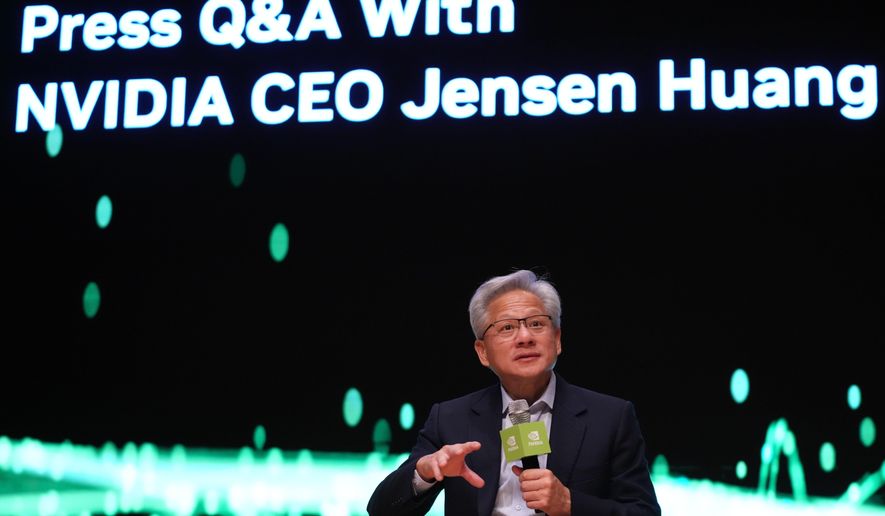
The July concession involved permission for Nvidia to export H20 AI chips. That followed a meeting at the White House between President Trump and Nvidia CEO Jensen Huang, who has lobbied to allow sales of AI chips to China.
H200 semiconductors are gauged to be about 10 times less powerful than Nvidia’s newer Blackwell chip. However, the H200 is said to be six times more powerful than the H20 that is currently being sold to Beijing.
The new export control concessions appear aimed at Mr. Trump’s bid to improve relations with China.
China has been a major target of U.S. tariffs under Mr. Trump and earlier this year retaliated by imposing curbs on Chinese exports to the U.S. of rare earth minerals used in goods ranging from autos to fighter jets.
The administration announced in April that exports of AI chips produced by Nvidia and Advanced Micro Devices would be strictly controlled over fears China will use the chips to power more lethal weapons enhanced with artificial intelligence.
Before loosening the curbs, Lin Jian, a Chinese Foreign Ministry spokesman, had said the U.S. was “politicizing, instrumentalizing and weaponizing tech and trade issues” and had made “malicious attempts to blockade and keep down China.”
Two China experts, Josh Hodges and Michael Sobolik, warned the Nvidia chips will be used to strengthen the Chinese military machine and undermine U.S. efforts to win an AI development race.
“In what race, though, does a runner win by equipping an opponent? In what war has a nation ever gained decisive advantage by arming its adversary?” Mr. Hodges and Mr. Sobolik wrote in Foreign Policy magazine.
“Exporting advanced AI chips to China would plug a gaping hole in China’s tech stack,” they stated.
Mr. Hodges is a member of the U.S.-China Economic and Security Review Commission, and Mr. Sobolik is a senior fellow with the Hudson Institute.
On Capitol Hill, several Republicans and Democrats criticized the plan to sell the H200 chips.
The House Select Committee on the CCP said exports of the high-powered Nvidia chips will help China catch up the U.S. in computing power. China also will “rip off” U.S. technology from the chips.
“The CCP will use these highly advanced chips to strengthen its military capabilities and totalitarian surveillance,” the committee said in a post on X.
Backing Japan over China radar lock on jets
The State Department on Tuesday offered its first muted backing for Japan over an incident last week involving a threatening radar illumination of two Japanese fighter jets by two Chinese fighters.
“China’s actions are not conducive to regional peace and stability,” a State Department spokesman said in a statement.
“The U.S.-Japan Alliance is stronger and more united than ever. Our commitment to our ally Japan is unwavering, and we are in close contact on this and other issues,” the spokesman said.
The statement issued in the name of an unidentified spokesman carries less weight than official statements that carry a spokesman’s name, or in some cases in showing stronger support, by statements attributed directly to Secretary of State Marco Rubio.
The muted response comes amid President Trump’s effort to play down threatening activities by China in seeking to conclude a trade deal with China. The president has announced plans for reciprocal summits, with a meeting in China with Chinese President Xi Jinping set for April.
The response late Tuesday was the first official U.S. response to an incident Saturday involving two Chinese fighters operating from the aircraft carrier Liaoning.
A Pentagon spokeswoman did not immediately respond to a request for comment.
The jets twice illuminated two Japanese Air Self-Defense Force jets with what are believed to be targeting radar, an action Tokyo called dangerous.
The incident occurred near the Japanese island of Okinawa and followed a fierce anti-Japan propaganda campaign by Beijing over remarks by Prime Minister Sanae Takaichi who suggested in remarks to parliament that Japan would defend Taiwan from a Chinese attack.
A Chinese Foreign Ministry spokesman, Guo Jiakun, did not criticize the State Department comments but said the training and exercises were in line with international law and conducted in a restrained manner.
China said the Japanese jets approached and disrupted Chinese navy activities during training in waters east of the Miyako Strait.
An aircraft radar lock-on is considered a provocative military action because it can be the first step before firing an air-to-air missile.
Modern jet fighters are equipped with defensive systems that can detect radar illumination.
Congress seeks new details on Chinese leaders’ wealth
A provision of the fiscal 2026 defense authorization bill working its way through Congress includes a new requirement for U.S. intelligence agencies to provide more details on the hidden wealth of Chinese communist leaders.
The provision was added after members of Congress were not satisfied with a similar required report produced by intelligence agencies that critics say focused more on Chinese corruption instead of the estimated hundreds of millions, or billions, of dollars said to be hidden in the leaders’ domestic investments and offshore bank accounts or real estate holdings.
The new report will require the Pentagon, State Department and intelligence agencies to limit the scope of the report to “the wealth of the leadership of the Chinese Communist Party.”
Elements to be included will be assessments of the personal wealth, financial holdings and business interests of Chinese Communist Party General Secretary Xi Jinping, and all members of the ruling Politburo Standing Committee, the seven-member collective dictatorship at the top of the party.
Congress also wants to see intelligence on the physical and financial assets owned or controlled by CCP leaders in China, Hong Kong and Macau; “high value” personal assets, and financial wealth outside mainland China.
Also, the report will be required to identify financial proxies, business associates, and other entities used by the leaders to obscure their wealth and assets.
The legislation also requests “nonpublic information” about the leaders’ wealth within the constraints protecting intelligence sources and methods.
The last report was required under 2023 legislation and was not made public until March. It was called “Wealth and Corrupt Activities of the Leadership of the Chinese Communist Party.”
That limited six-page report stated that Mr. Xi holds at least $1 billion in hidden wealth through relatives.
Most of the report focused on corruption with limited details on hidden wealth and the sections on CCP leaders’ holdings was based largely on press reporting from several years ago.
Paul Berkowitz, a China expert and former congressional aide, criticized the report as insufficient to the legislative requirement. “This pathetic seven-page report, two-and-a-half years in the making, is an insult to Secretary of State Rubio who requested it by law in December 2022, Director [Tulsi] Gabbard who released it, President Trump who needed it to protect our nation, and the American people who funded it,” he said at the time of the report’s release.
• Contact Bill Gertz on X @BillGertz.
• Bill Gertz can be reached at bgertz@washingtontimes.com.

Please read our comment policy before commenting.