


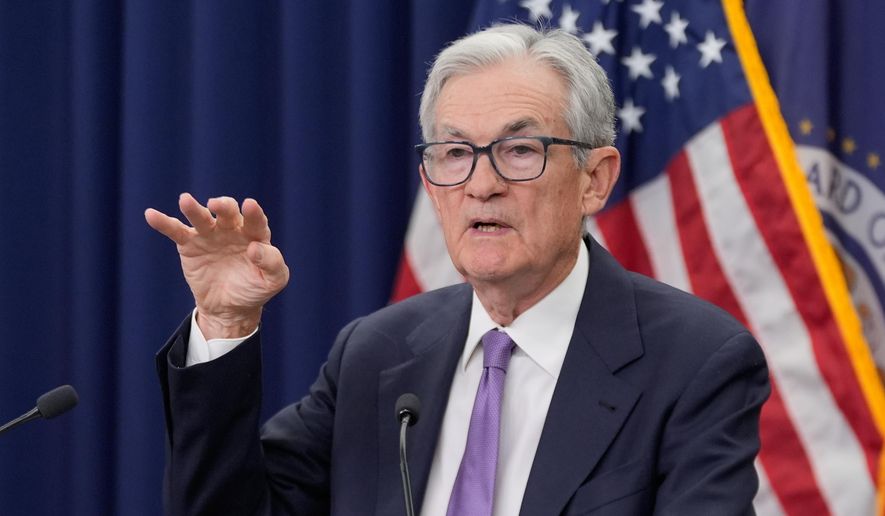

The Federal Reserve cut interest rates Wednesday by 0.25%, its third successive cut, as hiring woes overtake inflation fears as the central bank’s main concern.
The Federal Open Market Committee lowered its benchmark rate to 3.5% to 3.75% because job gains have slowed and the unemployment rate has edged upward in recent months.
“A good part of the slowing likely reflects a decline in the growth of the labor force, due to lower immigration and labor force participation, though labor demand has clearly softened as well,” Fed Chair Jerome Powell said in a press conference. “The downside risks to employment appear to have risen in recent months.”
The Fed’s decision moved monetary policy in President Trump’s preferred direction.
It’s still not aggressive enough for a White House that wants bold action from the central bank and a soon-to-be-named successor to Mr. Powell.
Mr. Trump said even lower rates would jump-start the economy as he confronts gripes about “affordability” heading into the midterm election season.
Mr. Trump’s recent appointee to the Fed, Stephen Miran, pushed for a 0.5% cut. Two other committee members, Austan Goolsbee and Jeffrey Schmid, wanted to keep rates frozen.
Central bankers have been divided on whether to cut rates to stimulate hiring or keep rates frozen, given stubborn inflation that is closer to an annual rate of 3% than the Fed’s target rate of 2%.
“While this will never be formalized or admitted publicly, the Federal Reserve’s inflation target has effectively been raised to 3% from 2%. Hence, we are in the midst of a rate-cutting cycle despite inflation remaining around 3% since mid-2023,” said Tom Hulick, CEO of Strategy Asset Managers, an investment management firm.
Fed decisions affect interest rates for savings, loans and investments, influencing consumer spending and business activity.
Stock markets reacted positively to the move. The Dow Jones Industrial Average rose 497 points, or 1%, to close at 48,057. The Nasdaq and S&P 500 also gained.
The Fed cut rates incrementally, by 25 basis points (0.25%) in three consecutive meetings, after employment reports showed a marked slowdown in hiring this year.
Central bankers were flying blind in recent weeks, because the Bureau of Labor Statistics couldn’t collect price data or survey businesses during the government shutdown from Oct. 1 to Nov 12.
Mr. Powell said the Fed relied on available data from other sources to inform its decision.
Kishore Kulkarni, a distinguished professor of economics at the Metropolitan State University of Denver, said the rate cut was sensible because the Fed’s preferred measure of inflation was “not very high,” at 2.8%, except for a few items such as beef and vegetables, where prices increased more.
“So it is quite a good step, in my opinion,” he said.
Mr. Powell said consumer spending remains solid, but activity in the housing sector remains weak, and the government shutdown weighed on economic activity.
Mr. Trump desperately wants the Fed to continue cutting rates. He says borrowers deserve better terms as he reshapes the economy and is furious at Mr. Powell for declining to cut rates earlier.
The president said he is close to naming a successor to Mr. Powell, whose term ends in May.
“We’re going to be looking at a couple of different people, but I have a pretty good idea of who I want,” Mr. Trump said Tuesday.
White House National Economic Council Director Kevin Hassett is considered the front-runner for the job.
Mr. Hulick said the words of this “shadow chair,” once named, will have a bigger impact on forward-looking markets than Mr. Powell’s through May.
Already, the president is reshaping the Fed.
He appointed Mr. Miran, a top White House economic official, to the Fed Board of Governors this year, and Mr. Miran quickly advocated for steeper rate cuts.
Other members have been more cautious. They said rate cuts would not address the underlying problems in the labor market and could exacerbate inflation, as Mr. Trump’s tariffs and other factors raise cost concerns.
Mr. Powell downplayed the level of dissent within the committee. He said it was a result of the tension between the Fed’s twin mandates of maximum employment and stable prices.
He said the committee’s discussions were thoughtful and civil.
Mr. Powell said recent decisions should stabilize the labor market while letting inflation continue its downward trend toward 2%, “once the effect of tariffs has passed through.”
The consumer price index, a key measure of inflation, soared to 9% in 2022 during the Biden administration and dropped to 3% on an annual basis. Although the rate of increase has cooled significantly, prices are still rising, posing a challenge for Mr. Trump.
The president says he inherited the problem.
Democrats “gave you the highest inflation in history, and we’re bringing those prices down rapidly — lower prices, bigger paychecks,” Mr. Trump said Tuesday at a rally in the Poconos region of Pennsylvania.
His speech effectively kicked off a midterm campaign season that is expected to focus on pocketbook issues. Republicans are clinging to narrow majorities in both chambers of Congress, and the balance of power will determine the contours of Mr. Trump’s final two years in the presidency.
The White House is taking unilateral steps to ease price pressures.
Mr. Trump recently eased tariffs on coffee, bananas and other groceries to lower prices and outlined a plan to slash the cost of beef.
The White House says tariffs are not a key driver of inflation and will result in one-time price increases for some foreign products. It agreed to reduce levies on groceries that are not produced in sufficient numbers within the U.S.
Mr. Trump has promised bigger tax refunds in 2026 and says new car and pharmaceutical plants will mean more jobs.
He also approved a $12 billion bailout for farmers, who have faced high equipment costs because of inflation and cost headwinds from his tariffs and trade wars.
• Tom Howell Jr. can be reached at thowell@washingtontimes.com.

Please read our comment policy before commenting.