



OPINION:
“The fact is that Ukraine, which is a non-NATO country, is going to be vulnerable to military domination by Russia no matter what we do,” President Obama told The Atlantic in 2016.
Mr. Obama was clear: Ukraine was a core Russian interest, but not an American one, so “Russia will always be able to maintain escalatory dominance there.”
Asked whether his position on Ukraine was realistic or fatalistic, Mr. Obama replied: “It’s realistic. But this is an example of where we have to be very clear about what our core interests are and what we are willing to go to war for. And at the end of the day, there’s always going to be some ambiguity.”
Mr. Obama looked the other way when Russia invaded Crimea in early 2014, convinced there was nothing America could do about it, living in a post-red-line world. He noted that Russian President Vladimir Putin invaded Georgia on George W. Bush’s watch, while U.S. troops were deployed in Iraq, undeterred by American presence in the region.
Mr. Obama reasoned that Mr. Putin’s decision to invade Georgia, a former Soviet republic, in 2008 was driven by many of the same reasons as his Ukraine invasion: to keep a former Soviet republic in Russia’s sphere of influence.
I have never endorsed Mr. Obama’s theory of leading from behind; however, he had a point on Ukraine that is still relevant. President Trump is doing his best to facilitate a peace accord between Russia and Ukraine, a war that started during President Biden’s tenure, but it may remain elusive.
European leaders whose countries neighbor Ukraine have been unable to resolve the issue for nearly four years.
Critics blame Mr. Trump for favoring Russia in the negotiations; however, Russia has always had the upper hand. It has approximately 1.3 million active military personnel, compared with Ukraine’s 900,000, and Mr. Putin has shown no restraint in deploying them. Russia also possesses an advantage in nearly all major categories of military hardware, including aircraft, naval fleets, tanks and artillery systems.
According to the BBC, Russian forces have slowly expanded the amount of territory they control, mainly in the east of Ukraine, and have continued their barrage of airstrikes on Kyiv and other cities. Over the weekend, Russia launched a combined missile and drone strike spanning about 10 hours, targeting Ukrainian energy infrastructure in Kyiv Oblast, killing at least three civilians and injuring at least 52.
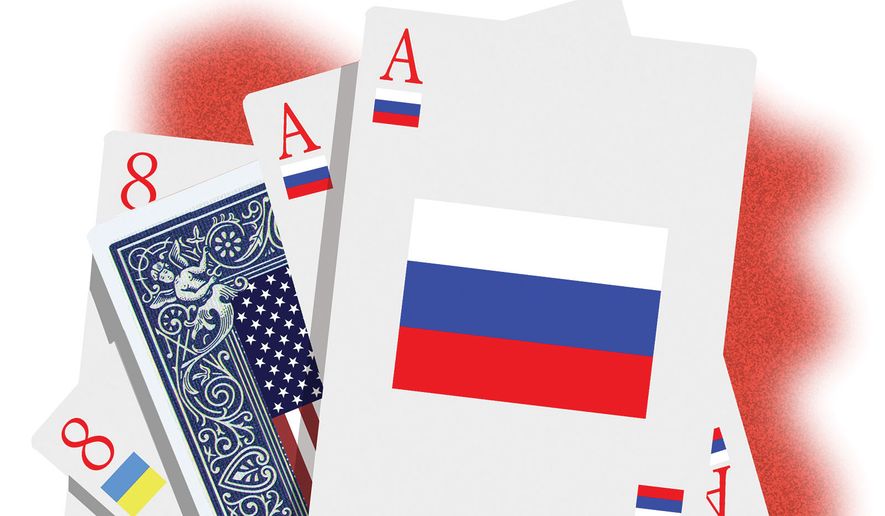
Yes, Ukrainians have fought bravely to defend their land; however, Mr. Trump was correct in February when he told Ukrainian President Volodymyr Zelenskyy, “You don’t have the cards. You’re buried there. Your people are dying. You’re running low on soldiers.”
As Secretary of State Marco Rubio, special envoy Steve Witkoff and Mr. Trump’s son-in-law Jared Kushner discuss a peace accord with Ukrainian officials, one thing is clear: Ukraine will have to give up some of its demands. If it chooses not to, the war will enter its fourth year, and more lives will be lost.
As this column pointed out in 2022, concessions will need to be made regarding land. Elections will have to be held; limits to the military need to be considered. NATO accession will have to be delayed or denied altogether.
Ukraine can’t win the war alone, and as Mr. Obama correctly noted in 2016, it isn’t a core interest of America’s.
If Messrs. Kushner and Witkoff fail to make any headway with Russian leaders this week after meeting with Ukrainian officials over the weekend, Mr. Trump’s time and attention would be better spent focusing on domestic issues such as affordability, crime, health care and immigration.
Peace between Russia and Ukraine would be nice, but it’s not an “America First” priority for most, if not all, of Mr. Trump’s voters.
• Kelly Sadler is the commentary editor at The Washington Times.

Please read our comment policy before commenting.