


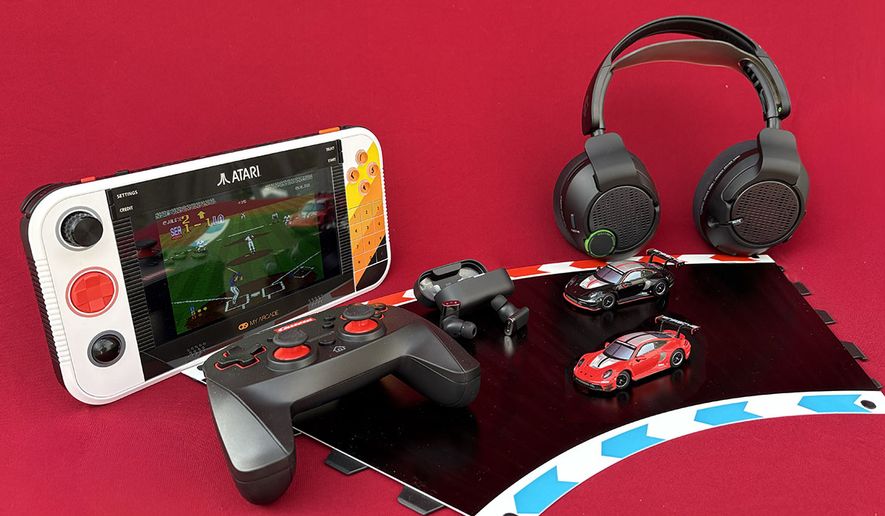

Here’s a look at a few of the best and coolest gift ideas for video gamers owning the latest entertainment consoles in the family.
Peripherals and gadgets
Let’s start with a few equipment ideas that will certainly help bring a smile to gamers’ faces.
Gamestation Go (Atari, $179.99) — Presenting a love letter to a bygone era when home entertainment consoles were in their infancy and visiting the mall arcade was an after-school requirement, one of the patriarchs of video gaming has decided to embrace its past while diving into a mobile entertainment future through a handheld nostalgia trip that features some of its, and its competitors, most popular titles.
Specifically, the Gamestation Go comes loaded with more than 200 games, primarily from the late 1970s and 1980s, packed into a 5-inch-tall by 10-inch-long and 1-inch-wide device.
The white-and-black beauty sports a high-resolution, 7-inch color display, stereo speakers, a built-in kickstand, Wi-Fi connectivity, a microSD card slot (for additional game loads), an HDMI port for connecting to a large screen and USB-C port for charging the battery (roughly five hours of gaming per couple of hours of charging).
SEE ALSO: 4K UHD and Blu-ray gift ideas for movie fans
True Atari fans will delight in playing the earliest home console classics such as Asteroids, Breakout, Missile Command and Yar’s Revenge, representing the formative years of Atari’s 2600 arcade era. (Remember that familiar wood-paneled console?)
Players also get “Recharged” versions of six classics, including Centipede featuring modern graphics and effects, new gameplay modes, refined controls, improved soundtracks and upgraded weapons and enemies, to name a few enhancements.
Next dive into popular titles from the Atari 5200 and 7800 console platforms such as Ninja Golf, Millipede, Basketbrawl; arcade originals such as Tempest, I-Robot, Lunar Lander, RealSports Baseball, seven Balls of Steel pinball tables; and licensed non-Atari games (Jaleco, Piko International) offering titles such as Pac-Man, Super Bases Loaded 2, Rod Land, P47: The Phantom Fighter, Avenging Spirit and Jim Power: The Lost Dimension.
The voluminous amount controls are also a major highlight including a paddle dial (spinner wheel), trackball, standard D-pad (directional pad, up/down/left/right), four face buttons (A, B, X, Y), a set of shoulder buttons and bumpers (left and right) and a numeric keypad (zero to nine plus extra keys).
Additional nongaming controls offer a power switch, home button, start/select menu navigation buttons, volume control (rocker) and a credit/coin button.
Highly worth noting is the SmartGlow lighting feature that literally lights up the controls relevant to a particular game being played.
One drawback is that humans with large hands may find the controllers spaced too far apart, which can cause fumbling and missed hits in some games. Additionally, there is no way to reconfigure the controls to suit individual tastes.
The package includes an AC adapter box, a charger cable and HDMI cable.
Yes, one can effectively argue that simply buying a Nintendo Switch makes for a much better deal for younger gamers.
However, I’ll target this as a gift for the 55-year-old in the family, looking to keep the brain spry and jog plenty of wonderful memories of a gaming industry in its infancy, as well as looking for an easy-to-use and easy-to-enjoy handheld device stuffed with unlimited action.

Valor Pro Wireless: Call of Duty: Black Ops 7 Edition (Scuf Gaming, starting at $209.99) — Santa has got just the right gift for the Xbox X|S gamer plunged into long winter nights of virtual firefights and looking for an edge to complete domination on the battlefield.
Scuf’s latest Cadillac of wireless controllers rises to the top by its visceral, weighty and tactile design, with rubberized grips, no less, and an abundance of action and customization options.
First look to the thumbsticks, built from Scuf’s new Endurance TMR (Tunneling Magnetoresistance) tech. Precise and drift-resistant, each flick, each subtle adjustment feels deliberate and tight for a shooter or any game demanding fine control.
Backing up that precision are other “pro-level” touches: four remappable paddles at the rear; dual-mode triggers that switch between full-press and instantaneous trigger-click; and a tri-mode connectivity system — 2.4 GHz RF for low-latency wireless (with included USB-A dongle for Xbox and PC), Bluetooth for versatility, or wired USB-C for the highest level of responsiveness.
Also, explore the removable magnetic face design layout to find face buttons — A, B, X, Y — that sit high and respond with a crisp, fast rebound, a directional pad with a faceted satellite cluster built for direct directional taps and a menu, view and share/capture button.
Flanking the top are the left and right bumpers and the underside hosts an essential suite of toggles and switches.
Specifically, a dedicated profile switch for cycling between custom control schemes on the fly (default to shooters, sports and racing genres of games), and trigger-mode selectors that flip instantly between full-travel analog pulls and razor-thin digital clicks and a tri-mode connectivity switch.
On the front, a power/mode indicator keeps users visually aware of wireless status and connectivity choice, and at the bottom, look for a pair of audio scroll wheels to change the chat and game volume mix or mute the chat.
Suffice it to report, Scuf crams lots of goodies into the controller that also advertises 17 hours of use on a full charge. Just looking at the inventory should make a player clearly understand that they now own the technology associated with a controller built for serious engagements rather than casual amusement.
Visually, the Black Ops 7 Edition pays aggressive homage to the latest Call of Duty. The shell is stamped with the bold gray “Cerberus” emblem, baring its teeth on the right handle, and a complement of light-gray, blue, and orange accents that runs across the body and face of the controller, giving it a futuristic combat vibe.
The package includes a 6-foot braided, sheathed USB-C to USB-A cable, two extra thumbsticks and two inner paddle blanking plates (to cover removed paddles).
For those gift givers that can absorb the price, the Valor Pro: Call of Duty: Black Ops 7 Edition complements a legendary gaming franchise with a premium and muscular controller, only to be appreciated by those serious about their craft.
Hybrid Highway Challenge (Carrera, $199.99) — One of the heavyweights in home slot car racing for the past 60 years delivers an artificial intelligence-powered simulation sure to capture the hearts of gamers with its blending of tactile as well as high-tech driving magic.
The “hybrid” aspect translates into the merging of analog track power with digital sensor-driven control and app-based management. The resulting platform turns a living room into a miniature motorsport research lab.
The fun begins with the 10 pieces of flexible plastic track (four straight and eight curved) that owners quickly slide together to build a possible dozen race courses through almost 20 feet of track.
Next, prepare the pair of 1:50 scale vehicles — a red-and-black Porsche 911 GT3 (roughly 3.5 inches long) — for competition. Each requires a roughly 20-minute charge (USB-C to USB-A cord included) to deliver roughly 30 minutes of race time.
Tracks can handle up to a whopping 16 vehicles in races, and a small selection of other compatible vehicles, such as BMW M4 GT3 and Ford Mustang GT3 ($59.99 each), are available for separate purchase that will be needed with large families looking to compete.
The heart of the system is registering the vehicles and tracks to the free Carrera Hybrid app (iOS and Android compatible) that acts as a crew chief, lap counter, telemetry hub and race director.
The app delves deeply into a racing simulation, utilizing statistics such as sector times, fuel simulations, tire wear models, and customizable race formats, including time-based, endurance, and points circuits — all of which evolve through a career mode. Additionally, there are options for free driving away from the tracks.
Of course, expect roaring engine and race sound effects also coming from the app, and details such as turning off lights and even the engine.
For drivers with varied skill sets, the wealth of customizations can level the playing field by dialing down the horsepower of vehicles or using driver assist to not allow veterans to dominate, giving younger rookies a chance to win.
The Hybrid takes roughly 20 minutes to set up and works flawlessly, though steering and acceleration will take some getting used to.
The package also includes a tool to take off vehicle tires and clean the axles, as well as a rubber pad to clean the tires.
Overall, Carrera’s Hybrid Highway Challenge really takes the checkered flag by offering high entertainment value for the price.
Expect a shared experience for siblings and friends that fuses competitive spirit, mechanical curiosity and the magic of racing. It revives the best parts of nostalgic analog slot car racing while leveraging smart technology that enhances and challenges human skills.
Gift givers can also add another 14 feet to courses through a pair of track packs ($79.99 each) to make much larger speedways, or add a rechargeable gamepad ($49.99) that attaches to the phone via Bluetooth and makes racing more akin to a typical video game setup.
Crusher PLYR 720 (Skullcandy, $159.99 to $269.99) — Gamers looking for a “face-melting” audio experience while playing their favorite action games will embrace a multifunctional, over-the-ear pair of headphones featuring a multisensory bass-thumping design further enhanced with enveloping THX Spatial Audio.
The combination headset with uni-directional removable boom microphone offers wireless connectivity through Bluetooth 5.3 or the 2.4GHz connection through a low-latency dongle transmitter for Nintendo Switch, PlayStation, PC and Xbox with a 30-foot range.
A welcomed addition is being able to use both wireless connections simultaneously to play a game as well as listen to music or take calls.
Onboard controls on the back of the left cup on the side include a power button for also switching between connection modes and Bluetooth pairing; and an overwhelmingly multifunctional joystick for volume adjustment (up and down), push left and sidetone and chat levels (left and right) and press down to select EQ presets (tuned for general gaming, first-person shooter, role-playing game, music and flat).
Additionally, the cup has a mute button and on the bottom a USB-C port for charging and a port for connecting a 3.5mm aux cable (wired connectivity)
On the right cup find a wheel to dial up the bass and a “custom” button that toggles (by holding for two seconds) between Head Tracking (a technology that detects the movement and position of the player’s head in real time to adjust the audio immersion) and THX Spatial Audio, or an owner can tap to play or pause a music selection.
Turning up Skullcandy’s adjustable sensory bass wheel allows the PLY 720 to enhance its patented speaker drivers that deliver an adjustable haptic bass feedback response to create a powerful and palpable effect on the owner’s body.
Specifically, at its highest setting, get blasted by low-end that causes cheekbones to quiver with sensations moving right down to the chest. It’s quite the jarring experience.
Gamers can expect roughly 48 hours’ worth of battery life on a single, two-hour charge using the included USB-C to USB-A cord.
The headset offers a comfortable fit for long gaming sessions, even on big heads, with breathable memory foam ear cushions, adjustable side bars and a weight-dispersing suspension headband strap.
Now, a special edition is also available and designed for use with the Xbox entertainment consoles through a switch on the included dongle that plugs directly into the console for immediate connectivity. The cosmetic appearance also offers a green bass wheel and glowing green cups.
Highly recommended is connecting the PLYR 720 to Skullcandy app (iOS and Android) to allow for firmware updates and further customization, such as EQ settings, Crusher Bass, head tracking and even LED color settings.
Overall, the PLYR 720 does not disappoint. Admittedly, the outrageous bass boost is more of a gimmick than a feature (unless a gamer wants to appreciate some brain-busting heavy metal), the headset’s functionality, ease of use and compatibility to all consoles make it a solid choice for gamers this holiday season.
While on the topic of aural experiences, Status Audio has produced a pair of earbuds that will succeed handsomely for those looking for a compact, multifunctional mobile casual gaming solution to fit their sound needs.
The Pro X ($299) prioritizes craftsmanship and sonic performance over gimmicks. It features a clean, compact design with just a hint of chrome on the stems, which disappear comfortably into the ear. The design is supported by multiple ear-tip options (three sizes are included) and an IP55 rating (water and dust resistance), making them suitable for workouts, travel, and everyday use.
Battery performance varies depending on configuration, but under typical usage, an owner should get six to eight hours of runtime before needing a two-hour charge back inside the case (USB-C port or Qi pad for charging case).
Even under more demanding circumstances — high volume, ANC (active noise cancellation) in effect, high-quality codec streaming — the Pro X holds steady for several hours.
Inside the minimalist design lives serious engineering chops: a triple-driver system featuring a 12 mm dynamic driver and two Knowles balanced-armature drivers.
The impressive speakers unleash a tight bass sound, controlled rather than boomy, and the midrange, where vocals and instruments breathe, has an authentic clarity. Treble detail arrives airy and crisp without ever crossing into harshness.
The ANC performs well in most environments, reducing engine rumble and urban background noise without introducing pressure or hiss.
Transparency mode is equally natural, letting an owner hear conversations or traffic without removing the earbuds. Call quality benefits from a six-microphone beam-forming system that isolates the voice clearly even in noisy spaces.
Each stem has a touch surface with tapping sequences to perform tasks such as play or pause, move to the next music track, end a call or toggle ANC to transparency. A difficult-to-press button on each can handle only power status, voice assistant access and ANC mode switching.
Owners can remap the touch controls via the Status Hub app (iOS/Android), which also offers a well-designed EQ customization.
Although way more than gaming earbuds, the Pro X does deliver as a mobile gaming audio solution, especially on an iPhone. Just make sure the proper earbud tips are chosen for a tight fit.
Bluetooth 5.3 and the AAC codec deliver strong fidelity and stable performance, and latency is low enough for casual and mid-level competitive play.
Footsteps, positional cues and environmental effects sound convincing, and the microphone quality makes them suitable for Discord or in-game chat.

ZB1 Smart String Lights (Lepro, $55.99 for 54-foot run) — Those looking to illuminate an indoor or outdoor home entertainment wonderland will appreciate the potential of a set of these multifunctional LED wonders.
Housed in an old-school Edison bulb and controlled by a robust smartphone app, the lighting can make a room or patio feel like entering a movie set. The string may look like classic café lights, but under the hood, they run some surprisingly sophisticated lighting tech.
Available in 54-foot and 100-foot runs with 15 or 30 polycarbonate bulbs (spaced three feet apart), the ZB1 uses RGB+IC, meaning each bulb is individually addressable and can display its own color independent of the others.
Instead of one uniform line of blue or red, owners can run cascading rainbows, moving gradients, dual-tone patterns and holiday-themed chases — all at once, all on a single strand.
Control is centered around the Lepro app (Android and iOS) using a 2.4 GHz Wi-Fi network (5 GHz not supported) and Bluetooth.
After registering for an account, setup is roughly a 15-minute process as the phone must be connected to an in-home network. Once the strand is plugged in, it initially glows blue as it looks for a connection. Once found, it gets paired to the network and identified with a strand name that can be personalized.
Owners can pick from premade scenes (sunsets, ocean waves, holiday themes) or design an effect per bulb. The app allows the adjustment of color, brightness, speed and pattern direction, and it stores favorites for one-tap recall. Because the LEDs are individually addressable, personalized designs can be as subtle or as over-the-top as imagination allows.
As impressive is now an extra AI layer applied to the app. An AI assistant can respond to text or voice commands to create a lighting scheme (such as “relaxing evening” or Halloween party”) or take a photo of an area and display complementary lighting.
Additionally, owners can go old school and check out the Lepro community tab on the app to find other folks who have uploaded some of their favorite lighting designs that can be applied to an owner’s strand, such as “toxic reactor” (neon green flashes) or “4th of July” (a red, white and blue repeating cascade).
Creative gamers or home theater owners can easily see the wild potential afforded by the tools, with the phone’s microphone picking up video game sounds or film musical scores.
Smart-home fans are also well served. The ZB1 integrates with Amazon Alexa and Google Assistant to power the lights on and off, change scenes, or dim them with voice commands. For basic control, there’s also an in-line controller on the cord that remembers the last setting when toggling power on, so a phone is not necessary every time.
Overall, for anyone wanting a set of lights that can smoothly pivot from calming dusk to full-scale techno kaleidoscope, the ZB1 hits that sweet spot between gadget and enlightening décor.

The Games
Let’s continue with some gift examples of fun and immersive video gaming experiences.
The Grinch: Christmas Adventures Merry and Mischievous Edition (Casual Brothers and Outright Games, reviewed on Xbox X|S, rated E, $29.99) — Theodor (Dr. Seuss) Geisel’s curmudgeonly holiday humbug stars in the definitive version of a previously released two-dimensional platformer that’s sure to give youngsters an invigorated, hands-on appreciation of the book and cartoons.
A player controls the Grinch as he works through 24 different levels broken into location settings as the Cave, Countryside, Who-ville and the Feast (the latter only previously available as a download to the original game) on a mission to steal Christmas from the materialistic population of Who-ville.
Along the Grinch’s travels that require climbing, bouncing, sprinting, swinging, climbing using a jet pack and even snowboarding, he avoids creatures such as spiders, bats and nutcracker toy soldiers; hides from aggressive gingerbread men and citizens; and collects presents, food and puzzle pieces.
He gets help from his overburdened dog named Max that a single player can switch back and forth to control both characters or allow a second player to join locally in a co-operative mode to allow the pooch to sneak into tight spaces and even use a parachute.
One of the best parts of the action has a player collect all of the pieces of a particular jigsaw puzzle, assemble the puzzle and get rewarded with a new skill, such as double jumping, a new tool, such as a candy cane rope, or unlock the options to wear Santa’s hat or boots.
A pair of extras will thrill parents. They include the ability to simply read along to the original Dr. Seuss book and admire its illustrations or take a look at some of the unfinished original page layouts from the classic, which include notes to the publisher.
For gamers younger than age 8, they will be enthralled with this old-school gaming Christmas treat and will have a satisfying experience interacting onscreen with a parent or friend as they work through a story based on a classic piece of holiday literature.
PGA Tour 2K25 (HB Studios and 2K, reviewed on PlayStation 5, rated E, $69.99) — Hitting the virtual greens of 2K’s latest edition to its prestigious golfing simulation delivers as robust an experience as any other high-end, micro-detailed sports game.
Much like top‑tier franchises in football, soccer and basketball, the game centers on character creation and progression through the ranks. The player begins by crafting a golfer and then works through smaller tournaments toward the big leagues.
On the amateur difficulty, the action is much more accessible, making it suitable for newcomers or casual play. Better yet, simply start a match with another player and select a real pro golfer such as Tiger Woods, Lydia Ko or Max Homa and tackle a course.
One standout feature is the breadth of play styles available, including selecting from five distinct archetype golfing styles such as the Powerhouse (for massive drives), Magician (for tricky recoveries) and Technician (focused on accuracy and versatility).
Compared to the previous games, these archetypes feel more refined and intelligent, allowing the player’s style to meaningfully influence performance from the outset.
Gameplay mechanics are smooth and intuitive: Swings are simply executed with the right stick (pull back and then flick forward) while a preview of the putt’s path aids shot‑planning, which helps ease new players into the experience.
The game features 27 officially licensed courses at launch, including major venues such as TPC Sawgrass (with its iconic Island Green), Oakmont Country Club and Royal Portrush Golf Club.
Online mode and competitive difficulty settings add strong replayability, while local multiplayer (pass-and-play with friends) allows up to four golfers to share a controller and compete.
With refined archetypes, professional broadcast‑style camera angles and extensive course licensing, PGA Tour 2K25 delivers an authentic experience for both newcomers and seasoned virtual golfers.
Silent Hill f (NeoBards Entertainment and Konami, rated M, reviewed on PlayStation 5, $69.99) — This stand-alone entry to a famed survival horror game franchise plunges a single player into a disturbingly beautiful nightmare set in 1960s Japan.
Specifically, within the fictional mountain‑pass town of Ebisugaoka, he assumes the role of Hinako Shimizu, a high‑school girl living a seemingly ordinary life in a remote setting, who becomes drawn into the town’s cryptic dark secrets.
The opening segments are now notably more navigable than in earlier entries of the series, offering a slightly less claustrophobic landscape and allowing for more breathing room.
However, the signature ominous tone still remains and complemented by the disturbing canvas of a rural mining town in decay — empty, rain-slicked streets, abandoned homes, dilapidated buildings, dead-end, stone-paved alleys — all shrouded in red fog, adding to a sense of unease.
Monsters take inspiration from Japanese demon lore in the shape of grotesque humanoids or mannequin‑like, dismembered figures, even spewing fluids and moving in unsettling ways. The jump scares are frequent and effectively placed.
As usual, a player’s tool options are minimal: rusty pipes, sickles, kitchen knives and bats, simple weapons that break over time. This resource fragility maintains a constant edge of tension.
Rather than relying purely on dark hospital corridors and maze-like layouts like in previous Silent Hill entries, the game emphasizes outdoor areas and ritualistic elements tied to the town’s folklore; the terror feels more spiritual and psychological than just visceral.
As clues are unlocked and mystical books uncovered, the player becomes obsessed within Hinako’s journey that evolves from societal repression to hopeless survival to anger and a final chance at cathartic self‑discovery.
Atmosphere and pacing shine: creatures hide in plain sight, shadows shift unexpectedly, and the game uses its smothering arsenal to full effect.
Much like previous games, the intense, violent episodes and disturbing content shape the narrative.
Although Silent Hill f manages to refresh the franchise with help from streamlined gameplay, a complex lead character and the more expansive enveloping setting, all combine to unleash an unforgettable horror experience.
Alien: Rogue Incursion — Part One: Evolved Edition Deluxe (Survios, rated M, reviewed on PlayStation 5, $39.99) — Fans of the iconic sci-fi horror movie franchise who do not own a VR headset finally get their chance to dive into a rebuilt, flat-screen version of last year’s suffocating first-person shooter.
Specifically, what was once a virtual reality panic attack is now a full-fledged survival horror game, complete with 60-frames-per-second action, 3D audio and nastier, smarter Xenomorphs.
A player steps into the combat boots of Zula Hendricks, an ex-Colonial Marine pulled from the Alien expanded universe, who answers a distress call on the storm-lashed planet Purdan.
Alongside her synthetic partner Davis 01, Zula investigates a corporate black site and the colony facility at Castor’s Cradle, only to find that Weyland-Yutani’s off-the-books experiments have gone exactly as badly as franchise veterans would expect.
From the very first slog across Purdan’s rain-swept surface, with an atmosphere processor looming in the distance, the game nails the look and feel of an Alien outpost gone dark.
However, Zula gets a relatively short experience, running about six to eight hours, and drops the player into a solo mission where exploration, survival, and pacing carry the game more than its narrative.
Action mixes Aliens’ “bug hunt” attacks, scavenging lockers and workstations for limited ammo and health, hacking terminals, and creeping down steel hallways while clutching a motion tracker that chirps its way directly into an owner’s nervous system.
When the dots close in, a player uses a concise but satisfying arsenal — pulse rifle, shotgun, revolver, proximity grenades and the trusty tracker with added tools like the ME3 Hand Welder — while constantly counting precious rounds.
Game mechanics, such as weapon wheels, quick-access tools on the D-pad, and re-tuned enemy behavior all make this feel like a legit console shooter, not a compromise for the original VR predecessor.
The not-so-great parts of the game included repetitive location layouts; a narrow enemy roster (warrior Xenomorphs and facehuggers do most of the work); less claustrophobic tension than the original; some painfully old-school manual saving that can strand careless players; and a frustrating story cliffhanger.
Still, Alien: Rogue Incursion — Part One: Evolved Edition Deluxe earns its place in the franchise library. It does not hit the highs of Alien: Isolation, but it is not trying to. Instead, players get a fast-paced, accessible experience that stays true to the aesthetic and tone of the Alien universe.
The Deluxe edition, for $10 more than the $29.99 standard edition, offers a bundle of extra armor and weapon skins plus the digital book “The Art of Alien: Rogue Incursion.”
Borderlands 4 (Gearbox Software and 2K, rated M, reviewed on PlayStation 5, $69.99) — The latest entry to a popular first-person, sci-fi shooter looter franchise delivers a more expansive open world and vibrant experience than previous entries while keeping the iconic cel-shaded, hand-drawn, comic-book visual aesthetic as eye-catching as ever.
A player can choose from four new Vault Hunters against a ruthless dictator named the Timekeeper and his minions, each offering distinct gameplay styles.
Vex is a Siren who summons allies, Amon is a Forge Knight tank who builds damage via elemental stacking, Harlow uses battlefield tech to reposition enemies, and Rafa brings a high‑mobility style with shoulder‑mounted guns. Each possesses three core action skills, with each skill featuring its own branching tree and multiple variations.
The Timekeeper commands a series of lieutenants that players confront throughout the roughly 30-hour campaign.
Boss fights arrive early and become highlights of the opening hours, packed with explosions, gore and shifting mechanics that keep combat fresh. Many enemies have their life force drained or detonate mid‑fight, and the chaos never lets up.
Gunplay is responsive and tight, and the mix of enemies and abilities creates a flow that keeps the player moving, dodging and experimenting with loadouts on the fly.
The game’s deep weapon pool includes pistols fitted with sniper-grade optics, shotguns that morph into portable turret launchers and elemental rifles capable of chaining status effects across entire squads
Among the standouts are legendary weapons, such as Bloody Lumberjack — a brutal assault rifle known for its high damage output and crunchy handling — and Kaoson, a returning SMG revamped for the game with explosive sticky-round capabilities that make it a go-to for boss fights and high-value targets.
Now combine that with a level of customization that stands out as one of the strongest elements in the series so far to offer a reported 30 billion gun variations (zoinks).
Every component — from barrel length and firing mode to elemental tuning and off-hand attachments — can be fine-tuned, making each weapon feel uniquely handcrafted. The result is a system that encourages experimentation and rewards imagination, transforming every firefight into a playground of tactical chaos.
The result is a loadout sandbox that encourages experimentation, rewards creative builds and ensures that even after dozens of hours, you’re still discovering new toys to wreak havoc with.
Beyond the main story, Borderlands 4 offers an overwhelming amount of content.
Side quests, bounties and optional challenges populate every corner and reward exploration with new loot, upgrades and gear variety.
The core gameplay loop remains addictive: Chase new guns, tackle harder waves, evolve builds. The game supports both solo play and multiplayer, and the action remains vigorous throughout.
Between its large world, weapon creativity, layered Vault Hunter systems, and strong early boss design, Borderlands 4 delivers a satisfying evolution of everything a player demands from the universe.
• Joseph Szadkowski can be reached at jszadkowski@washingtontimes.com.

Please read our comment policy before commenting.