



OPINION:
We have arrived at full immersion in the political season. From now until Election Day and likely weeks beyond, political rhetoric will abound, exposing the public to hyperbole, distortions and omissions of facts.
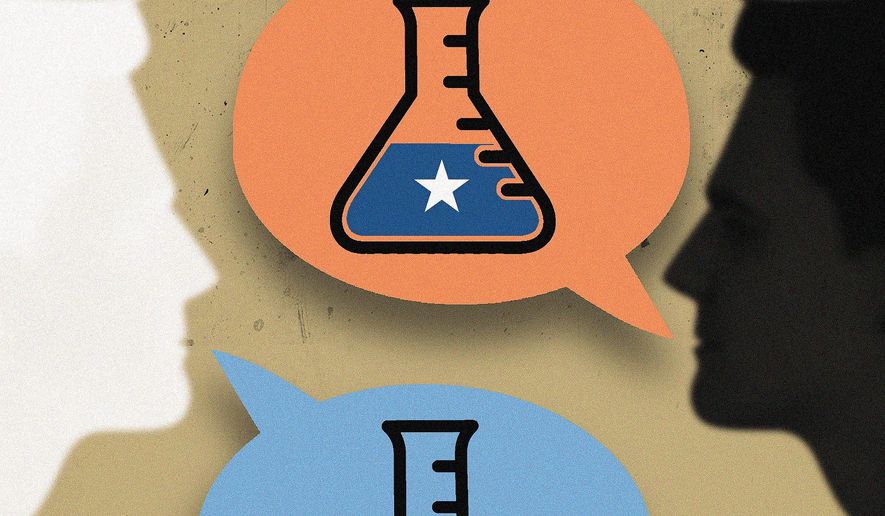
Such exposure has become expected in politics. Unfortunately, political speech tactics have also crept into disseminating scientific information to the public.
Examples of political speech tactics applied to science abound. These stratagems that twist the truth include the exclusion of critical information needed to fully understand the intricacy of a scientific study, cherry-picking data to conform to a predetermined conclusion, extrapolating conclusions based on limited data to substantiate dubious claims, appealing to emotions to promote acceptance of a favored result and storytelling that includes more fiction than fact, thereby perpetuating a false narrative.
The communication of authentic science must supersede these crass political ploys that distort reality.
Authentic science consists of theory and practice tied to integrity and humility. Observation, hypothesis and testing are among the components of objective investigations that lead to dependable discoveries.
The challenge of delivering unvarnished scientific information to the public to improve the chances of nonpartisan conclusions is huge and necessary. Scientific results that are often overly simplified are typically quite nuanced. Experience from my own specialty in atmospheric science — air-pollution meteorology — provides pertinent examples.
In my 40-plus years of fieldwork, consulting and education on the dispersion of air pollutants, I witnessed numerous occasions where the public was coerced by superficial information.
At one public meeting where I delivered findings from my dispassionate air-quality analysis of an industrial operation that garnered national attention, activists were armed with rudimentary distortions. The activists used their blather to stir public opposition to the operation through energetic protests. One protest that occurred the day after the meeting even led to a segment on CBS’ “60 Minutes.”
Despite the hoopla, the plans for the industrial operation were thoroughly reviewed and approved, and government construction and operating permits were granted. It has been in business for decades without serious incident.
Other meetings I participated in involved audiences understandably but often unnecessarily anxious about projects involving rehabilitation of abandoned properties, cleanup of a nuclear materials site, hazardous waste incineration, cement kiln use of discarded tires for fuel, extensive public building repairs and the like.
If the activity was conducted as specified in the approved permit application, the community air quality impact would be quite small, even difficult to measure in the atmosphere in some cases.
Nevertheless, a credulous public can be primed to overreact by activists or government officials pushing political rhetoric.
One particularly egregious pronouncement came from an Environmental Protection Agency official asserting that one molecule of an airborne cancer-causing chemical could cause cancer. Although that cause and effect is theoretically possible, unnecessary worry can actually contribute substantially to poor health.
There is certainly cause for concern after catastrophic industrial accidents or train derailments, such as the one that happened in East Palestine, Ohio. Again, my experience with such incidents shows that political rhetoric can be counterproductive to providing the help affected residents require.
Bottom line: Whether from routine industrial operations or catastrophes, carefully crafted language is exceptionally important for expressing complex technical information in simple, understandable terms while still being true to the science. Unfortunately, deception abounds from politicized science frequently broadcast to the unsuspecting public, and not just during election season.
• Anthony J. Sadar is a certified consulting meteorologist and an adjunct associate professor of science at Geneva College in Beaver Falls, Pennsylvania. He is the co-author of “Environmental Risk Communication: Principles and Practices for Industry” (CRC Press).

Please read our comment policy before commenting.