



OPINION:
Picture this: The prairie winds are blowing over the plains. On the horizon is a little cabin with three little girls in their bonnets. Ma is cooking breakfast on the stovetop and Pa is out in the barn. The primers are ready and home school will begin after morning chores.
This is home schooling, right? Schoolwork is secluded and second to daily demands and chores.
That might be what you picture when you think about home schooling, and maybe back in the days of “Little House on the Prairie,” it was like that. Well, it’s not really like that anymore!
Subscribe to have The Washington Times’ Higher Ground delivered to your inbox every Sunday.
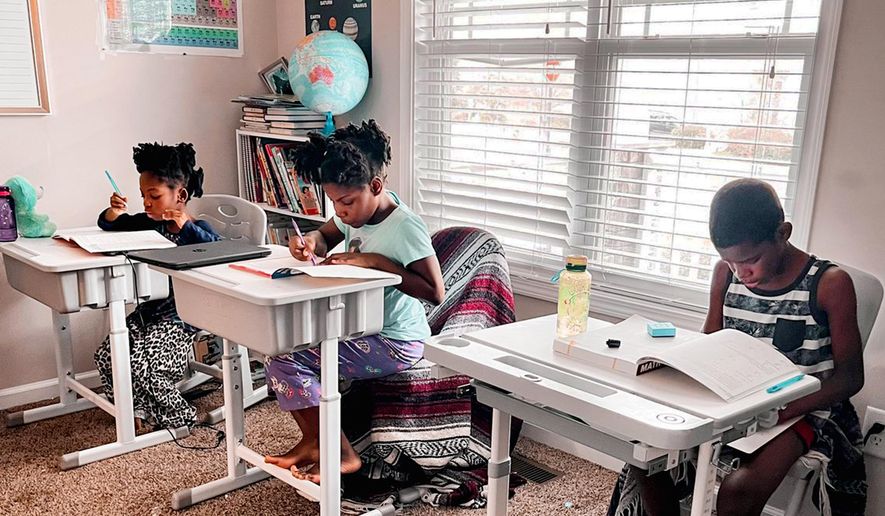
Today, home schooling is a robust educational option. Families from all socioeconomic, political and religious backgrounds are using all kinds of curriculum and scheduling approaches to provide their kids with a quality, personalized education that allows them to pursue productive and meaningful careers and roles in society.
But persistent myths still linger around home schooling. It’s time to dispel these myths and look at the reality.
Myth 1: My kids and I will be stuck in the house all day long.
Nope! For us, and probably for many of the 5 million home-schoolers in the U.S., we are out of the house learning quite a bit.
My kids are 9 and 11, and they are in two co-ops this year. The first co-op meets on Tuesdays and has around 60 kids from kindergarten through sixth grade. They participate in lunchtime, recess, and individual class periods — all of which take place outside our house.
Kids dive deep into specific topics that include all the disciplines, including literature, science, history, geography, and exploring other cultures. This year, the focus started with simple machines; at midyear, they’ll move on to reptiles, and before the year ends, they will experience what life was like in Colonial America (oops, here come the bonnets). The second co-op is writing-intensive and is led by teachers in a classroom setting.
In addition to the co-ops, they have opportunities to go on field trips. The local theater, the Kennedy Center, a water treatment plant, the Planet Word museum, and the National Museum of Natural History are just a few examples. They also get to learn from a variety of professionals that we meet along the way: veterinarians, gemologists, park rangers, equestrians, authors, librarians, mechanics … I could go on and on.
Myth 2: My kids will be weird and unsocialized and won’t be able to interact with other humans.
It’s true that home-school students spend more time with their parents than the average public school student. But because home schooling incorporates daily life into education, home-schoolers are meeting people of all ages all the time.
Brendan Case and Ying Chen of the Harvard Human Flourishing Program wrote in a 2021 Wall Street Journal op-ed that “home-schooled children generally develop into well-adjusted, responsible and socially engaged young adults.”
These interactions happen naturally at the grocery store, at the post office, through internships and volunteer opportunities, on field trips, and in co-op settings. Home-schoolers also interact with other students through sports teams, drama groups, 4-H clubs, Scouting and more. Our co-op recess includes kids ranging in age from 6 to 16, and this mixing of ages and stages leads to better understanding and socialization. These experiences prepare them to interact with people of all ages and many different walks of life.
Myth 3: My kids won’t be able to play competitive sports or join clubs.
There are competitive home-school sports opportunities around the country. About half the states are home-school-friendly and allow home-schoolers to play on public school sports teams. Homeschoolers can also play on private school teams in a variety of sports. Home-school sports are growing and becoming more competitive. Some elite athletes home-school to practice their sport. Coco Gauff, a professional tennis player who just finished her high school education on the road, won her first Grand Slam tournament this year at age 19 — the U.S. Open.
Myth 4: My kids won’t be able to get into college.
Home-schoolers can get into all kinds of colleges and universities.
“The high achievement level of homeschoolers is readily recognized by recruiters from some of the best colleges in the nation. Schools such as Massachusetts Institute of Technology, Harvard, Stanford, and Duke University all actively recruit homeschoolers,” education expert Susan Berry said in a 2015 Business Insider article on home schooling.
Many colleges and universities not only welcome but seek out home-schooled kids. Why is that? It could be that home-schooled kids have already honed their executive functioning skills from a young age and have proved that they can work independently and succeed. Home-schoolers may even have a better idea of what their interests are in college.
The Business Insider story continued, “Research suggests homeschooled children tend to do better on standardized tests, stick around longer in college, and do better once they’re enrolled.”
Myth 5: My kids won’t get to know people from other backgrounds and cultures.
Homeschoolers are quite a diverse bunch of kids. The 2021 U.S. Census Household Pulse Survey shows that the number of Hispanic families homeschooling their children almost doubled from 6.2% in 2019-2020 to 12.1% in 2020-2021; Black families home-schooling quintupled from 3.3% to 16.1% in that same time frame, and for Asian families, the number increased from 4.9% to 8.8%.
Think Impact says that 50% of families who home-school do so for a safe environment, 35% for individual attention, and 15% for other reasons. Families choose to home-school for a variety of reasons, and diversity in home schooling is growing as a result.
The flexibility and possibilities homeschooling offers are endless, and you might find it’s a great educational option for your family — whether you wear bonnets or not.
–
Sandra Kim has over 15 years of experience in marketing, public relations, and media relations with various Fortune 500 companies. She is also the mother of three kids who started home-schooling them during the pandemic. She has a Master of Science in journalism from the Northwestern University Medill School of Journalism. At Northwestern, she received a $10,000 special studies scholarship in religion, spirituality and ethics. She lives in Loudoun County, Virginia, with her husband, John, their three kids, and a rescue puppy named Tupelo.
The Homeschool Legal Defense Association is a nonprofit advocacy organization that makes home schooling possible by protecting home-schooling families and equipping them to provide the best educational experience for their children. We have been trusted for over 40 years to care for home-schooling families as we safeguard their freedom and secure the future of home education.

Please read our comment policy before commenting.