


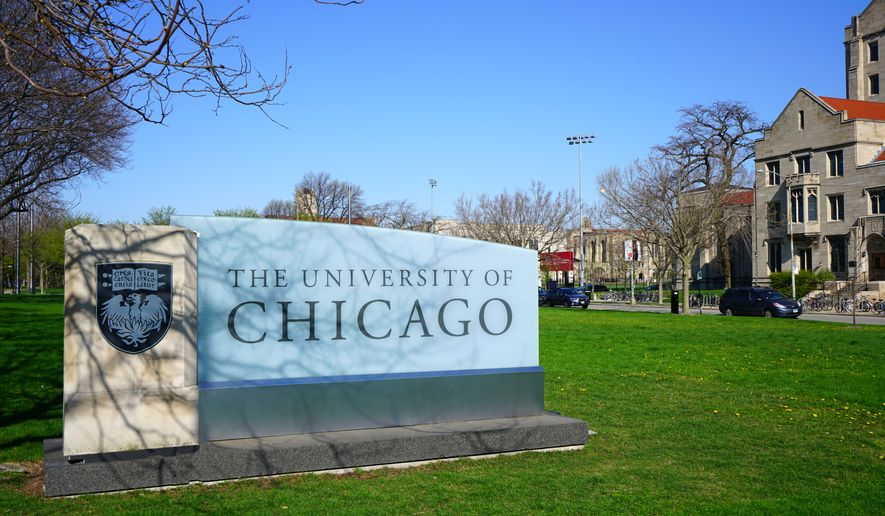

A national survey of four-year college students puts the University of Chicago at the top and Columbia University at the bottom of a free speech ranking of 203 top schools.
The nonpartisan Foundation for Individual Rights and Expression and the academic research firm College Pulse on Wednesday called the third annual opinion poll of 44,847 students “the largest survey of campus free expression ever performed.”
The poll found that 63% of respondents worried about damaging their reputation because someone “misunderstood something they said or did.” An equal percentage said it’s acceptable to some extent to shout down a campus speaker.
Rankings were based on FIRE’s analysis of five factors in students’ responses: “comfort expressing ideas,” “disruptive conduct,” “administrative support,” “openness” and “mean tolerance.” The last was adjusted for homogenous student bodies that appear tolerant but lean hard to the left or right.
In descending order, respondents listed abortion, racial inequality, COVID-19 vaccine mandates, transgender issues and gun control as the top taboo topics on their campuses.
“When certain topics become off limits, student rights are in jeopardy,” said Sean Stevens, FIRE’s senior research director. “Prospective college students should consider carefully whether they want to attend a school that punishes faculty, guest speakers and students for holding minority opinions.”
After the private University of Chicago, four public schools rounded out the top five colleges rated “good”: Kansas State University, Purdue University, Mississippi State University and Oklahoma State University.
The bottom five colleges are private schools.
FIRE rated Columbia as “abysmal” for free speech. It noted seven incidents in which the Ivy League school sanctioned scholars for expressing their opinions.
In 2020, Columbia students demanded the dismissal of professor Mitch Silver after calling his course on modern urban terrorism “Islamophobic.” This year, Columbia School of Medicine fired its psychiatry department chair over a tweet about a dark-skinned model.
The next-worst colleges, rated “very poor,” were the University of Pennsylvania and Rensselaer Polytechnic Institute. Then came Georgetown University and Skidmore College, both rated “poor.”
Ronald J. Rychlak, a law school professor and former associate dean at the University of Mississippi, said private schools tend to be weaker on free speech because they aren’t required to follow “the same constitutional strictures.”
“The trend toward more freedom of speech at public institutions is gratifying and a reflection of the importance of the First Amendment,” Mr. Rychlak said.
Rated “above average,” Ole Miss ranked 26th on the list.
Most colleges on the list did not respond to requests for comment.
Jonathan Zimmerman, a professor in the history of education at the University of Pennsylvania, expressed concern over his school’s second-to-last ranking.
“As a Penn professor, I’m both saddened and embarrassed that so many of our students do not feel free to express themselves,” Mr. Zimmerman said in an email. “Our job is to help people learn. And if they’re biting their tongues, they will learn less.”
According to FIRE, on-campus hostility to free speech targets conservatives most often.
The poll found that 42% of conservative students said they “often” feel uncomfortable speaking freely on campus, compared with 13% of liberal students.
Depending on the speaker, 59% to 73% of respondents said they oppose allowing controversial conservative speakers on campus, compared with 24% to 41% who oppose liberal speakers.
“Conservative students by a wide margin over liberal students fear to speak their minds on campus, and a preponderance of students now favor censorship of views they dislike,” said Peter Wood, president of the conservative National Association of Scholars.
All schools at the bottom of FIRE’s list have been subjects of controversies in recent years.
Early this year, Georgetown University Law Center suspended libertarian scholar Ilya Shapiro over a Jan. 26 tweet that predicted the Biden administration would nominate “a lesser Black woman” to the Supreme Court by excluding other qualified candidates based on gender and race.
After apologizing, Mr. Shapiro resigned from his post in June. He objected to the Catholic school’s requirement that he undergo racial sensitivity training to be reinstated.
At the University of Pennsylvania, student activists shut down a 2016 talk by former CIA Director John O. Brennan and persuaded officials in 2019 to rescind a speaking invitation to Thomas Homan, the Trump administration’s Immigration and Customs Enforcement chief.
The survey was conducted from Jan. 13 to May 31 using the College Pulse mobile app and web portal. The margin of error for undergraduate students was 1 percentage point.
• Sean Salai can be reached at ssalai@washingtontimes.com.

Please read our comment policy before commenting.