



President Biden managed to salvage a sliver of his climate change agenda in the $1.5 trillion government spending bill, with at least $18 billion of it going to programs intended to reduce the use of fossil fuels.
Mr. Biden’s climate agenda is alive on other fronts as well as the price of gasoline soars in the U.S. A new report on Monday showed that approvals of new drilling permits by the administration have plunged about 85% since last spring.
From money for environmental justice and climate research to spending on clean energy and environmental projects in developing countries, the spending bill marked a significant increase in climate- and environment-related funding compared to the previous administration.
The climate spending included $92 million for diesel emissions reduction grants and $100 million, an $83 million increase, for environmental justice. Those programs were part of $9.56 billion for the Environmental Protection Agency, an increase of $323 million to replenish Trump administration cuts.
Another $260 million goes to clean energy programs in other countries, a $77 million increase from Trump-era levels, and $185 million goes to “sustainable landscapes” in other countries, an increase of $50 million.
While reviving some of the items from Mr. Biden’s failed $1.75 trillion Build Back Better Act, the approved spending fell far short of the $500 billion allocated for climate change programs in the massive bill.
Still, House Appropriations Committee Chair Rosa L. DeLauro, Connecticut Democrat, described the spending as “historic investments in clean energy and climate science.”
“We are tackling our toughest challenges, confronting climate change through environmental enforcement,” Ms. DeLauro said.
Republicans said much of the funding was misdirected or wasteful. Rep. Cathy McMorris Rodgers, Washington Republican and ranking member of the Energy and Commerce Committee, said the non-defense portion of the funding includes a “reckless amount of spending.”
“Rather than fund the Democrats’ radical rush-to-green agenda, America should be leading to produce more oil and natural gas to help our allies, counter Putin and lower energy costs here at home,” she said.
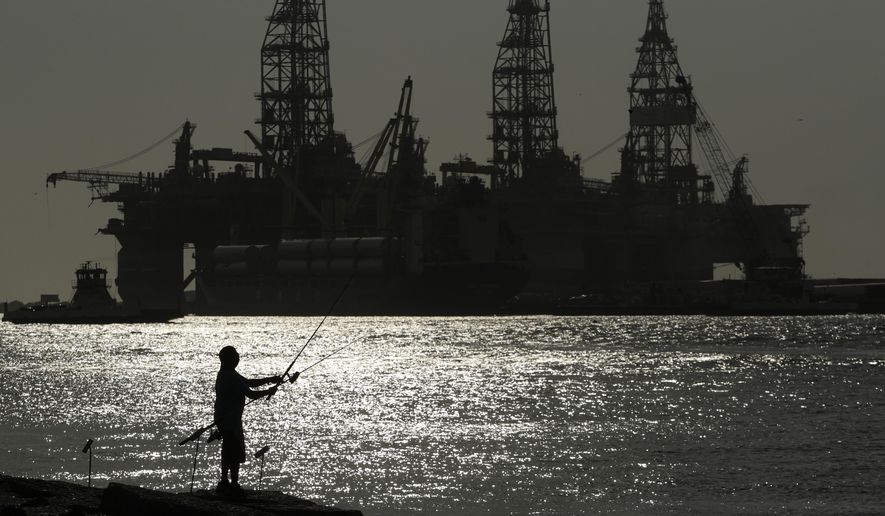
But the administration has considerably slowed its approval of new oil and natural gas drilling leases on public lands, despite facing pressure to more aggressively urge fossil fuel companies to increase their production in the face of high domestic energy prices.
The number of approvals in recent months has been less than half what they were at their peak around the time Mr. Biden took office, going from as many as 643 in April 2021 to as few as 95 in January of this year, according to Bureau of Land Management permit statistics reviewed by E&E News.
That’s a reduction of 85% since last spring.
Though Mr. Biden’s administration gave the green light to more oil and gas drilling wells in his first year than his predecessor did in his first year, the steep decline since last summer came at a time when inflation began exacerbating energy costs and causing prices at the pump to increase.
Russia’s recent invasion of Ukraine has only made matters worse.
Until recently, the Biden administration has been reluctant to say that domestic producers should ramp up output to blunt record-high prices and rejected calls from Republicans and critics to rapidly increase the approval of new drilling permits on public land.
A leading argument from the White House has been that companies sit on some 9,000 unused oil and natural gas leases. But few leases ultimately end up being viable energy producers.
The average cost for a regular gallon of gas was at $4.33 on Monday, according to AAA. That is an increase of 26 cents from one week ago and 84 cents from one month ago.
According to House and Senate appropriations committees, these are among the biggest tranches of money for climate change in the $1.5 trillion government spending bill for the current fiscal year:
• $14 billion in energy and water development appropriations for “transformative investments in clean energy and science, which will help develop clean, affordable and secure American energy.” This includes a record $3.2 billion for the Department of Energy, an increase of $338 million.
• A portion of NASA’s $7.6 billion budget to “enable better scientific information about the Earth and its changing climate.”
• $423 million for international organizations and programs under the State Department. Portions will be for tackling global climate change with the Montreal Protocol Multilateral Fund and the U.N. Intergovernmental Panel on Climate Change/U.N. Framework Convention on Climate Change.
• $200 million for the National Oceanic and Atmospheric Administration to conduct climate research, an increase of $18 million. Of that, $10 million is to “provide actionable climate information to inform Americans’ decisions about how to adapt to the changing climate.” Another $6 million will go to building more offshore wind farms.
• $125 million to the Clean Technology Fund to combat climate change and develop low-carbon technologies in developing countries.
• $120 million for the Defense Department’s climate infrastructure programs.
• $120 million for climate change and resiliency military construction projects, a $106 million increase.
• $117 million for the Interior Department for renewable energy and environmental assessment.
• $78.3 million for U.S. Department of Agriculture to “tackle the climate crisis in farming and rural communities and include research to monitor, measure, and mitigate climate change, accelerate climate smart agriculture practices, reduce greenhouse gases, and advance clean energy technologies.”
• Unspecified amounts for the Departments of Transportation and Housing and Urban Development to combat climate change, including by reducing greenhouse gas emissions and increasing structural resiliency.
• Ramsey Touchberry can be reached at rtouchberry@washingtontimes.com.

Please read our comment policy before commenting.