



OPINION:
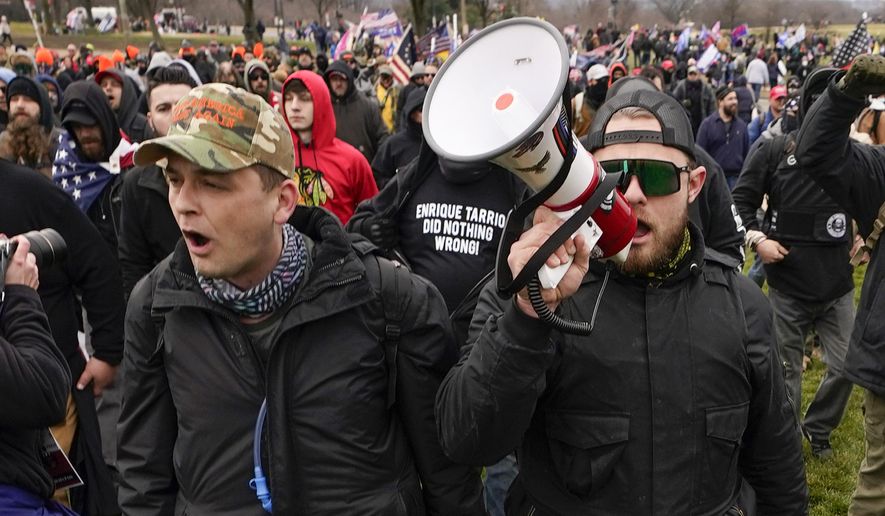
This past weekend former President Donald Trump said if he were elected to a second presidential term, he would consider pardoning some of the defendants charged in the Jan. 6, 2021, Capitol breach. His remarks drew immediate criticism from the media, Congressional Democrats and even some Republicans.
“Another thing we’ll do — and so many people have been asking me about it — if I run and if I win, we will treat those people from January 6 fairly. We will treat them fairly,” he said during a rally in Conroe, Texas. “And if it requires pardons, we will give them pardons. Because they are being treated so unfairly.”
We didn’t interpret Mr. Trump’s words as a blank check for all those who rioted at the U.S. Capitol. Mr. Trump was most likely referring to the Jan. 6 cases in which defendants have either been overcharged with elaborate, treasonous sounding crimes, or been left languishing in pre-trial detention for otherwise minor charges like trespassing.
All of the Jan. 6 cases have been prosecuted in the most politically charged atmosphere since the Iraq War when anti-war demonstrators filled the streets of Washington, and oftentimes, the corridors of the U.S. Capitol.
Many of those anti-war defendants, who also interfered in important Congressional hearings and disrupted votes, were not charged with federal crimes under the U.S. Code. They were charged with lesser misdemeanor crimes prosecuted with D.C. Code violations by the District of Columbia. In many instances, Congressional Democrats whose offices were invaded, wouldn’t even press charges against the anti-war protestors because their demonstrations served their political aims against then-President George W. Bush.
Since Jan. 6, 2021, Democrats have tried to use the U.S. Capitol breach as their version of the 1933 Reichstag fire. Irresponsible members of Congress have often referred to the riot as the most significant attack on the complex since the British burned Washington in 1812. This narrative conveniently omits two critical past political acts of violence that were more significant than what happened on Jan. 6 that ultimately exonerated or led to the release of those charged.
On March 1, 1954, four members of the Puerto Rican National Party disrupted a vote on an immigration bill after firing live rounds of bullets with semi-automatic handguns onto the floor of the U.S. House of Representatives to protest the 1898 annexation of the island. Five Congressional representatives were wounded in the shooting. All four members were sentenced to life imprisonment but were later pardoned by then-President Jimmy Carter in 1978 and 1979.
On March 4, 1971, the radical leftist Weather Underground planted a bomb below the chamber of the U.S. Senate that detonated, blowing up a restroom and barbershop. The group issued a statement saying they attacked “the very seat of U.S. white arrogance” over military action in Laos. The bombers, Bernardine Dohrn and Bill Ayers, fled as fugitives for several years. When they returned, Ms. Dohrn received three years of probation and all charges were ultimately dropped against Mr. Ayers and other Weather Underground members for the Capitol incident.
All charges were dropped in relation to other related bombing events at the NYPD in 1970 and Pentagon in 1972, purportedly because of FBI overreach.
In light of these facts, it is clear the Democrats and the media have selective memory when it comes to presidential pardons and the prosecution of crimes targeted at government buildings and officials.
To treat the unarmed defendants of Jan. 6 with as much prosecutorial zeal — or worse — than the political terrorists who actually took aim at killing innocent people in the U.S. Capitol with bombs and bullets is inconsistent with fairness, and morally unconscionable.
We agree with Mr. Trump that some of the Jan. 6 defendants have been selectively prosecuted with overelaborate charges and their pre-trial detention is unfair. We believe it is only appropriate for Mr. Trump — should he return as our nation’s 47th president — or Mr. Biden for that matter, to use the Constitution’s pardoning power under Article II to carefully reconsider all of these cases to ensure equal justice —and fair treatment — under the law.

Please read our comment policy before commenting.