



OPINION:
With inflation rising and supply chains still struggling to unclog, the Biden administration is searching for tools to combat both and is flailing.
Here is a crucial example: The administration is enthralled with a scheme it dubs consolidated corporate power, or what many observe is a simple “big is bad” mentality. A 2021 executive order from the White House’s brain trust on “competition” made this clear, targeting industries ranging from agriculture to technology to transportation with a staggering 72 recommendations to intervene in the private sector. Such centralized micromanaging didn’t work for the old Soviet Union and won’t work today.
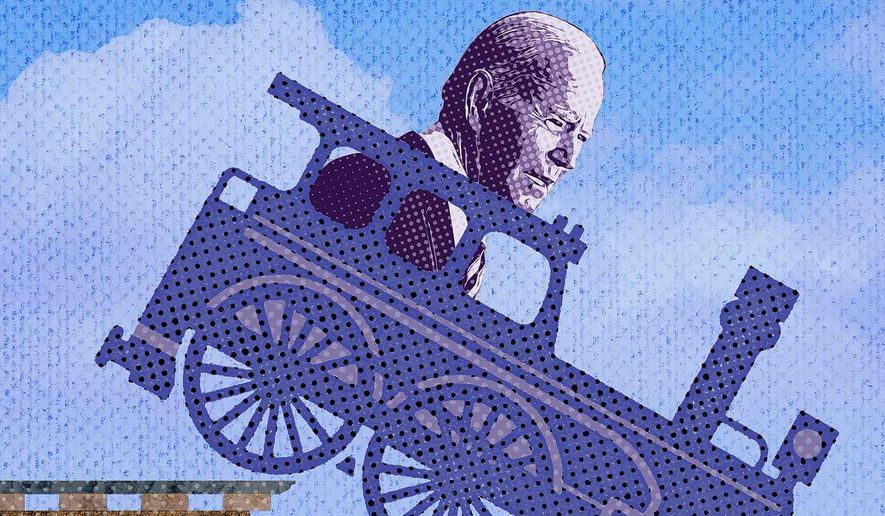
Flying under the radar is a directive for the U.S. Surface Transportation Board to pursue a radical change in regulation that would force railroads to move traffic for competitors and subsidize their operations. This is yet another example of politicians disguising and obscuring the true nature of a proposal. In this case, the federal government is pursuing price and operational controls of railroads. This drastic change upends the wildly successful reforms enacted by Democrats under the watch of former President Jimmy Carter.
Ironically, the consequences of Mr. Biden’s re-regulatory move, called reciprocal switching by policymakers but termed forced access by economists, will slow down freight rail movements and worsen the supply chain congestion. Inflation will worsen too.
Thanks to the Democrats’ deregulation in 1980, the U.S. freight rail system has become the finest, most efficient in the world — a vivid contrast to where the industry found itself in previous generations under extensive regulation. When it comes to carrying freight, no other country in the world — including European nations our leaders seemingly envy — matches American railroads in the quality of infrastructure and the application of high-tech tools. Our rail freight system today is the envy of every country.
The success and ability of America’s railroad system to serve just about every corner of the U.S. economy is because of regulatory reforms passed and maintained under previous administrations that largely got bureaucrats out of pricing and routing scenarios.
Unfortunately, there are business lobbies and several officials who want to repeat the terrible past by imposing again the kind of suffocating regulations that had brought our railroads to their knees. The proposal under consideration at a March hearing would force a railroad to let a competitor serve customers using its network — which it spends billions to maintain — at an arbitrary rate set by the government. Rather than pursue legal paths for rate regulation, or negotiate terms for such an agreement through private negotiations, proponents of the measure think that the government should extend its expertise to rail operations.
This would be like the government telling Comcast it needs to let Verizon run its internet traffic over its network, or ordering Ford to let GM build cars in its facilities. All scenarios would deter investment, as simple economics tell you that the “host” in that scenario is unable to reap the rewards of sustained spending. In the case of railroads — a complex network — ample analysis also shows that a government capture of operations would, unsurprisingly, hinder the movement of goods.
This perverse policymaking is being pursued not because railroads are abusing their power, but because some companies want Washington to extract lower rates for them.
In the ultimate irony, some of the White House’s favorite constituencies — organized labor and Amtrak — both oppose this regulatory scheme. Their reasoning is simple: We should all want the most efficient railroads possible. Forcing cargo switches where they don’t make sense will not only slow down freight movements, but it will also delay Amtrak service and put workers in harm’s way.
Inflation and supply chain woes are real. Railroad failures are not. It is time for Washington to abandon this fantasy.
• Steve Forbes is chair and editor-in-chief of Forbes Media.

Please read our comment policy before commenting.